بخور مريم
It grows out of cracks in Palestinian limestone from November. Almost nobody outside this region has seen it wild — only its descendants, on windowsills, sold under a name that puts its homeland in the wrong country.
Updated · 6 registers · 7 sources cited
Register 01What it is called
بخور مريم — bakhur Maryam, Mary's incense. The name is shared across the Levant, and it is not the only one. This plant is also زعمطوط (za'amtut), قرن الغزال (gazelle's horn, for the way the petals curl back), دان القط (cat's ear), and the older العرطنيثا. Marian plant-names run right through Palestinian botany, attached to species that flower in winter and early spring, around the feast days.
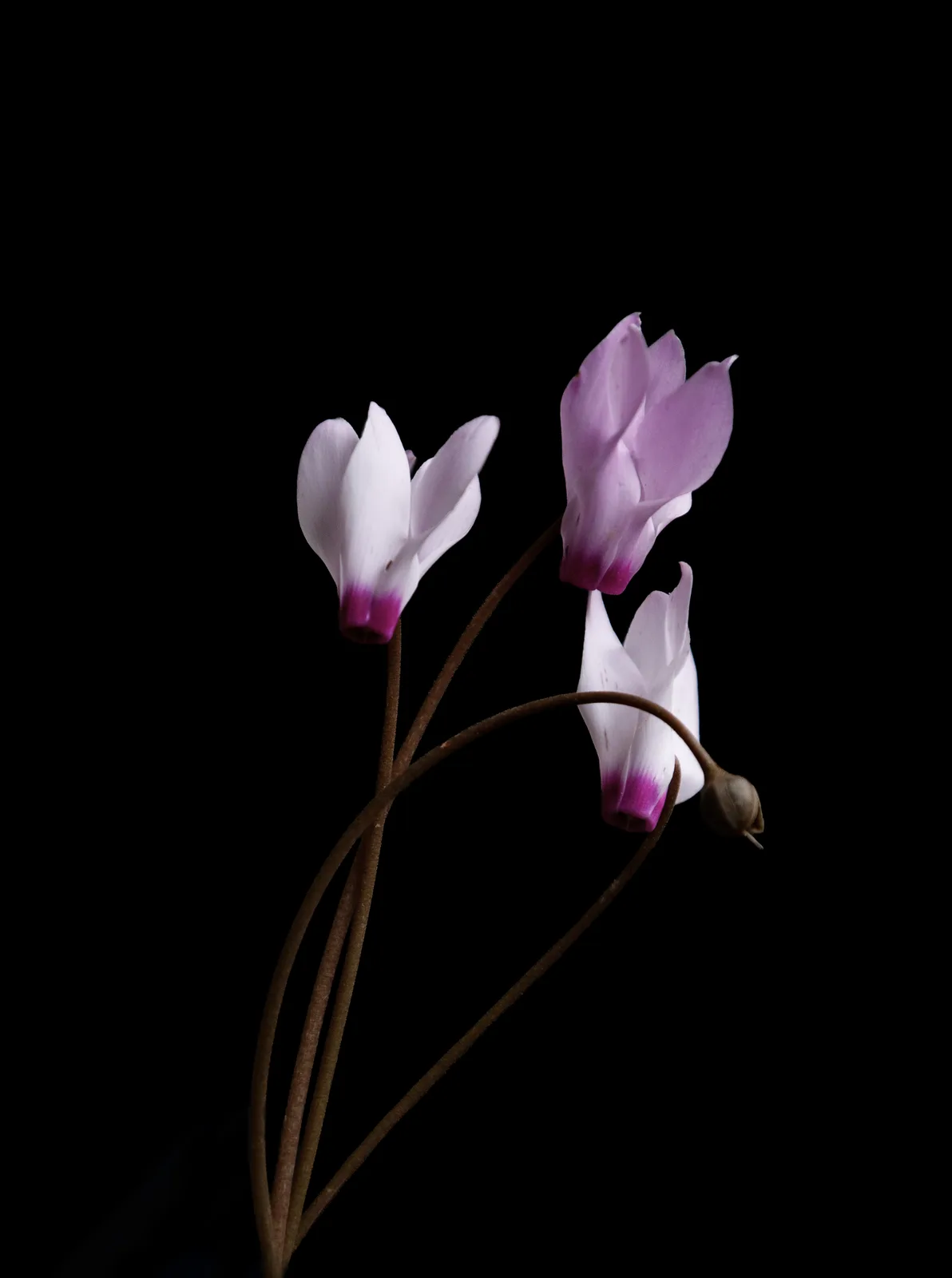
The plant grows from a flattened underground tuber and sends up two things at once: a rosette of heart-shaped leaves, dark green and marbled with silver, and a set of long reddish stems each carrying a single flower. The petals are swept sharply backwards, as though the flower were falling upward. Each is white or pale pink with a deep magenta blotch at the mouth.
The Latin name is wrong. Cyclamen persicum is not Persian. It is native to the eastern Mediterranean, Palestine, Lebanon, Syria, Cyprus, southern Turkey, and was named in the eighteenth century by the English botanist Philip Miller on a mistaken assumption about where it came from. The error is now the plant's official name in every language that uses the binomial system. Register 06 returns to this, because it is not an isolated slip.
Register 02Where it grows
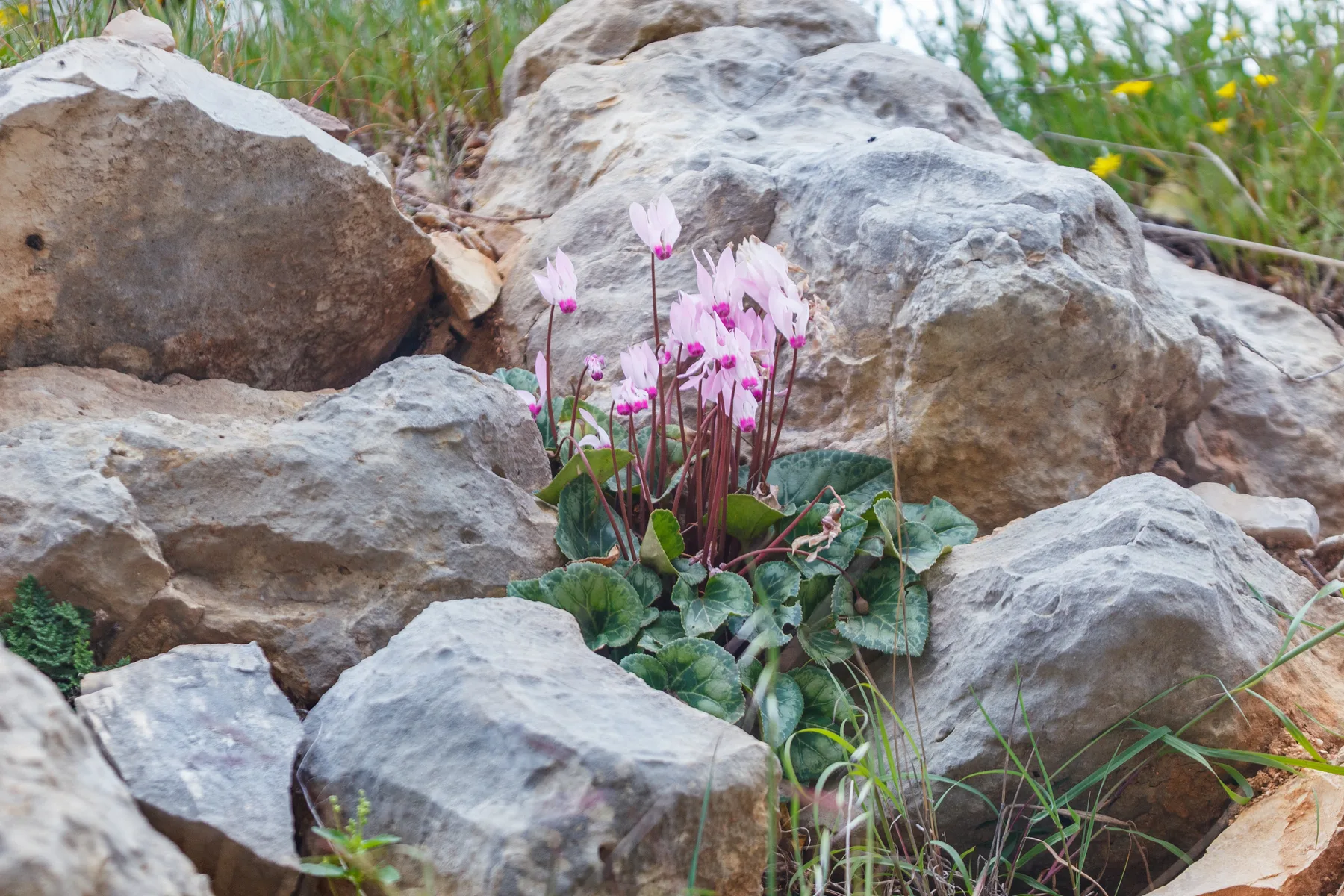
Bakhur Maryam flowers through the wet months, roughly November to March, then dies back underground and waits out the summer as a tuber. It is a rock plant. It colonises crevices in limestone outcrops, the shaded gaps between boulders, terrace walls, and the broken ground at the foot of cliffs — where the tuber sits protected and the leaves catch whatever light reaches them.
This is why it is so often photographed coming out of bare stone. The plant is not clinging on despite the rock. The rock is the habitat. Limestone is what this landscape is made of, the terraces, the field walls, the houses, and the cyclamen is one of the plants that reads it as ground.
Register 03Not food
Bakhur Maryam is not eaten. The tuber is loaded with saponins and is toxic to people and to livestock. Around the Mediterranean, cyclamen tubers were historically crushed and thrown into pools to stun fish — a use that says clearly enough what they do.
This matters for Register 05. Cyclamen is not a food plant, has never been one, and is not gathered in quantity by anyone. Keep that in mind when the protected-plants list comes up.
Register 04The plant on every windowsill
Nearly every cyclamen sold as a pot plant anywhere in the world is a cultivated form of this species. The florist's cyclamen — bred up for flower size and colour, sold by the million each winter across Europe, North America and Japan — descends from the small wild plant that comes out of Palestinian limestone.
A global ornamental industry rests on a plant most of its customers have never seen growing, in a country most of them have been taught to think of as bare.
That last point is not rhetorical. The framing of this landscape as empty, arid and unproductive, awaiting improvement, was built into colonial plant science, as the Palestinian geographer Omar Tesdell has documented: the region was reclassified from "undesirable, arid region" to "promising dryland" precisely as claims were being staked on it. The wild populations of this cyclamen are a genetic reservoir for a commercially significant crop. Their value is entirely invisible from the shop where their descendants are sold.
Register 05Policing what grows
Bakhur Maryam is on a protected-plants list that Israeli authorities enforce inside present-day Israel and extend, through the Civil Administration under military command, into the occupied West Bank. Picking it is nominally an offence.
An occupying power's authority to legislate over occupied land is narrow by design. The Hague Regulations of 1907 require it to respect "the laws in force in the country" unless absolutely prevented (Article 43), and treat it as "only administrator and usufructuary" of the territory's property, including agricultural land — entitled to use, not to appropriate (Article 55). Fourth Geneva Convention Article 64 permits new legislation only for the occupier's security, its obligations under the Convention, or orderly government. Al-Haq describes what has happened instead as de facto annexation: sovereign authority extended over the West Bank through legislative acts, "in breach of its limited administrative authority as a belligerent occupant."
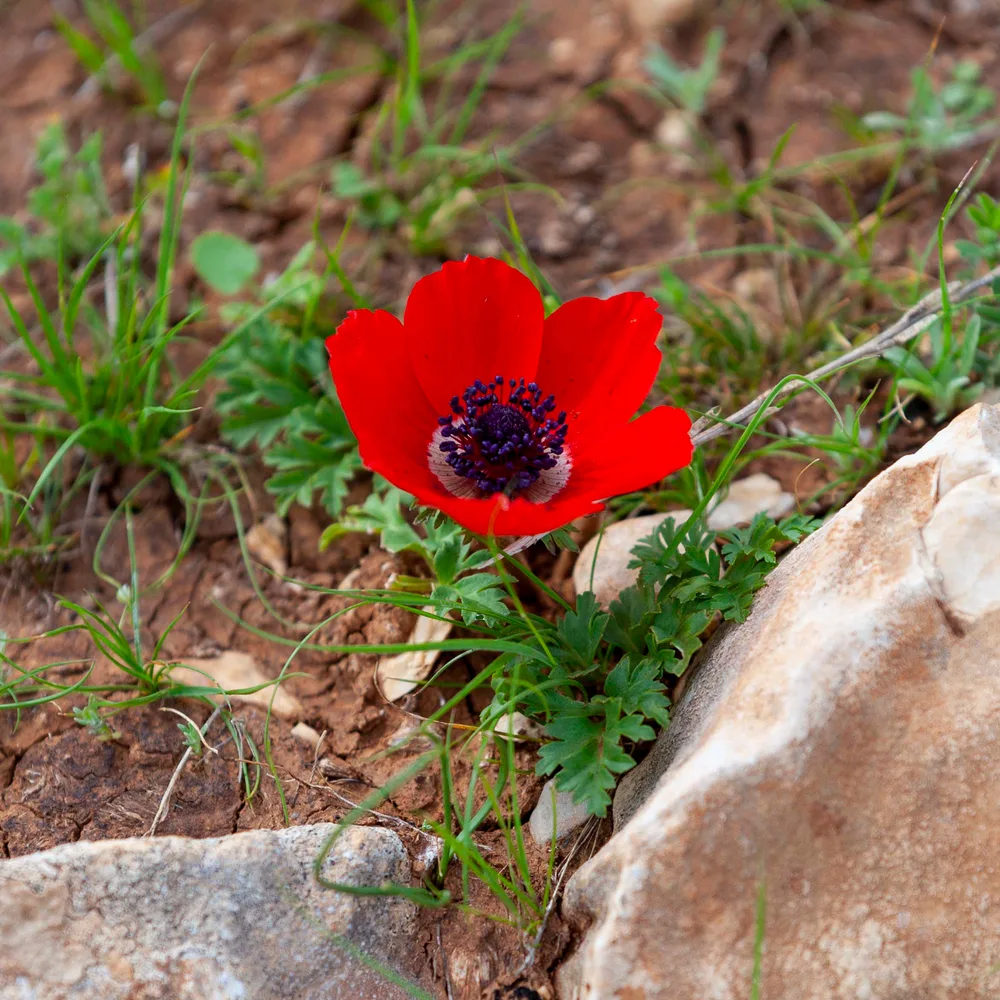
Now look at what the list actually does. It covers dozens of species. The showy ones it names, cyclamen, anemone, narcissus, primrose, are picked by Israelis, and court archives contain no indictment for any of them. The prosecutions are for three plants: Origanum syriacum (za'atar), Gundelia tournefortii (akkoub) and Salvia fruticosa (maryamiyya). Not ornamentals. Food. Between 2004 and 2016 Israeli courts decided 61 za'atar and akkoub cases plus dozens more for sage, and every defendant was Palestinian, as documented by the lawyer and researcher Rabea Eghbariah (القدس العربي; Oxford Symposium). Settlers who pick or burn the same plants are not charged.
Cyclamen is the alibi. A toxic flower nobody gathers, on a list whose only function in practice is to criminalise three plants Palestinians eat.
In 2019 the Palestinian legal centre Adalah demanded the designations be cancelled and criminal enforcement suspended, arguing the ban had no reliable factual basis, did not serve the purpose of the law, and disproportionately harmed a population that has gathered these herbs for centuries. Adalah documented 26 indictments and 151 fines between 2016 and 2018 alone.
Register 06Photographed before
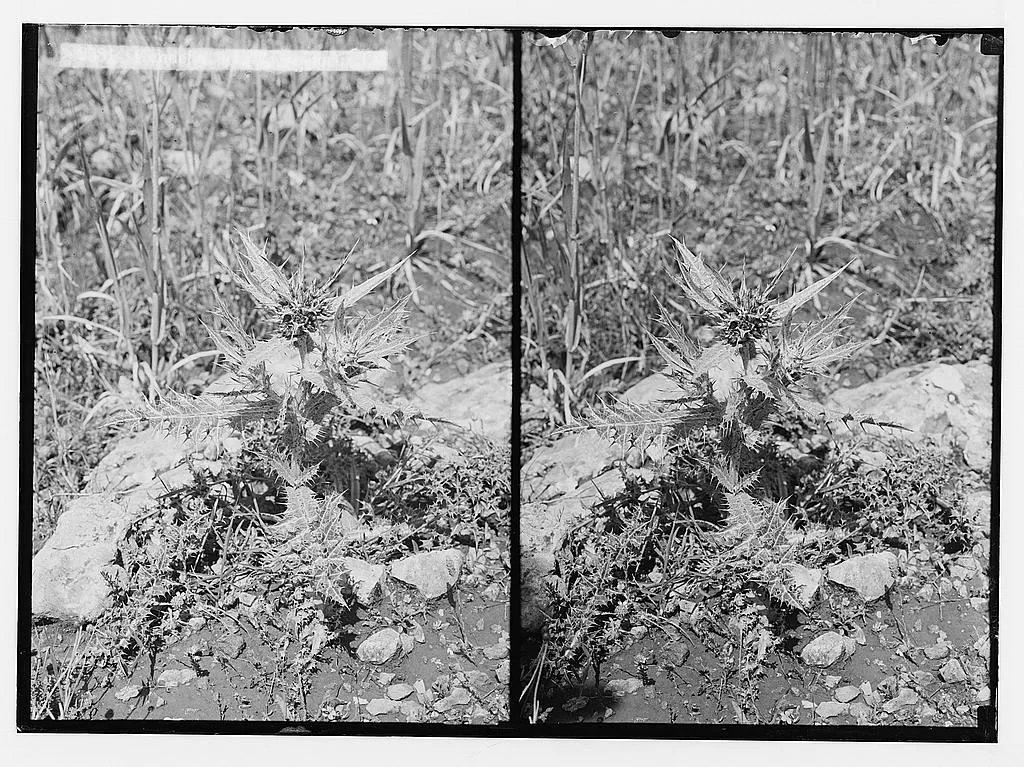
Between roughly 1900 and 1920, the American Colony Photo Department in Jerusalem produced a series of 166 glass-plate negatives titled Wild Flowers of Palestine, now in the Library of Congress. Bakhur Maryam is in it (LC 2019691790).
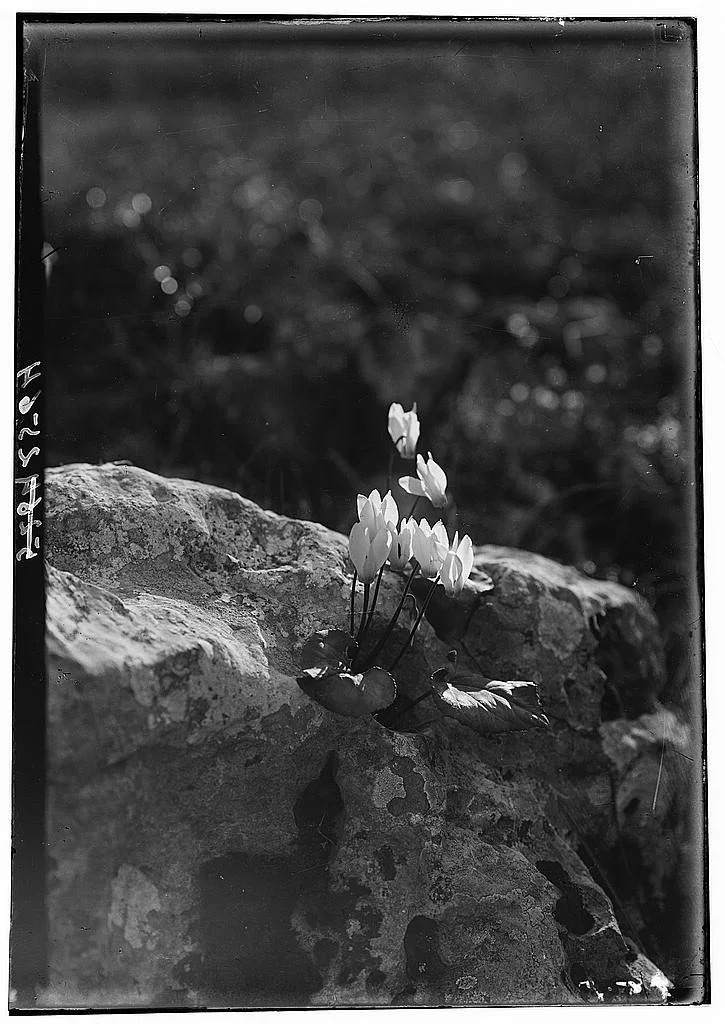
Library of Congress, Matson Collection, matpc.00190 · no known restrictions on publication
They filed it as C. latifolium — a name botany has since discarded. Elsewhere in the same series they captioned the anemone “Lily of the field,” out of the King James Bible. And the binomial that finally stuck to this plant, persicum, places it in Persia, which is not where it is from.
Three names for one flower, none of them Palestinian, all of them applied from outside and two of them simply wrong. Meanwhile the plant has been بخور مريم here the whole time.
The series is also, plainly, the same project as this one — the American Colony photographers made specimen plates and plates marked "taken in their natural settings," the studio and the hillside, exactly the pairing made here a century later. Both photographers went out to the limestone, and both brought a plant indoors to shoot it against a plain ground.
Sources
- أرض الزعتر والعكوب الحزين… لماذا تجرّم إسرائيل قطف النباتات الطبيعية بالسجن والغرامات؟ — القدس العربي
- The Struggle for Za'atar and Akkoub: Israeli Nature Protection Laws — Rabea Eghbariah, Oxford Symposium on Food & Cookery
- Israel reformulating ban on harvesting wild herbs used in Palestinian cuisine — Adalah, The Legal Center for Arab Minority Rights
- “Wild flowers of Palestine. Cyclamen (C. latifolium Sibth. et Sm.)” — American Colony Photo Department, c.1900–1920 · Library of Congress, Matson Collection
- Omar Tesdell — research on dryland agriculture and the reclassification of Palestine's landscape — Birzeit University
- بخور مريم — ويكيبيديا العربية (folk names)
- Hague Regulations 1907, Arts. 43 and 55 · Fourth Geneva Convention, Art. 64 — ICRC