توفيق كنعان
He spent forty years writing down what Palestinians knew about their own plants, because he had worked out early that it was going to be taken. In 1948 he watched his library burn from the other side of the city walls. He was not working alone — a circle of Palestinian scholars was doing the same work beside him.
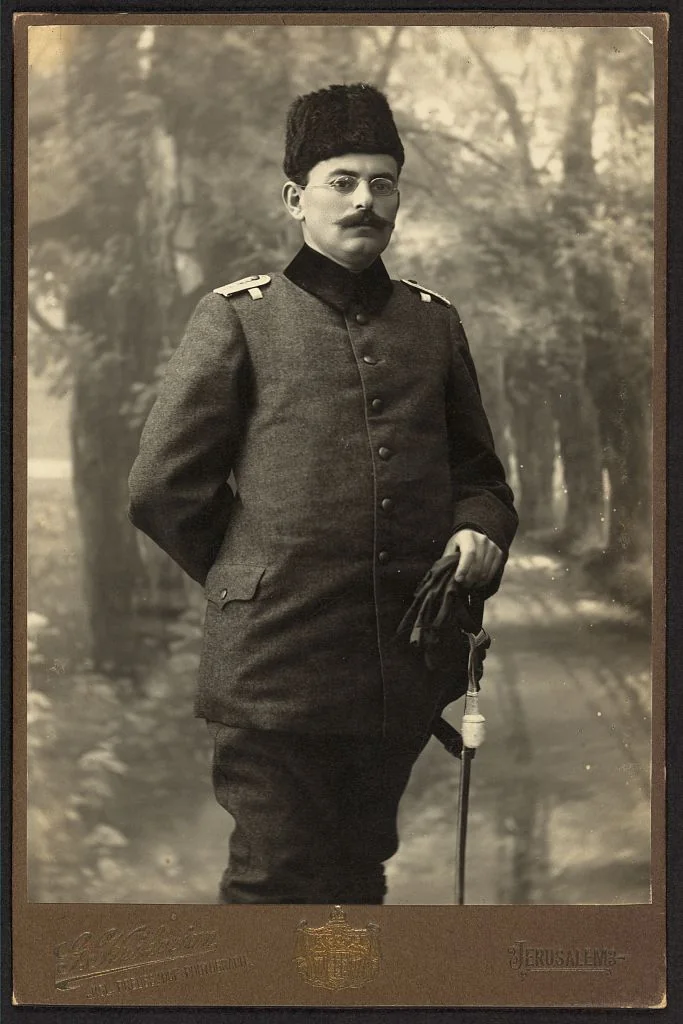
Photograph by Garabed Krikorian, Jerusalem · Library of Congress, LCCN 2007675292 · public domain
Updated · 7 registers · 11 sources cited
01Who he was
Tawfiq Canaan — توفيق كنعان — was born in Beit Jala on 24 September 1882, the second son of Bishara Canaan, the first Arab pastor of the Arab Lutheran Church. He studied medicine at the Syrian Protestant College in Beirut, now the American University of Beirut, and graduated with honours in 1905 — the year of the photograph above.
The medical career alone would fill a page. He worked on germ science, tropical disease and malaria; he was appointed director of Jerusalem's anti-malarial section in 1913; he served as an Ottoman army doctor through the First World War, contracting both cholera and typhoid; and from 1918 until 1948 he ran the Leper Hospital in Jerusalem. He published more than sixty scientific papers in European medical journals, and in 1944 he co-founded the Arab Medical Association in Palestine and was elected its president (palquest, Interactive Encyclopedia of the Palestine Question).
And alongside all of that he wrote some forty-five papers on Palestinian folklore, about thirty of them published between 1920 and 1938 in the Journal of the Palestine Oriental Society, whose president he became in 1927.
02The survey he called for
What makes Canaan matter to this record is not that he collected folklore. Europeans were doing that in Palestine throughout the same decades. It is why he did.
He recognised from an early period the importance of this tradition in rooting Palestinian national identity, and called for a total survey of it before it disappeared.
That is palquest's summary of his position, and the date matters: he was arguing this in the 1920s and 1930s — before the Nakba, before the mass destruction of villages, at a point when "before it disappeared" was a prediction rather than a description.
He was also a pioneer in a second, more specific sense. He wrote about the Palestinians as a nation rather than as a collection of religious communities who happened to live in the same place, and he built his case out of cultural continuity — quoting the Bible, the Qur'an, classical Arabic literature and everyday village speech in the same paragraph to show one continuous population in one continuous landscape.
He argued this politically too. He opposed British policy and Zionist settlement publicly, called for an end to Jewish immigration and for a guaranteed minimum of land for Arab farmers with a ban on dispossession, and on 3 September 1939, the day Britain declared war on Germany, the British arrested him and held him in Acre prison for nine weeks. It did not stop him writing.
03What he actually recorded
In 1928 he published “Plant-lore in Palestinian Superstition” in the Journal of the Palestine Oriental Society, volume 8, pages 129–168. Forty pages on what Palestinians called their plants, when they expected them, and what they meant.
It opens with a claim that this record has effectively been restating for a century:
The Palestinian is primarily an agriculturist and his daily work brings him into constant touch with nature, in which and by which he lives.
What follows is a working ethnography. A table of Arabic plant names and where they come from — hannun el-biss, cat's flowers, because the blossom is compared to a cat's eye; maryamiyyeh, Mary-like — and on the same page, the story of how the sage got her name and the note that the dead are laid upon it; lisan et-tor, ox-tongue; sabinet er-ra'i, shepherd's soap. A list of villages, valleys and ruins named after plants — qaryet el-'inab, the village of grapes; wadi et-tuffah, the valley of apples; jabal ez-zaytun, the mount of olives.
And then the agricultural year, as proverbs. Not sayings about farming — instructions, with the plants as the instrument:
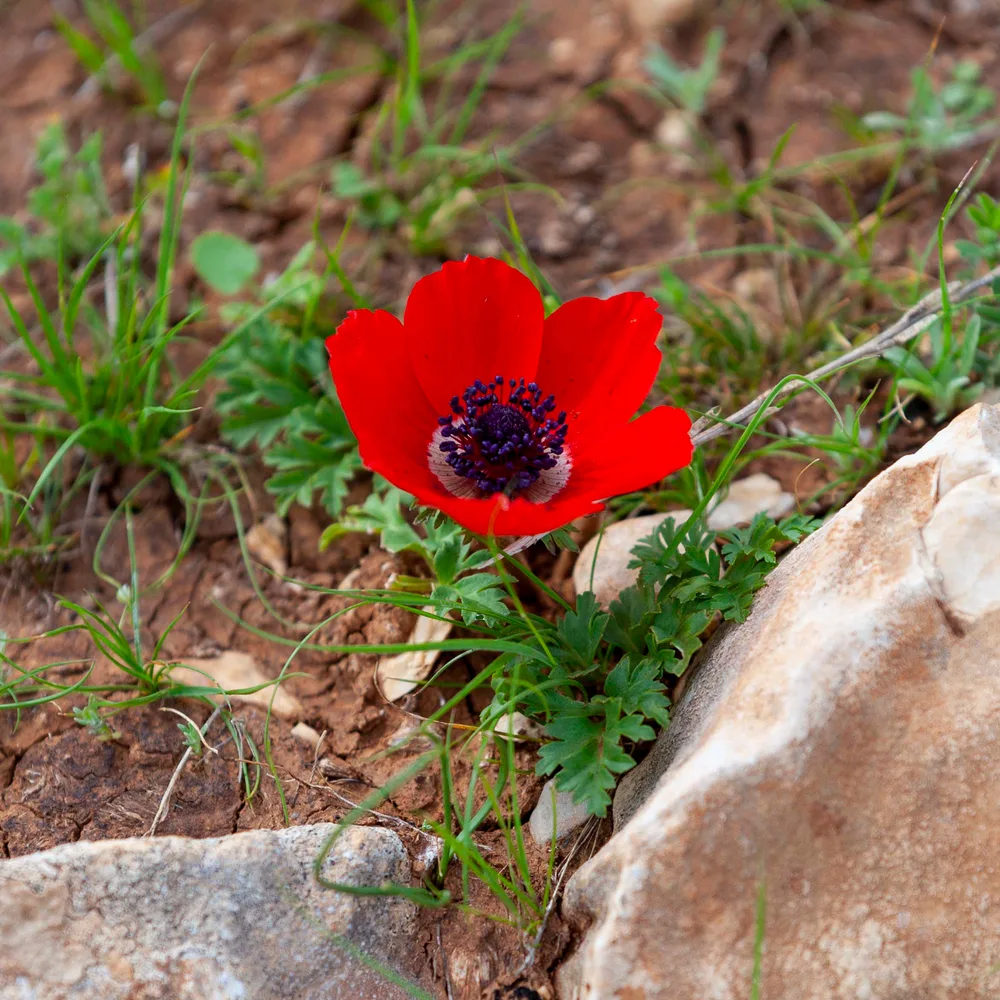
- “April is marked specially by the blossoming of the Anemone coronaria” — with a footnote giving the classical name as شقائق النعمان, shaqa'iq an-Nu'man. The flower as a calendar entry (Record 01).
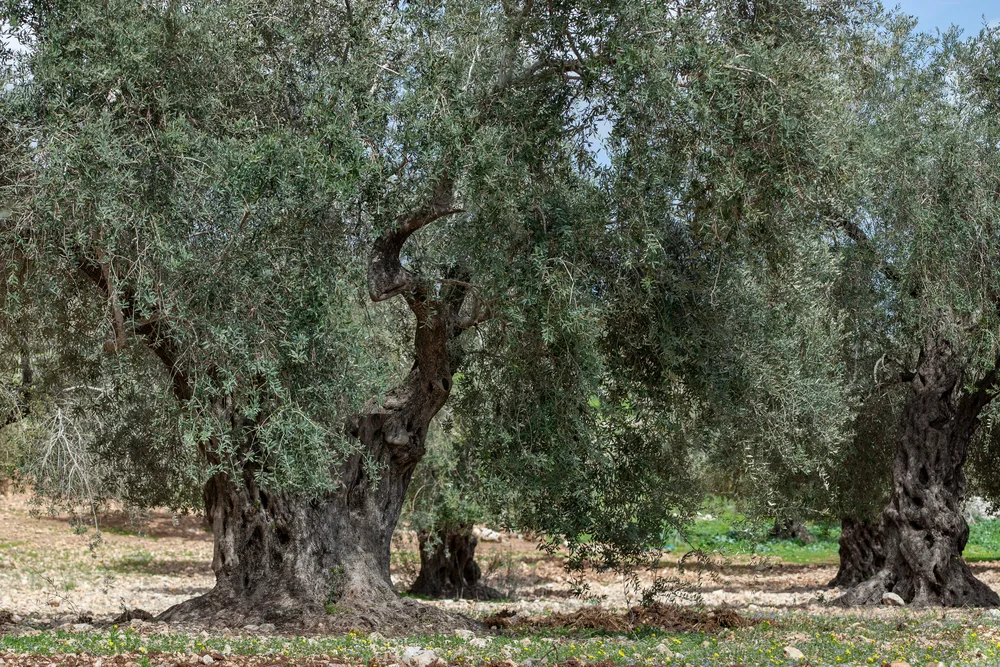
- إن أبرز في آذار هيّئ له الجرار — if the olive tree blossoms already in March, prepare the big jars for the oil; but if it waits until April, prepare the scoops, because the crop will be small (Record 03).
- The leaves of the vine are in March as small as the ears of the mouse.
- Do not look, O thou pitiful one, at thy crop until the first leaves of the fig-tree have sprouted.
He records the olive harvest by name and by variety — the malusi, small and black, whose oil is good though gathering it "makes one old," and the huwari, whose oil "turns over in the frying-pan," meaning it is excellent. He notes the gleaning custom: once a family has taken its olives from a tree, anyone may gather what is left, and widows, orphans and the poor go first.
And he records what plants mean in a dream, in a short table built on wordplay. Quince, safarjal, means a journey or a parting, from safar. Carob, kharrub, means ruin, from kharaba. Vine, dawali, means recovery, from dawa, medicine.
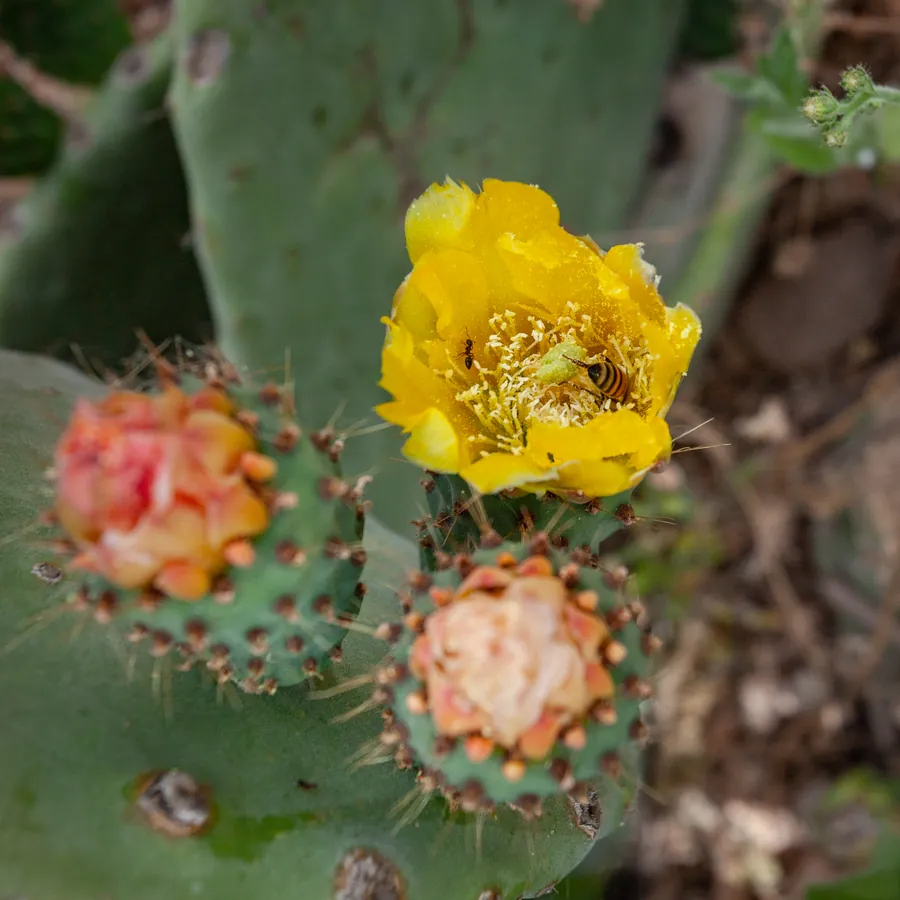
And the prickly pear:
| Plant | Arabic | Meaning in a dream | Canaan's derivation |
|---|---|---|---|
| Prickly pear | صبر | Patience; success which requires prolonged effort | sabr — verb, to wait; noun, patience |
Printed in 1928. Twenty years before the Nakba gave the sabr its second meaning, and before the fact that it cannot be uprooted turned the hedges into the map of the destroyed villages (Record 04).
He also sets down the legend attached to it: the prophet al-Khadr, who drinks only from the water of life, once emptied what was left in his goblet over a nearby plant. It happened to be a prickly pear. Ever since, Canaan writes, this plant has remained ever green and indestructible.
04The word “superstition”
There is something uncomfortable in that title, and this record is not going to pretend otherwise.
Canaan's papers are called things like Plant-lore in Palestinian Superstition, Belief in Demons in the Land of the Bible, Superstition and Popular Medicine in the Land of the Bible. The prose calls Palestinian peasants primitive, describes a normal harvesting technique as a "bad habit," and reaches constantly for biblical parallels, because that is what made a Palestinian fellah legible to the European learned societies that published him.
He was writing in English and German, for the Journal of the Palestine Oriental Society and the German Palestine societies, at a moment when the only available frame for this material was Western Biblical Studies looking for survivals of scripture. To get Palestinian knowledge into the permanent scholarly record at all, he had to file it under the categories of the people who controlled that record.
The same problem, in the same city, in the same decade, as a photographer captioning a Palestinian anemone “Lily of the field” for a Western market.
The difference is what survives underneath the filing. Strip out the word "superstition" and what is left in that 1928 paper is a Palestinian scientist recording, in precise detail, an agricultural and linguistic system belonging to his own people — the names, the months, the varieties, the proverbs, the customs of who may glean and when. He used the vocabulary he had to use. He was not describing somebody else's exotica. He was writing down his own.
05He was not working alone
This record spent its first weeks citing Canaan as though he were a solitary figure. That is wrong, and the correction matters more than a footnote, so it is being made here.
Canaan belonged to a group of Palestinian scholars who published in the same journal, in the same decades, on the same material. The sociologist Salim Tamari named them the Jerusalem Circle and gave their method a name in Arabic: الإثنوغرافيا الجذرية al-ithnughrafiya al-judhuriyya, rooted ethnography — the study of a living tradition by people living inside it (Tamari, Lepers, Lunatics and Saints: The Nativist Ethnography of Tawfiq Canaan and his Jerusalem Circle).
Three of them appear directly in the sources this site is built on:
- Stephan Hanna Stephan (1894–1949) — born in Beit Jala, like Canaan, and schooled at the same Schneller institution. A Syriac Orthodox Palestinian who read Arabic, English, German, Ottoman Turkish and Syriac; joined the Mandate Department of Antiquities and was promoted Archaeological Officer in 1945; broadcast on the Palestine Broadcasting Service's Arab Hour from 1936. This site quotes him on the Palestinian year (The Year, Register 05).
- Omar Salih al-Barghouti عمر الصالح البرغوثي (1894–1965) — Palestinian writer and a member of the Palestine Oriental Society itself, author of تاريخ فلسطين. His Rules of Hospitality (قانون الضيافة) appears in the same 1924 volume as Canaan's sacred-tree survey, and it supplies the other half of an argument this record makes (Under the Law, Register 05).
- Elias Nasrallah Haddad (1878/9–1959) — teacher, linguist and ethnographer, for most of his life at the Schneller school in Jerusalem, where he rose to head the institution. He wrote on the Palestinian guest-house and on village education. He was born at Khirbat Qanafar, in what is now Lebanon, and spent his working life in Palestine — worth stating precisely rather than folding him in.
The photographs of this flora were made largely by foreigners. The writing was not. It was done here, by people from here, and published in Jerusalem.
That is a different claim from the one this site started with, and a stronger one. The archival register on the plant pages is about who held the camera. This register is about who held the pen — and the answer is less lopsided than the photographs suggest.
061948
Canaan built a house in the Musrara quarter of Jerusalem and ran his private clinic out of it — the first Arab clinic in that quarter. His library was there, and so was the collection of amulets and talismans he had been assembling since 1905, which by 1947 numbered about 1,400 pieces.
In early May 1948 the house took direct mortar hits fired from the western, Jewish-held quarters of the city. The family fled to the Greek Orthodox monastery in the eastern part of Jerusalem, where the Patriarch gave them a room. They stayed two and a half years.
From across the city walls, Canaan watched militias carry the contents of his house and his library away. Three manuscripts, finished and ready for publication, were lost. Then the house was set on fire (palquest).
The man who spent forty years arguing that Palestinian heritage had to be written down before it disappeared, watching his own record of it burn.
The amulets survived. He had got them out. His family later gave the collection to Birzeit University, where it remains. He went on working: head of the Lutheran World Federation's medical department in Jordan from 1949, founding clinics in Jerusalem, Beit Jala, Hebron, Taybeh and Azariyya, then medical director of the Augusta Victoria Hospital until 1955. He published papers the year before he died, in Jerusalem, in January 1964.
The same year took the circle apart. Stephan Hanna Stephan, his wife Arasky Keshishian and their sons Arthur and Angelo became refugees in Lebanon. He died there in 1949, the year after the Nakba, aged fifty-four; the family later went on to Brazil. The scholar W. F. Albright had once called him “a young man of promise.”
So the body of work this site draws on was not simply written and then archived. It was written by people who were dispersed, and in Stephan's case died displaced, within a year of finishing it. The record of Palestinian plant knowledge and the people who made it were broken up in the same event.
07Why he is in this record
Because until now the historical depth on this site has been almost entirely European. The American Colony's glass plates, Linnaeus and the binomials, the archive at the Library of Congress. Good sources, all of them, and all of them looking at Palestine from outside.
Canaan is the counterweight: a Palestinian, working in Palestine, recording Palestinian plant knowledge from inside it, at exactly the same time and in exactly the same city as the photographers whose plates appear throughout this record. When this site says that a Palestinian plant vocabulary existed, was precise, and was tied to a farming calendar and a landscape — that is not an inference. It is written down, in 1928, by a man who lived there and asked.
There is a second reason, and it is less comfortable. Canaan did this work because he believed it was about to be destroyed, and then it was, and then his own record of it was destroyed too. That is not a tidy story about heritage. It is a warning about what documentation is for, and how fast the window closes.
He was right about the disappearance. He was just wrong about who would be doing the forgetting.
Sources
- T. Canaan, “Plant-lore in Palestinian Superstition,” The Journal of the Palestine Oriental Society 8 (1928): 129–168 — read in full at source. All quotations, proverbs, plant names, olive varieties and the dream table on this page are taken directly from it.
- Tawfiq Canaan — biography — Rita Awad, palquest, Interactive Encyclopedia of the Palestine Question · Institute for Palestine Studies
- Salim Tamari, Lepers, Lunatics and Saints: The Nativist Ethnography of Tawfiq Canaan and his Jerusalem Circle — University of California Press, 2010 · the study that named the circle and coined الإثنوغرافيا الجذرية. Cited, not read: palestine-studies.org blocks automated access.
- Stephan Hanna Stephan (1894–1949) — birth at Beit Jala, the Department of Antiquities and Palestine Broadcasting Service posts, the languages, and the family's flight to Lebanon where he died in 1949. See also Sarah Irving, “A Young Man of Promise,” Jerusalem Quarterly 73.
- عمر الصالح البرغوثي — biography — palquest · member of the Palestine Oriental Society, author of تاريخ فلسطين
- Sarah Irving, “Elias Nasrallah Haddad: Translating Visions of Palestine,” Jerusalem Quarterly 85 — Haddad's dates, his birth at Khirbat Qanafar, and his career at the Schneller school. Cited, not read: host blocks automated access.
- Omar Salih el-Barghuthi, “Rules of Hospitality (Qanun ad-Diyafeh),” JPOS 4 (1924): 175ff — read at source; the ابن السبيل material used on Under the Law
- Portrait of Tawfiq Canaan, 1905, by Garabed Krikorian, Jerusalem — Library of Congress, LCCN 2007675292 · public domain
- T. Canaan, “Mohammedan Saints and Sanctuaries in Palestine,” JPOS 4 (1924): 1–84 — the first instalment of the study later issued as a book in 1927, serialised across JPOS 4–7. Read at source for the sacred-tree material: the سبيل rule (Under the Law), the carob and the jinn (Culture), and the olive proverbs (Record 03).
- Canaan's other principal works, cited but not read for this page: Aberglaube und Volksmedizin im Lande der Bibel (Hamburg, 1914); Dämonenglaube im Lande der Bibel (Leipzig, 1929); “Folklore of the Seasons in Palestine,” JPOS 3 (1923): 21–35 — read at source for The Year.
- Khaled Nashef, “Tawfiq Canaan: His Life and Works,” Jerusalem Quarterly 16 (2002): 12–26 — noted as the standard reassessment; not consulted directly for this page.