How many wild plants grow in Palestine?
1,710 native taxa in the West Bank alone, and 1,826 across Palestine as a whole. Both figures come from Palestinian botanists who spent decades assembling them. The second number is now four years old, because the part of Palestine it covers that is no longer possible to survey is Gaza.
Published · 6 registers · 10 sources cited
01The short answer
The native vascular flora of the Palestinian West Bank runs to 1,710 taxa — 1,668 species and 42 subspecies — in 652 genera and 102 families. That is the figure published in 2026 by Mohammed Saleem Ali-Shtayeh, Salam Yousef AbuZaitoun and Rana Majed Jamous in the Biodiversity Data Journal (Ali-Shtayeh, AbuZaitoun and Jamous, 2026).
For Palestine as a whole the number is 1,826. Their earlier synthesis, published in 2022, counted 1,826 native taxa across the State of Palestine: 1,683 recorded in the West Bank and 1,217 in the Gaza Strip, of which 140 have been recorded in Gaza and nowhere else in Palestine.
Of the 1,710 West Bank taxa, 1,695 are flowering plants, five are conifers and ten are ferns. It is a great deal of botanical variety for a small area, which is the point the checklist opens with: the West Bank sits inside the eastern Mediterranean biodiversity hotspot, and its rainfall, altitude and soil change sharply over very short distances.
02Who counted them
Name the people, because the count is theirs. The Palestinian flora has been assembled, revised and republished by a small team working out of the Biodiversity and Environmental Research Center in Til, near Nablus, and An-Najah National University.
- Mohammed Saleem Ali-Shtayeh — Palestinian botanist and ethnobotanist, and the author whose surveys this record cites more than any other living scientist.
- Rana Majed Jamous — co-author on the checklists and on the wild-edible-plants survey of the northern West Bank.
- Salam Yousef AbuZaitoun — co-author of the 2026 update.
The same team produced the 2008 survey of wild edible plants that this record uses whenever it needs to say how much of the country actually gathers a given plant — 190 informants, 100 species, ranked (Ali-Shtayeh et al., 2008). The counting of Palestinian plants is not being done from outside. It is being done in Nablus, and published open-access so anybody can check it.
The checklists are of the State of Palestine — the West Bank and the Gaza Strip. They are not a flora of historic Palestine, and this page does not present them as one.
03What the flora is made of
Six families carry more than four in every ten native plants in the West Bank.
| Family | Taxa | Share | What this record holds from it |
|---|---|---|---|
| Fabaceae | 198 | 11.58% | — |
| Asteraceae | 184 | 10.82% | Akkoub |
| Poaceae | 161 | 9.42% | — |
| Caryophyllaceae | 82 | 4.80% | — |
| Brassicaceae | 80 | 4.68% | — |
| Lamiaceae | 80 | 4.68% | Za'atar, maramia |
The richest genera are Trifolium, Allium, Silene, Medicago, Astragalus and Salvia — clovers, wild onions and garlics, campions, medicks, milk-vetches and sages. It is a flora of legumes and grasses and aromatic herbs, which is another way of saying it is a flora shaped by grazing, by cultivation and by people, for a very long time.
That last column is the honest one. This record holds fifteen plants against 1,710. It is a photographic and cultural record of particular plants, not a flora, and it should not be mistaken for one.
04Twenty-eight per cent of it is threatened
482 of the 1,710 taxa, 28.2%, fall in an IUCN threatened category. Ninety-four are Critically Endangered, 169 Endangered and 216 Vulnerable. Another 399 are Near Threatened, and 122 have too little data to assess at all.
Twenty-nine taxa are already recorded as extinct or possibly extinct in the West Bank. They have not been confirmed in recent decades. Among them are the elder, Sambucus nigra; a wild wheat relative, Aegilops vavilovii; the Italian orchid, Orchis italica; and the sub-endemic grass Sporobolus minuartioides, which the checklist records as locally extinct.
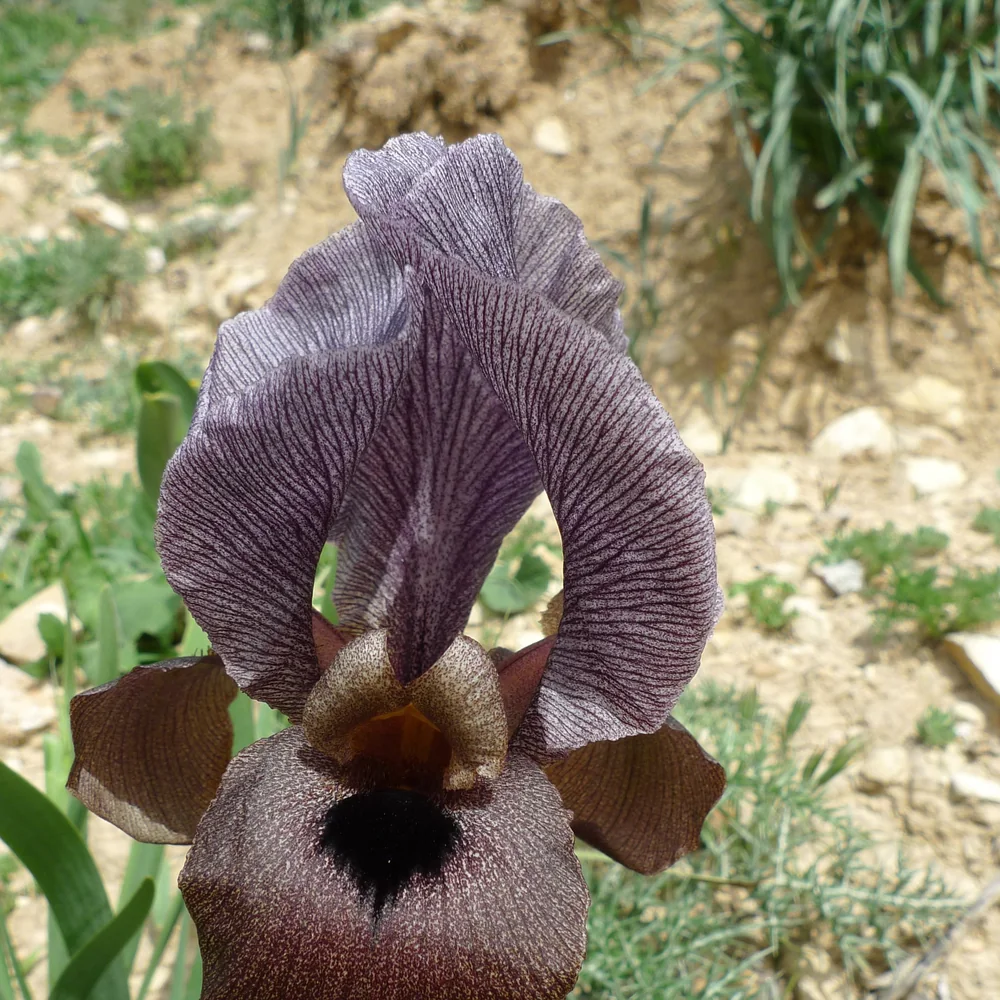
151 taxa are endemic or sub-endemic to Palestine and its immediate neighbours. Only two are endemic to Palestine and nowhere else: Iris lortetii var. samariae and Ferula samariae. Both carry the name of Samaria. One of them is an iris, which is worth pausing on, because Palestine's national flower is also an iris, and the family sits eighth on the endemic list with eight taxa.
Two plants on earth grow in Palestine and nowhere else. One of them is an iris.
05The part that can no longer be counted
The 2026 checklist covers the West Bank and stops there, and its authors say plainly why. Restrictions on field survey, on specimen verification and on access to data, forced by the war on Gaza since 2023, have made a reliable floristic update for Gaza “currently unfeasible” (Ali-Shtayeh, AbuZaitoun and Jamous, 2026).
Here is what that sentence costs. On the last count that included it, the Gaza Strip held 1,217 of the 1,826 native plant taxa recorded for Palestine — two thirds of the entire national flora — and 140 of those taxa had been recorded in Gaza and nowhere else in the country.
- 1,826 native taxa recorded across Palestine (2022)
- 1,217 of them recorded in the Gaza Strip — two thirds
- 140 recorded in Gaza and nowhere else in Palestine
- 0 comprehensive surveys of Gaza's flora possible since 2023
Two thirds of Palestine's plant life is in the part of Palestine that scientists can no longer walk across. The 140 are the sharper number. Those are coastal and dune and sand-plain plants, and Gaza is the only place in Palestine where that habitat exists. Whatever has happened to them since October 2023, nobody has been able to go and see. What the destruction of Gaza's cropland and orchards looks like from orbit, where it can be measured, is on the count of destroyed olive trees.
06What is doing the damage
The checklist attributes the extinctions and the threat categories to habitat degradation, land-use change and hydrological alteration. That is the scientific register, and it is accurate as far as it goes.
In the West Bank those three phrases have specific mechanisms behind them, and they are documented elsewhere on this record. Land-use change here includes the confiscation of land, the routing of the separation wall through cultivated hillsides, and the loss of access that kills a terrace system within a few seasons once the family farming it can no longer reach it (Record 03).
And some of the pressure on wild plants is enforced by law against the people who gather them. Three of the most-used wild food plants in Palestine — za'atar, akkoub and maramia — are designated protected species under Israeli military and civil orders, and Palestinians have been prosecuted and fined for picking them. The conservation case and the enforcement record are set out separately, with the evidence for each, on Under the Law.
Sources
- M. S. Ali-Shtayeh, S. Y. AbuZaitoun and R. M. Jamous, “An updated checklist of the vascular flora native to the State of Palestine – West Bank,” Biodiversity Data Journal 14: e188380 (2026) — the 1,710 taxa, 652 genera, 102 families; the family and genus counts; 151 endemic or sub-endemic taxa; 482 threatened (28.2%); 29 extinct or possibly extinct; and the statement that a Gaza update is currently unfeasible. Open access, CC BY 4.0. Read at source via the Europe PMC full-text API. Palestinian-authored.
- M. S. Ali-Shtayeh, R. M. Jamous et al., annotated checklist of the native vascular plants of the State of Palestine (2022) — the 1,826 Palestine-wide total, 1,683 West Bank, 1,217 Gaza, 140 exclusive to Gaza. Cited here as reported and summarised in the 2026 update above. Palestinian-authored.
- M. S. Ali-Shtayeh, R. M. Jamous, J. H. Al-Shafie‘ et al., “Traditional knowledge of wild edible plants used in Palestine (Northern West Bank),” J. Ethnobiol. Ethnomed. 4:13 (2008) — the same team's wild-edible survey, 190 informants and 100 species, used throughout this record. Palestinian-authored.
- Palestine Institute for Biodiversity and Sustainability, Bethlehem University — Mazin Qumsiyeh's institute; the second Palestinian body publishing primary biodiversity work on this flora
- Plants of the World Online — Royal Botanic Gardens, Kew; used to confirm accepted names for the species named on this page
- GBIF — the second nomenclatural check
- The three protected plants, the orders behind the designation and the prosecutions: Under the Law.
- What has been destroyed in Gaza that satellites can measure: How many olive trees has Israel destroyed?
- The fifteen plants this record actually holds, in both languages: Palestinian plant names.
- Palestine's national flower, one of the eight endemic Iridaceae taxa: What is the flower of Palestine?