الحنون
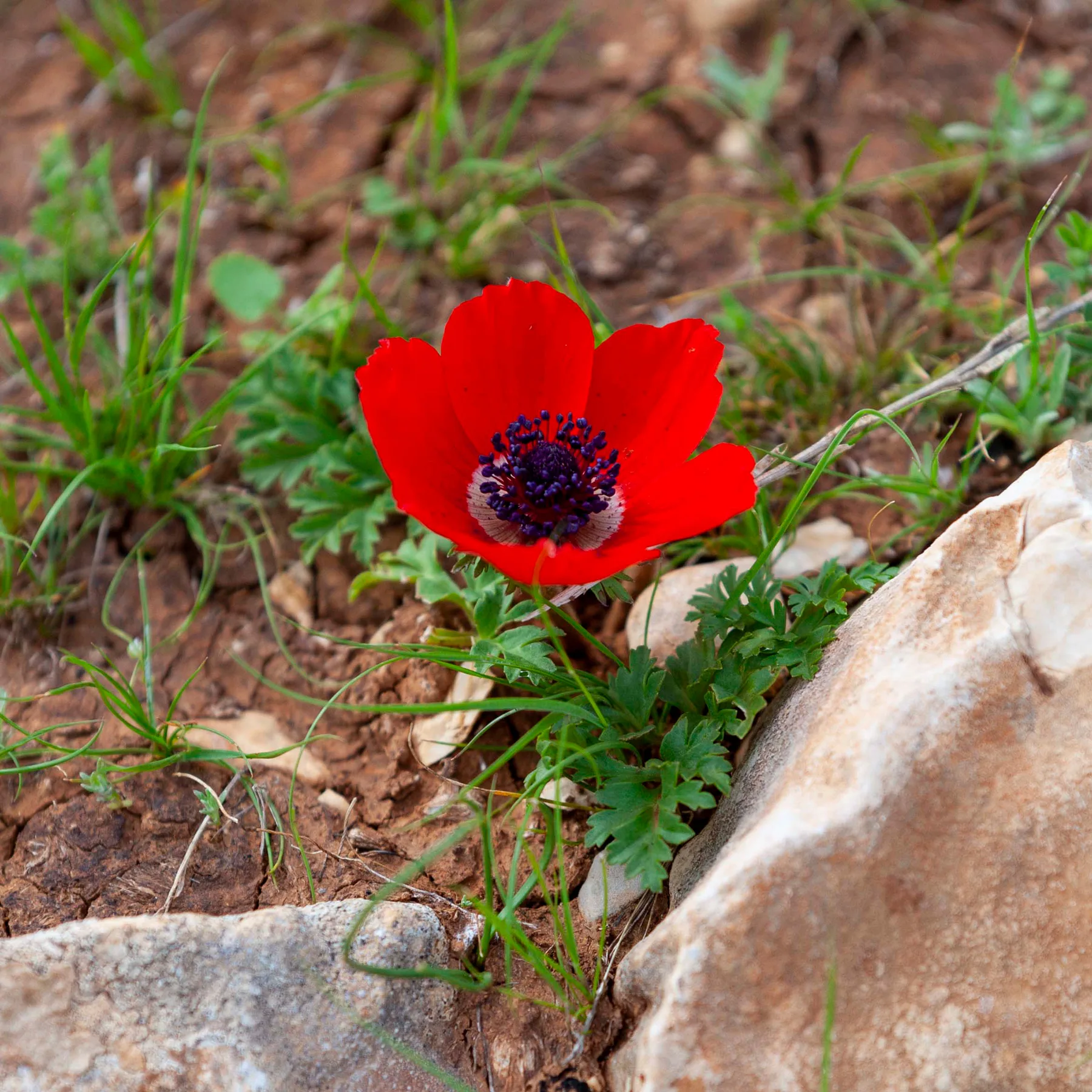
Red petals, a black centre, a ring of white, a green stem. It comes up in December on ground nobody is farming, lasts a fortnight, and carries more of Palestine in it than anything else that grows here.
Updated · 7 registers · 8 sources cited
Register 01What it is called
In Palestine this flower is الحنون — hannun, or دحنون, dahnun. It is also زهرة النساء, the women's flower, and زهرة الدم, the blood flower. The formal Arabic name, شقائق النعمان, is the one that reaches the dictionaries. Hannun is the one people say (حمزة العقرباوي, ألترا فلسطين).
It is not a poppy, and that confusion has its own page. Anemone coronaria belongs to Ranunculaceae, the buttercup family; the true poppies of Palestine, Papaver rhoeas and its relatives, sit in Papaveraceae. English-language writing conflates them almost universally. The hannun has broad rounded petals and a dense violet-black centre ringed in white, with finely divided leaves gathered at the base. A poppy has four crumpled petals on a bristly stem and leaves a pepper-pot capsule when the petals drop; the hannun leaves a cottony seed head.
The species occurs in white, pink, purple and yellow across the Levant. In Palestine the deep scarlet form dominates, and it is the one carrying everything else on this page.
Register 02Where it grows
The hannun flowers from December into April and marks the turn of the agricultural year. Palestinian farmers used it to close the grain-sowing window:
طلع النرجس والحنون
ظبّ بذارك يا مجنون
The same flower as a calendar entry turns up in the scholarly record too. In 1928 the Palestinian physician and ethnographer Tawfiq Canaan, setting out the Palestinian farming year month by month, wrote simply that “April is marked specially by the blossoming of the Anemone coronaria”, and footnoted the classical name as شقائق النعمان (Canaan, JPOS 8, 1928, p. 135; more on Canaan). A proverb and a scientific paper, a village and a learned society, agreeing on what the flower is for.
The narcissus and the hannun are up — put your seed away, you fool. A working instruction, not a metaphor: once these two are flowering it is too late to sow (ألترا فلسطين).
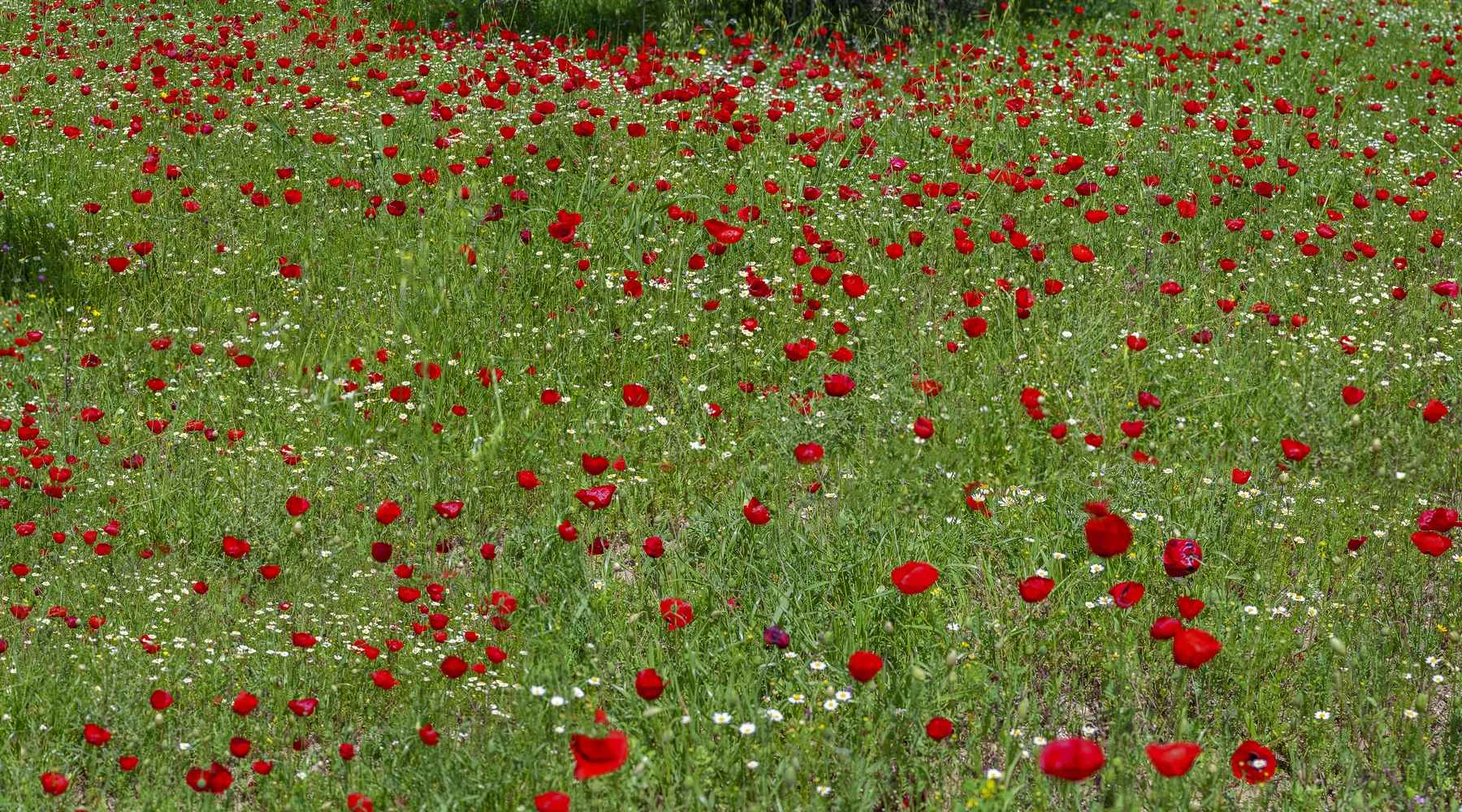
A single flower lasts one to two weeks. The stem is slender, the petals thin, and the warming sun finishes them. What persists is the colony. The hannun does not grow alone. It seeds itself in dense stands across wide ground, and it favours الأرض البور, fallow land, rain-soaked and unworked. Where a field goes unfarmed for a season, the hannun takes it.
That is worth sitting with. In Palestine, land goes unfarmed for reasons, and the flower that floods into it is the same one people associate with their dead.
Register 03The blood in the name
Every account of where شقائق النعمان comes from arrives in the same place by a different road.
The most repeated attaches it to al-Nu'man ibn al-Mundhir, the Lakhmid king of al-Hira, who saw the flower, loved it, and ordered it protected and planted around his palace at al-Khawarnaq. In a second telling it came up on his grave after the Persian king had him killed. In a third, his sisters — شقيقات, the same root as shaqa'iq — wept over that grave until the red flower grew, and it took their name.
Arabic points the same way on its own. النعمان is one of the Arabic words for blood, which makes this flower blood's sibling in colour. A separate reading traces Nu'man to nahman, from the Syriac نحم — to rise from the dead.
Older than any of it: the blood of Adonis in Phoenician myth, the scattered blood of Ba'al in Canaanite. This flower was carrying murder and resurrection in this soil before there was a language here to write either down.
Which settles something. The link between this flower, blood and the dead is not a recent political reading laid over an older pastoral symbol. It is the oldest layer there is, running back through Arabic into the Canaanite and Phoenician substrate of the same ground (ألترا فلسطين).
Register 04In the culture
The hannun runs through Palestinian speech and song. A red-cheeked face is «وجهه أحمر مثل الحنون». In the dal'ouna, sung at weddings and gatherings, the flower stands in for the beloved and for longing:
قلبي مزهر مثل الشقايق
بالله اسمعي كلامي وارحمونا
My heart is in flower like the anemones — for God's sake hear me out and have mercy. Other verses set the beloved's cheek beside the wild hannun, or wish it would come up in the orchards (ألترا فلسطين).
It is the flower of the martyrs. Red petals, black centre, white ring, green stem — the four colours of the Palestinian flag, assembled by the plant itself, coming out of the ground with nobody arranging it. Palestinians read it as blood that watered the land, and it recurs constantly in poetry, in tatreez, in painting, on walls.
Given Register 03, this is not a flag borrowed by a flower. It is the oldest meaning the plant has, arriving at its most recent name.
It is also, for most Palestinians, the answer to the question what is the flower of Palestine — even though the flower the State of Palestine formally designated in 2016 is a different plant entirely, سوسن فقوعة, the Faqqua iris. Both answers are set out here.
Register 05Not food, but medicine
The hannun is not eaten. Like much of the buttercup family it carries protoanemonin, which blisters skin and inflames the mouth and gut. It has no place in the Palestinian wild-food tradition, which is otherwise among the richest in the Mediterranean, and which is the subject of the register below.
It does have a place in Arabic pharmacology. Dawud al-Antaki catalogued its uses at length in his Tadhkira, the seventeenth-century Arabic medical compendium. The plants of this region were being described, named and classified in Arabic for centuries before European botany arrived to rename them in Latin (ألترا فلسطين).
Register 06Policing what grows
The hannun appears on a protected-plants list that Israeli authorities enforce inside present-day Israel and extend, through the Civil Administration under military command, into the occupied West Bank. Picking it is nominally an offence.
The flat phrase "Israeli law" does real work in obscuring it. Under the Hague Regulations of 1907, an occupying power must respect "the laws in force in the country" unless absolutely prevented (Article 43), and is "regarded only as administrator and usufructuary" of the territory's public property, including its agricultural land — entitled to use it, not to deplete or appropriate it for its own population (Article 55). Fourth Geneva Convention Article 64 permits new legislation only for the occupier's security, its obligations under the Convention, or the orderly government of the territory. An occupier's authority to make rules over occupied land is narrow, exceptional and temporary by design. Al-Haq's term for what has happened instead is de facto annexation — the Knesset extending sovereign authority over the West Bank through legislative acts, "in breach of its limited administrative authority as a belligerent occupant."
So this is not a park by-law. It is a regulation written by a legislature Palestinians cannot vote for, delivered through a military administration, governing what they may pick from their own hillsides.
And it is not enforced. The list runs to dozens of species. Surveys show Israelis pick anemones, narcissus and primrose. Court archives contain no indictment for any of them. The prosecutions are for the three wild plants Palestinians eat: Origanum syriacum (za'atar), Gundelia tournefortii (akkoub) and Salvia fruticosa (maryamiyya). Between 2004 and 2016 Israeli courts decided 61 za'atar and akkoub cases plus dozens more for sage, and every defendant was Palestinian, as the lawyer and researcher Rabea Eghbariah has documented (القدس العربي; Oxford Symposium). Settlers who pick or burn the same plants are not charged.
A list that shields a flower nobody is punished for taking, while criminalising a herb only one people is punished for gathering, is not protecting plants. It is regulating a population's access to its own land.
In 2019 the Palestinian legal centre Adalah demanded the designations be cancelled and criminal enforcement suspended, arguing the ban had no reliable factual basis, did not serve the purpose of the law, and disproportionately harmed a population that has gathered these herbs for centuries. Adalah documented 26 indictments and 151 fines between 2016 and 2018 alone. Each March, ahead of the akkoub and za'atar season, the Israeli Nature and Parks Authority runs a public warning campaign.
Register 07Photographed before
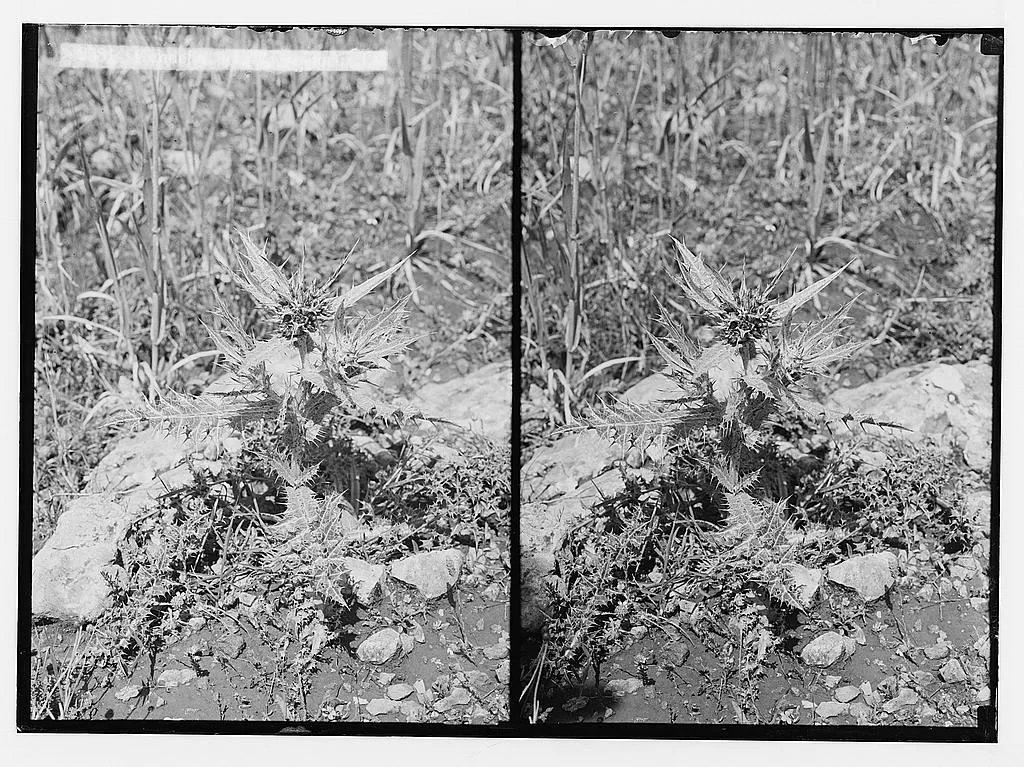
This is not the first photographic record of the hannun. Between roughly 1900 and 1920 the American Colony Photo Department in Jerusalem — a foreign Christian community running a commercial photography business — produced a series of 166 glass-plate negatives titled Wild Flowers of Palestine, now held in the Library of Congress (LC 2019696097).
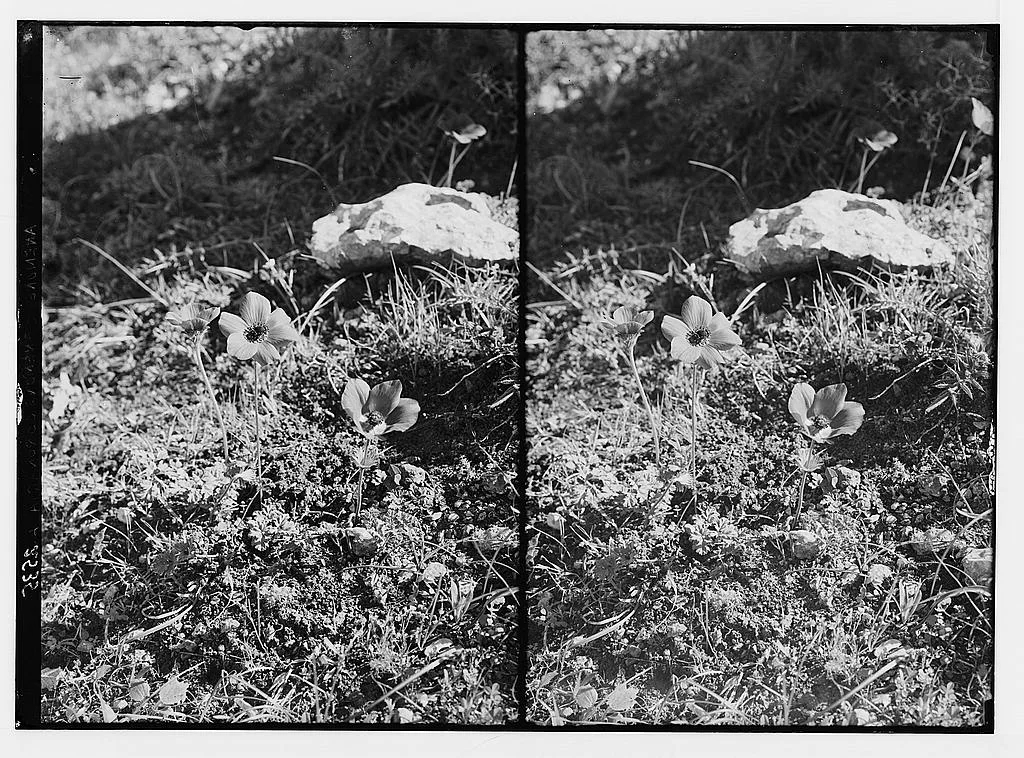
Library of Congress, Matson Collection, matpc.02407 · no known restrictions on publication
They captioned it “Lily of the field.” Whether that phrase names this flower at all is a question with its own answer. It is one of seven captions in that survey built on a scriptural phrase, in a series of 119 plates carrying no Arabic at all. The phrase is from the King James Bible. A flower Palestinians had been calling hannun for centuries was catalogued for a Western audience under a name taken from someone else's scripture — plated, sold as a stereograph, and archived in Washington. The same series files cyclamen under C. latifolium, a name botany has since abandoned.
The series is also, unmistakably, the same project as this one. The American Colony photographers made specimen plates and plates marked "taken in their natural settings" — the studio and the hillside, the same pairing made here a century later.
The 1900 caption calls this flower a Lily of the field, out of the King James Bible. Nobody who grew up on this hillside has ever called it that.
Sources
- شقائق النعمان.. أسطورة الدم والحب — حمزة العقرباوي, ألترا فلسطين
- أرض الزعتر والعكوب الحزين… لماذا تجرّم إسرائيل قطف النباتات الطبيعية بالسجن والغرامات؟ — القدس العربي
- The Struggle for Za'atar and Akkoub: Israeli Nature Protection Laws — Rabea Eghbariah, Oxford Symposium on Food & Cookery
- T. Canaan, “Plant-lore in Palestinian Superstition,” The Journal of the Palestine Oriental Society 8 (1928): 129–168 — the anemone as the April marker, p. 135; read at source
- Israel reformulating ban on harvesting wild herbs used in Palestinian cuisine — Adalah, The Legal Center for Arab Minority Rights
- “Wild flowers of Palestine. ‘Lily of the field’ (Anemone coronaria L.)” — American Colony Photo Department, c.1900–1920 · Library of Congress, Matson Collection
- Matson (G. Eric and Edith) Photograph Collection — Library of Congress Prints & Photographs, 22,061 items, Palestine 1898–1946
- Hague Regulations 1907, Arts. 43 and 55 · Fourth Geneva Convention, Art. 64 — ICRC