الكبّار
It grows out of the face of a rock, or out of a wall, in the months when almost nothing else in Palestine is flowering. The part that gets eaten is the flower that was never allowed to open.
Updated · 6 registers · 4 sources cited
Register 01What it is called
This plant carries an unusual number of Arabic names — more than any other plant in this record, and the whole index is counted here — which is generally a sign that people have had a long and practical relationship with something. Barari, the Palestinian open-science platform for wild food plants, records among others القبّار (qabbar), الكبّار (kabbar), الشفلح (shafallah), الأصف (asaf) and العلّوق (alluq) (براري).
The European name arrives late and second-hand. Caper, and the botanical Capparis, come through Latin from Greek kapparis, a word Greek itself appears to have taken from further east, along with the pickle.
Spinosa is for the spines: a pair of small hooked thorns sitting at the base of each leaf, which is how you know the plant in the months when it is doing nothing else.
Register 02Where it grows
The kabbar's habitat is, roughly, places with no soil. It grows from cliff faces, from the joints of limestone outcrops, from scree, from terrace walls, and from the mortar courses of built masonry, sending a root system down into the rock far deeper and further than anything visible above it suggests.
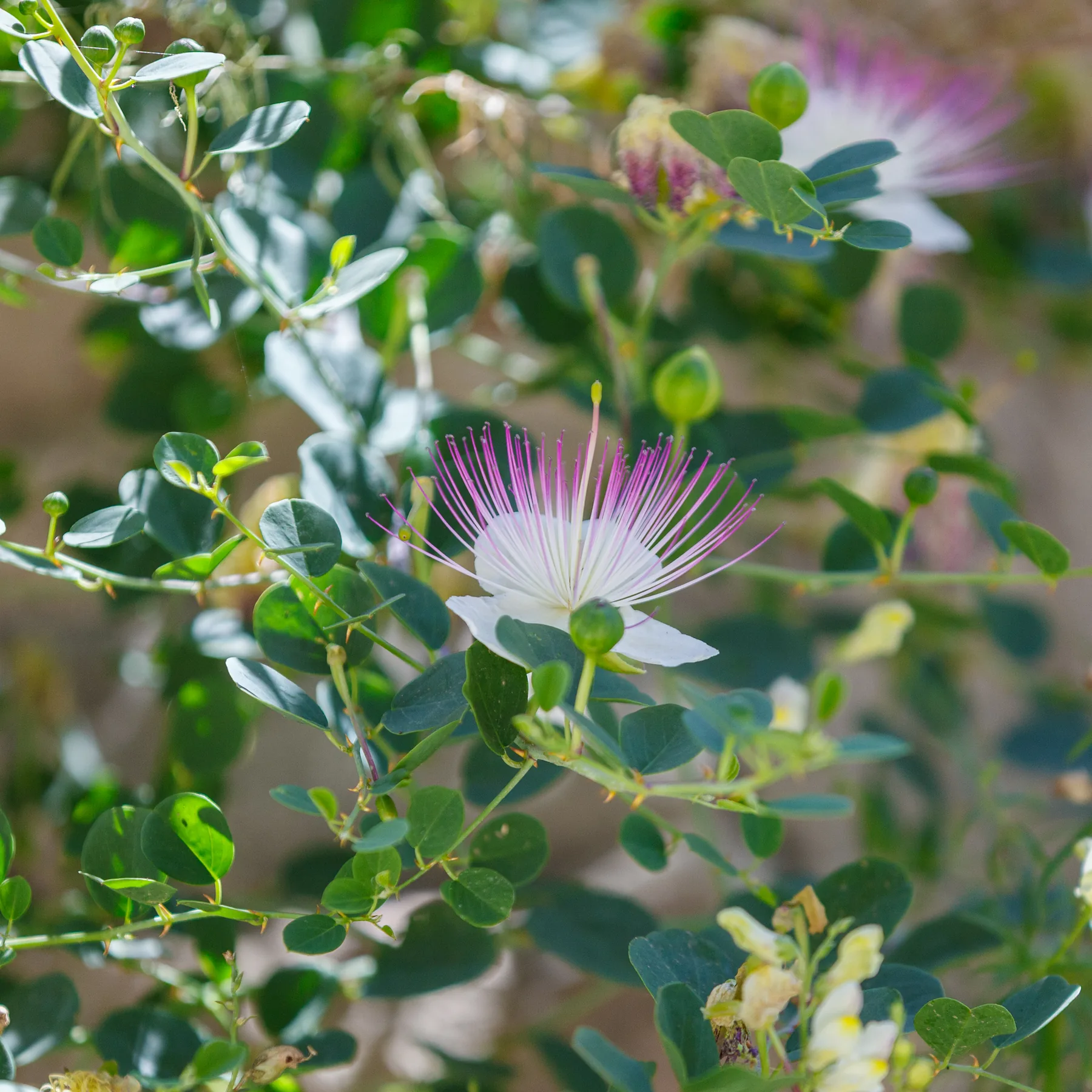
The round, thick, waxy leaves are the second half of that strategy: built to hold water and to survive full sun on bare rock through a Palestinian August. It is in flower from April into September (براري), so it is at its most spectacular in exactly the season when the hillsides have gone brown and the anemones and cyclamen have been finished for months.
Almost everything else in this record needs the rains. The kabbar needs a crack.
Register 03The flower
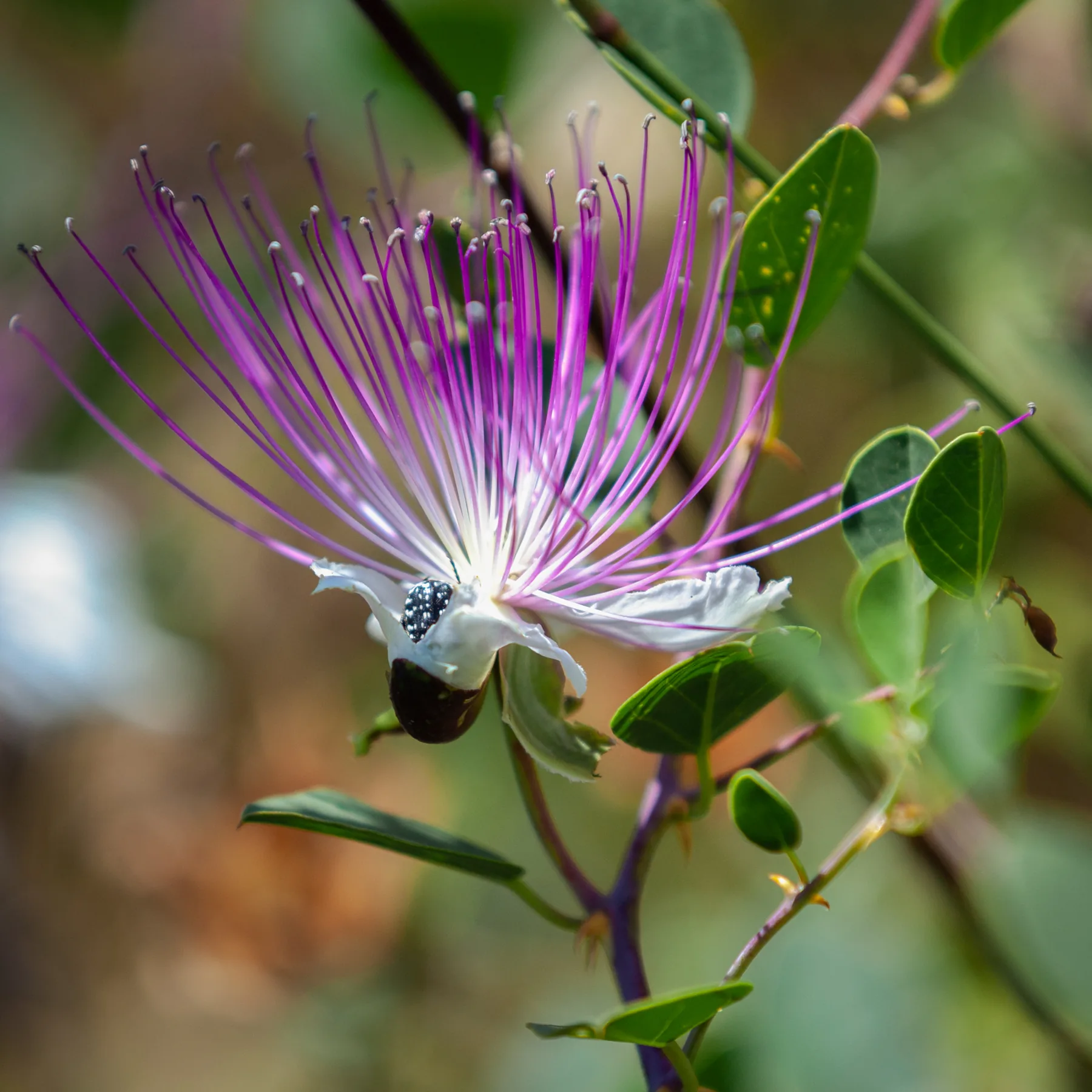
It is one of the most extravagant flowers in the Palestinian flora and it is built strangely. Four white petals sit underneath. Above them a wide fan of long stamens spreads out like a brush, white at the base, deepening through pink to violet at the tips. Out of the middle of that fan, a single stalk carries the ovary well clear of the flower, held out in the air above the stamens.
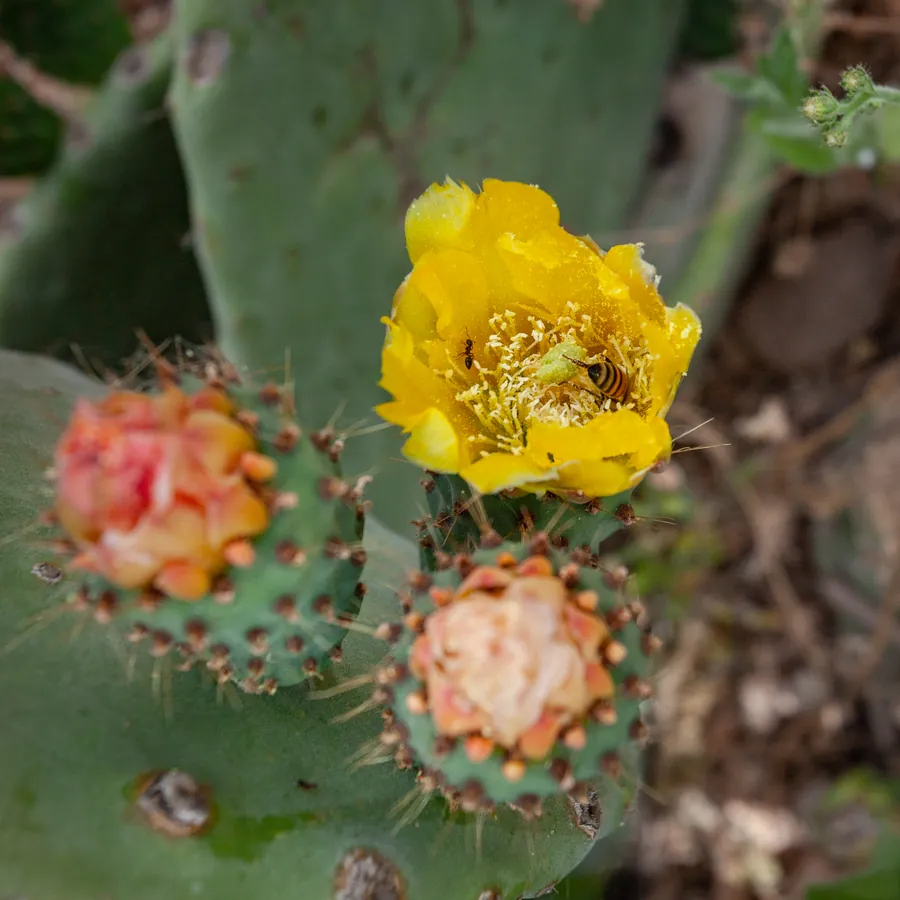
The flowers are short-lived, opening and going over quickly, which is why a kabbar bush in season carries every stage at once: fat closed buds, one or two flowers wide open, and the spent stalks of yesterday's. The photographs on this page were taken at that moment.
Large bees and beetles work them hard while they last. One is sitting in the middle of the flower at the top of this page, doing the only thing the flower opened for.
Register 04At the table
The crop is the bud, picked hard, green and tightly closed, before any of the above happens. What is on the table is a flower that was prevented.
Buds and young leaves are gathered in Palestine in May and June and are eaten pickled or in salads (براري). The raw bud is bitter and sharp, and salting or brining is what converts it into food. The fruit that follows a flower that was allowed to open, the caper berry on its long stalk, is pickled in turn.
Gathering is slow, hot and awkward work, done by hand, on rock, in summer, around the spines, and it has to be repeated as new buds come. The season runs two months and the same bush is gone over again and again, one bud at a time.
Register 05In the pharmacy
The kabbar sits inside the Palestinian herbal tradition as well as the kitchen. Barari's entry records community knowledge of preparations made as decoctions from the flowers, buds, leaves, root bark and roots, with recorded uses including analgesic, anti-inflammatory and diuretic (براري).
This is documented, community-held knowledge recorded by Palestinian researchers. The point of a platform like Barari is that each entry has a source and a chain of custody. Recording it here is history and ethnobotany, not medical advice, and this record does not offer any.
The broader pattern matters for how this site reads the Latin names. The plants of this region were named, catalogued and prescribed in Arabic for centuries before European botany arrived to rename them — a point this record also makes on the hannun, where Dawud al-Antaki's seventeenth-century Tadhkira catalogues a flower that Linnaean botany would reintroduce to the world a hundred years later under a different name.
Register 06Photographed before
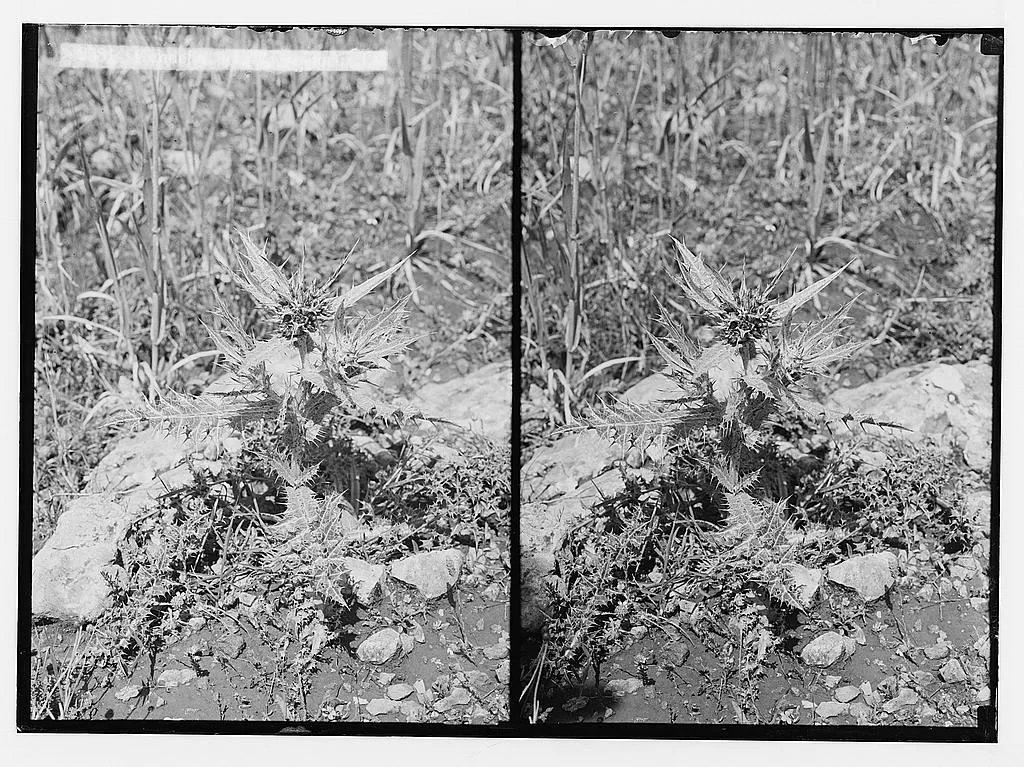
The American Colony Photo Department's series Wild Flowers of Palestine, made in Jerusalem in the first decades of the twentieth century, includes a caper. Unusually for that series, the caption is exact — the plant is given its correct binomial rather than a scriptural nickname.
What the photographer chose to shoot matters more than the caption.
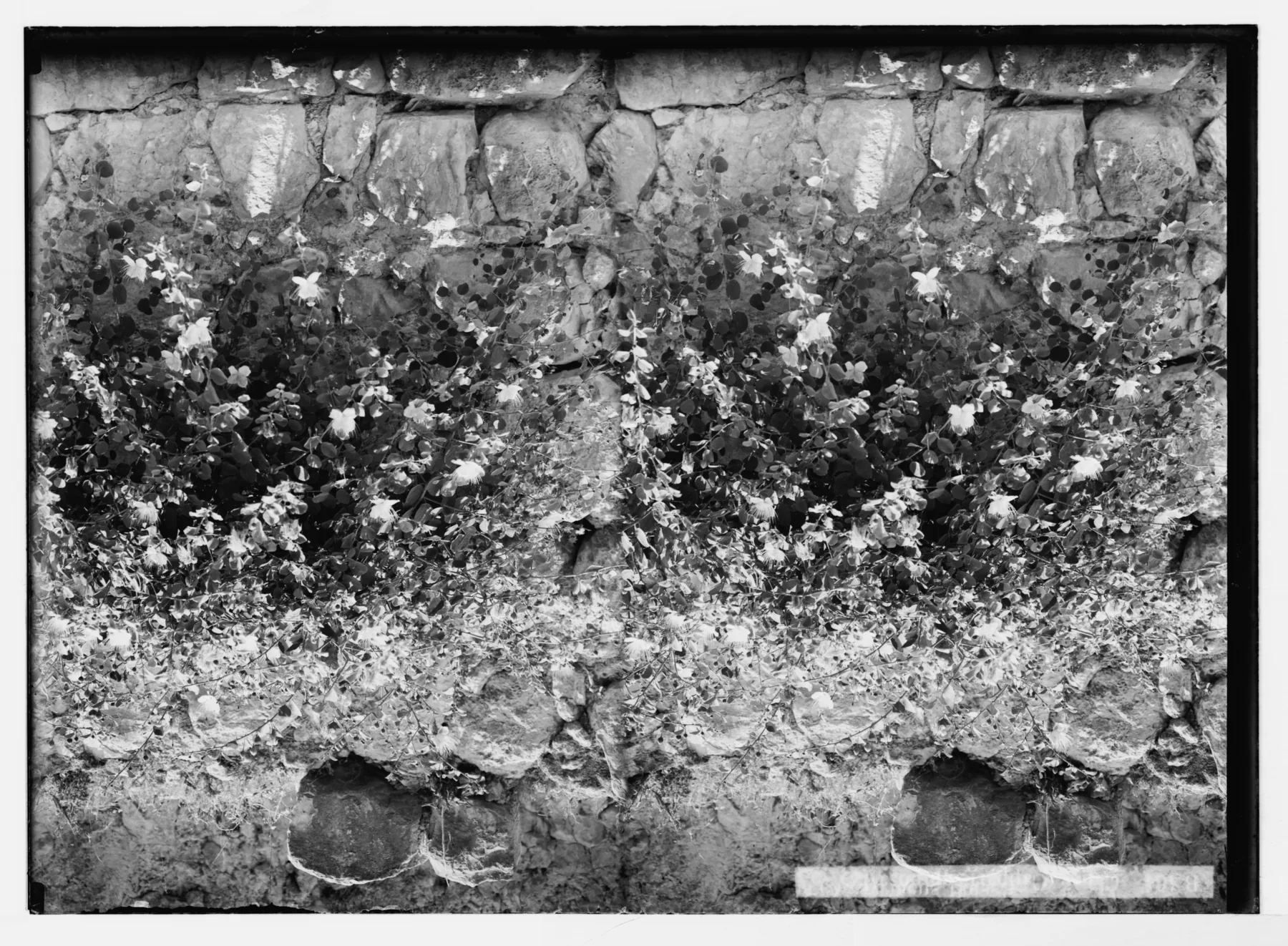
Library of Congress, Matson Collection, matpc.05843 · public domain
The plate shows a caper growing out of the courses of a dressed stone wall, running horizontally along the joint it found, in full flower, holding onto masonry somebody cut and laid.
A hundred and twenty-odd years later the same species is doing the same thing on the same kind of stone, and the photograph above and the photographs at the top of this page were taken by two people with nothing in common except the subject.
Both photographers went to the rock and shot a caper in flower. The 1900 plate was made for a Western market that wanted the Holy Land. This one was made by someone from here, who files it under the name the people living with the plant actually use.
Sources
- Capparis spinosa L. — species entry (Arabic names, flowering and foraging periods, edible parts, recorded traditional uses) — براري / Barari, an open-science platform on wild food plants in Palestine, developed by the Makaneyyat research team with support from the Palestinian American Research Center
- About Barari — براري / Barari
- “Wild flowers of Palestine. Caper (Capparis spinosa L.)” — American Colony Photo Department, c. 1900 · Library of Congress, Matson Collection, matpc.05843
- Palestinian Wild Food Plants — ed. Omar Imseeh Tesdell · Khalil Sakakini Cultural Centre and AFAC, 2018