Who decides what Palestinians may gather from their own land.
Israel has made it a crime to gather za'atar, akkoub and maramia, and the people it prosecutes are Palestinians. The cases are documented below, and they show what the ban is for. They are not the whole of the wrong. The wrong is the claim underneath them: a colonising power deciding what a colonised people may take from its own hills.
Updated · 6 registers · 18 sources cited
01Start with who is making the rule
This page does not ask whether the ban is applied fairly. There is no fair version of it. A rule about what Palestinians may pick from Palestinian land, written and enforced by the power that took that land, is colonial rule whatever it says about flowers.
The phrase "Israel's protected-plants list" hides that. The list is a nature-protection scheme Israel applies in two ways. Inside the territory it took in 1948 it is the law of the state built on the expulsion of some 750,000 Palestinians, applied to the Palestinians who remained. In the occupied West Bank it is extended through the Civil Administration, under military command, over people who have no vote in the legislature that wrote it and no say in how it is drafted or applied.
Palestinian human-rights organisations name the structure. Al-Haq and seven other Palestinian groups titled their 2022 report Israeli Apartheid: Tool of Zionist Settler Colonialism, and argue that the remedy is decolonisation and self-determination, not equal treatment inside the existing arrangement. That is the frame of this page.
Even the law of occupation, which states wrote for themselves, does not give Israel the power it is using:
- Hague Regulations 1907, Article 43. With the legitimate power's authority having passed into the occupant's hands, the occupant "shall take all the measures in his power to restore, and ensure, as far as possible, public order and safety, while respecting, unless absolutely prevented, the laws in force in the country." Existing law stays. The occupier is not a legislature.
- Hague Regulations 1907, Article 55. The occupier is "regarded only as administrator and usufructuary" of the territory's public property, including its agricultural land. It may not appropriate or deplete it for the benefit of its own population.
- Fourth Geneva Convention, Article 64. New legislation is permitted only for three narrow purposes: the occupier's own security, its obligations under the Convention, or the orderly government of the territory. Deciding what an occupied population may gather from its own hillsides is none of the three.
- ICJ, July 2024. The International Court of Justice found Israel's continued presence in the occupied Palestinian territory unlawful, together with its settlements, which are colonies, the annexation measures, and its use of the territory's natural resources.
Al-Haq and Adalah's term for what Israel has done instead is de facto annexation: the Knesset has, over decades, "increasingly extended its sovereign authority over the West Bank through legislative acts, in breach of its limited administrative authority as a belligerent occupant" (Al-Haq; Adalah).
Those articles are cited to show that the ban fails even by the rules occupiers agreed to. They are not the measure of what is just. An occupation that kept inside them would still be an occupation.
Prosecute the flower-pickers as well, and it is still a colonising power policing what Palestinians eat. Drop every herb case tomorrow, and the claim to decide is still standing.
02The conservation claim
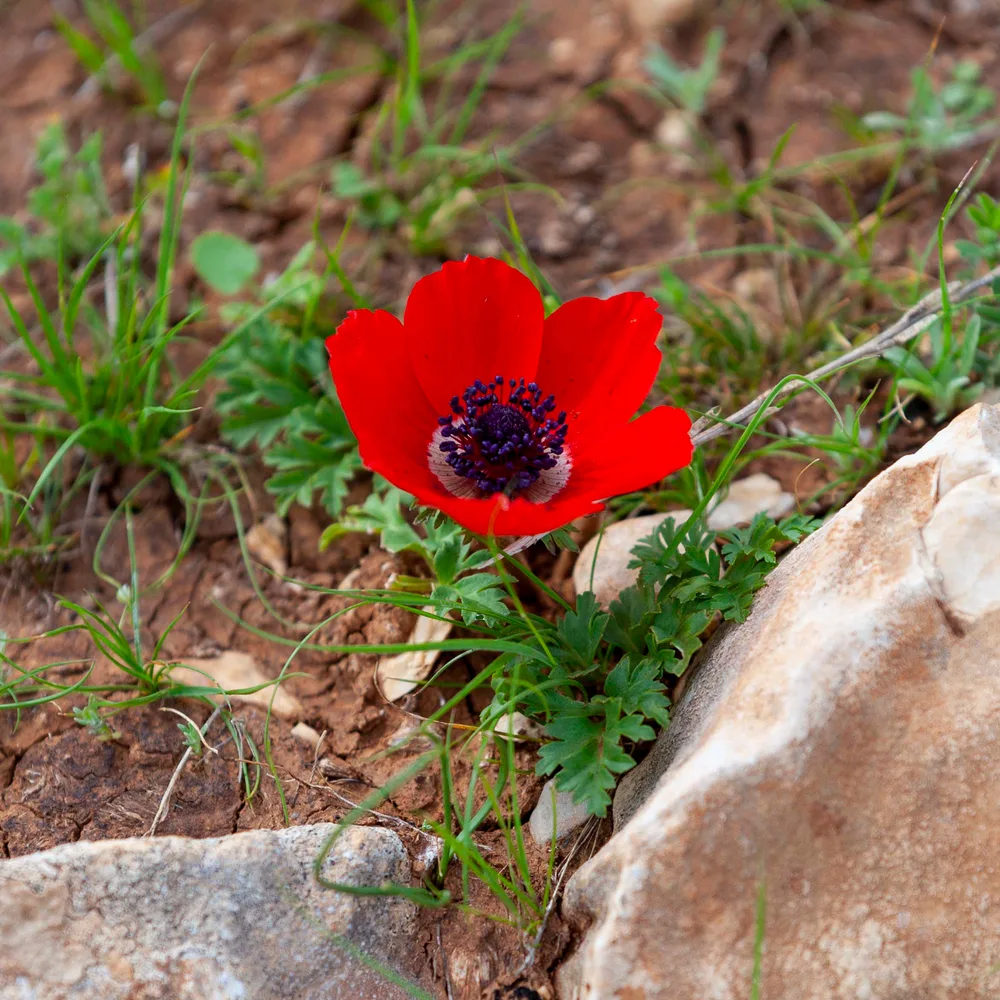
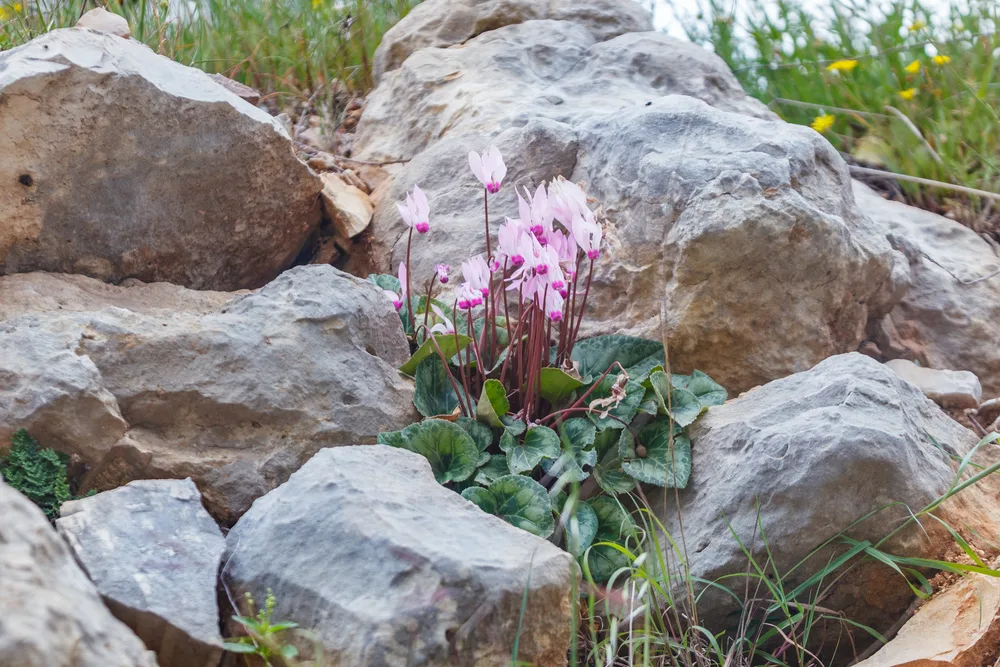
The list runs to dozens of species. Among them are the plants that appear on a postcard: the anemone, the cyclamen, the narcissus, the iris, the wild orchids. Israel's stated purpose is conservation.
Palestinians already care for these plants, and the right to do so is theirs. Palestinian botanists assessed the West Bank's native flora in 2026 and found 482 of 1,710 taxa threatened (the count, and who made it). The Environment Quality Authority recommended the Faqqua iris as the national flower, and the Palestinian protected-areas record documents it (Record 10). And the country had its own law of the harvest long before any of this, set out in Register 05.
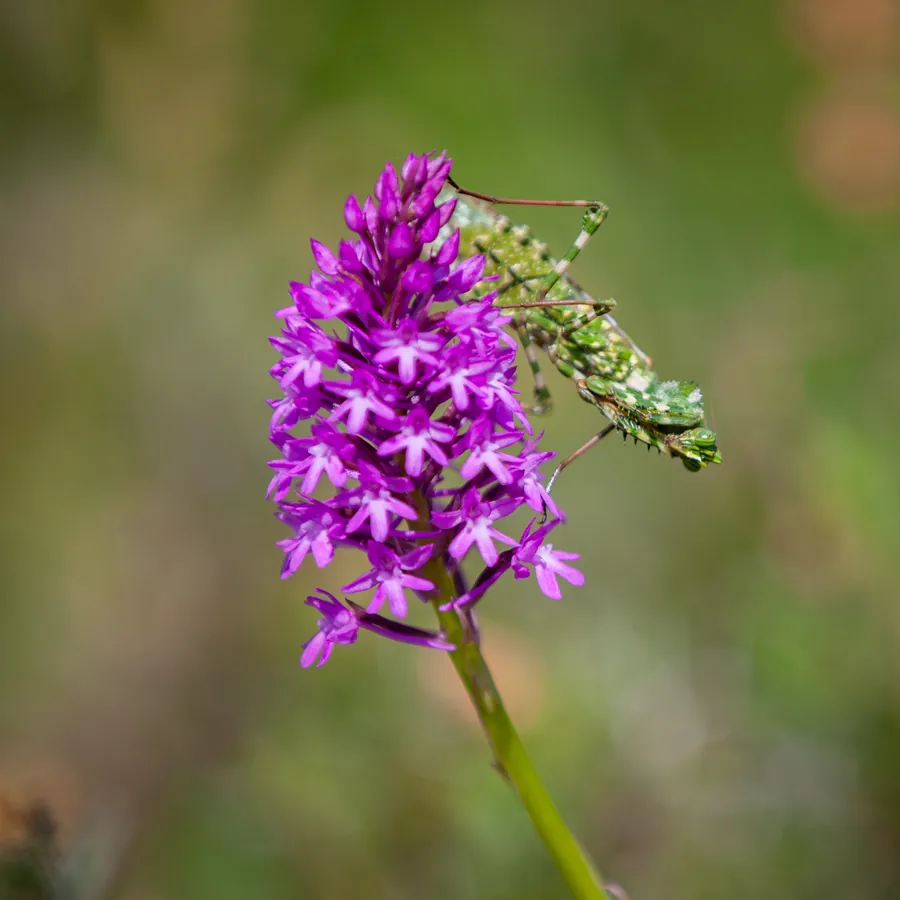
The wild orchids are the plants in real trouble: slow-growing, dependent on soil fungi, dug commercially for the salep trade, and declining across the eastern Mediterranean (Record 07, Register 04). That is a reason for the people of the land to act. It does not hand a colonising power jurisdiction over them.
The artist Jumana Manna, who filmed the prosecutions, describes what the conservation language does:
“For Palestinians, these laws constitute an ecological veil for legislation that further dispossesses them from their land, while the occupation's state representatives insist on their scientific expertise and duty to protect.”
03Who Israel prosecutes
The enforcement record shows what the ban is for. Two separate bodies of documentation exist. They cover different windows and different instruments, and this record keeps them apart rather than adding them into a bigger-sounding number.
The court record, 2004–2016. The lawyer and researcher Rabea Eghbariah examined Israeli court archives for this offence. Over that period the courts decided 61 cases concerning za'atar and akkoub, plus dozens more concerning sage. Every defendant was Palestinian. Across the same archive there is no indictment at all for picking anemone, narcissus or primrose — species that surveys show are picked (القدس العربي; Oxford Symposium).
The enforcement record, 2016–2018. Separately, the Palestinian legal centre Adalah documented 26 indictments and 151 fines in that three-year window, again falling on the population that has gathered these herbs for centuries (Adalah).
The three plants at the centre of both datasets:
| Plant | Species | What it is | Status |
|---|---|---|---|
| زعتر | Origanum syriacum | Wild za'atar — dried and mixed with sumac and sesame | Prosecuted |
| عكّوب | Gundelia tournefortii | Akkoub — the flower head, gathered March to May | Prosecuted |
| مريمية | Salvia fruticosa | Maryamiyya — the sage in the tea | Prosecuted |
| الحنون | Anemone coronaria | Not eaten. Toxic. | No indictment recorded |
| بخّور مريم | Cyclamen persicum | Leaf gathered; the plant itself toxic | No indictment recorded |
| السحلب | Anacamptis pyramidalis | Wild orchid, declining across the region | No indictment recorded |
A ban that never touches the flower and always finds the herb is not protecting plants. It is controlling a people's access to its own land.
This record calls that pattern the ornamental exemption: the showy flowers are protected on paper, and the plants Palestinians eat are protected in court. It holds even for the national flower itself, which is toxic, is gathered for decoration, and has never generated a prosecution.
The pattern is the evidence. It is not the offence. This record is not asking Israel to apply its list evenly. A colonising power that fined the flower-pickers too would still be deciding, by force, what Palestinians may take from their own hills.
Each March, ahead of the akkoub and za'atar season, the Israeli Nature and Parks Authority runs a public warning campaign. The campaign is timed to the harvest of the plants Palestinians eat.
There is a film of this. The Palestinian artist Jumana Manna spent years filming the prosecutions and made Foragers (2022, 64 minutes, in Arabic), shot in the Golan Heights, the Galilee and Jerusalem. It follows people gathering akkoub and za'atar, and it follows them into the courtroom. Her summary of what the law does is quoted in Register 02.
She notes the restrictions have produced “fines and trials for hundreds caught collecting these native plants,” and frames the question the whole apparatus turns on: who decides what is made extinct, and what gets to live on. Two independent bodies of evidence — a legal archive and a film — arriving at the same finding.
04What a challenge inside Israeli law can do
In 2019 Adalah, the Legal Center for Arab Minority Rights, demanded that the designations be cancelled and criminal enforcement suspended. It argued that the ban:
- lacked a reliable factual basis;
- did not serve the purpose of the law it was made under;
- and disproportionately harmed the Arab population that has used these herbs for hundreds of years.
The Nature and Parks Authority said it would revise its enforcement policy (Adalah).
Those are the arguments an Israeli authority can be made to answer: evidence, purpose, proportion. Palestinian lawyers use them because that is the only room they are given, and people facing fines need the fines to stop. But a win on those terms changes how the ban is applied. It leaves Palestinians gathering za'atar by permission of the same authority, which can withdraw the permission.
05Palestinians already had a law of the harvest
Israel's stated purpose is conservation. That purpose assumes these plants need protecting from the people who gather them. What was in force here before any of these orders existed says otherwise, and it was written down by Palestinians.
In 1924 Tawfiq Canaan published a long survey of Palestinian shrines, and in it he described the rules governing the trees growing at them. A fruit tree at a shrine — a mulberry, a fig, a vine, a prickly pear — was held to be سبيل sabil: anyone passing may eat as much as they choose, and nothing may be carried away. Most people said the fatiha before picking. Beyond that, no one would cut a branch, however small, and even broken or withered wood could not simply be taken — it could be burned only for a meal cooked in fulfilment of a vow (Canaan, JPOS 4, 1924, 35–36).
Sabil is the same word used for the public water cistern built beside the road and kept filled for whoever is thirsty, with a cup left there. One word covers both: what is set aside for the passer-by.
And the root runs further. In the same 1924 volume of the same journal, the Palestinian writer Omar Salih al-Barghouti عمر الصالح البرغوثي — a member of the Palestine Oriental Society — set down the rules of hospitality, قانون الضيافة. He describes the تكايا takaya of Jerusalem and Hebron, endowed to feed the poor and the ابن السبيل ibn as-sabil — the son of the road, the wayfarer — daily, with soup and bread (al-Barghouti, JPOS 4, 1924, 175ff).
One root. سبيل is the thing set aside for the road; ابن السبيل is the one walking it. The fruit on the saint's tree, the water jar at the roadside, and the bread in the city — the same idea, three institutions, two Palestinian authors, one volume.
That is a harvest rule with a limit built into it, and it is not the only one Canaan recorded. The same body of work documents:
- Gleaning rights — صيافات sayyafat for olives and بعارات ba'arat for grain, with widows, orphans and the poor going first (Record 03).
- The blessing said over seed, which asks that the crop feed not only the household but the birds, the person who cuts ears without permission and eats, the guest, the weak and the hungry. The thief is named ahead of the guest (The Year, Register 04).
Three separate customs, all recorded before 1935, all doing the same thing: guaranteeing access to food to people who own nothing, while capping what any one person can remove.
Restraint was never the coloniser's to teach. It was already law here, made by the people it bound, and it did not require prosecuting anybody.
Israel issued its orders over a people with a documented, working law of its own for sharing and limiting the harvest. Nothing in the sources read for this page shows the orders taking account of it. They put permission and punishment in its place, and Israel enforces them against the three plants that people eats.
06A different mechanism: the olive
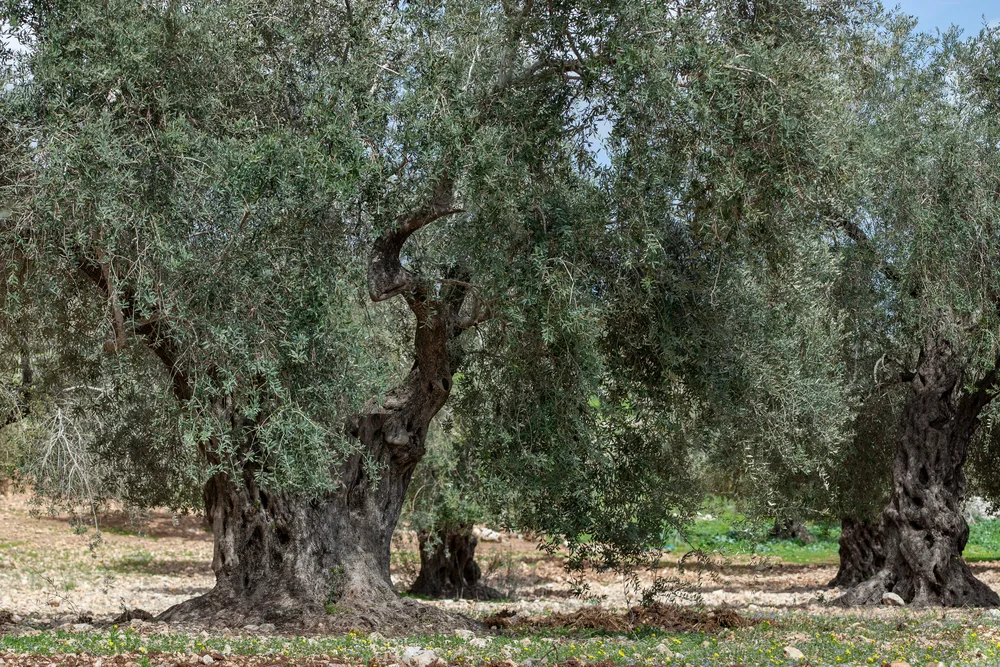
For the plants above, the instrument is a list and a fine. For the olive it is more direct: Israeli settlers and Israeli forces cut, burn, bulldoze and poison the trees, and Israeli restrictions keep the people who own them away. Figures documented by the UN Office for the Coordination of Humanitarian Affairs, which has recorded settler attacks in the occupied West Bank since 2006:
- After the 2023 harvest, more than 96,000 dunums of olive-cultivated land went unharvested because Israeli restrictions kept the farmers off it.
- Access to those areas had required “prior coordination”, a scheduled Israeli military permission, and in 2023 the Israeli authorities cancelled almost all of those approvals and kept the agricultural gates in the separation wall overwhelmingly closed.
- The Food Security Sector put the loss at more than 1,200 metric tons of olive oil and US$10 million.
- By 10 December 2025, OCHA had documented over 1,700 settler attacks causing casualties or property damage that year across more than 270 communities — five a day — injuring 1,110 Palestinians.
Alongside the violence runs the access regime: groves behind the separation wall, beside a colony, or inside a closed military zone can be reached only with an Israeli military permit, on designated days, for a set number of hours — leaving farmers unable to prune, plough or harvest properly (OCHA).
Read the two mechanisms together and they are one. Gathering criminalised at one end, access severed at the other, and in the middle a population that cannot get to the hillside in the season the plant is up. As Record 06 puts it: you do not have to ban a plant to end the practice of gathering it. You only have to make the walk impossible for long enough.
Sources
- أرض الزعتر والعكوب الحزين: لماذا تجرّم إسرائيل قطف النباتات البرية؟ — القدس العربي، على بحث المحامي والباحث ربيع إغبارية (court archive, 2004–2016)
- Rabea Eghbariah — on the criminalisation of za'atar and akkoub — Oxford Symposium on Food and Cookery
- Adalah: cancel the designation of za'atar and akkoub as protected plants — Adalah, the Legal Center for Arab Minority Rights (26 indictments and 151 fines, 2016–2018)
- T. Canaan, “Mohammedan Saints and Sanctuaries in Palestine,” The Journal of the Palestine Oriental Society 4 (1924): 1–84 — the سبيل rule on shrine trees, the prohibition on cutting, and the use of fallen wood, at 35–36; read at source
- Omar Salih el-Barghuthi عمر الصالح البرغوثي, “Rules of Hospitality (Qanun ad-Diyafeh),” JPOS 4 (1924): 175ff — the تكايا endowed for the poor and ابن السبيل; read at source. Al-Barghouti was a Palestinian member of the Palestine Oriental Society — see the Jerusalem Circle.
- Jumana Manna, Foragers (2022) — 64 min, Arabic, filmed in the Golan Heights, the Galilee and Jerusalem. Quotations are from the artist's own synopsis; this record has not screened the film.
- Israel confirms de facto annexation of West Bank lands — Adalah
- Al-Haq, Addameer, Al Mezan, Al-Quds University, JLAC, MIFTAH, PCHR and CCPRJ, Israeli Apartheid: Tool of Zionist Settler Colonialism — November 2022 · the settler-colonial frame, and decolonisation and self-determination as the remedy
- “Nakba 1948: Ethnic Cleansing of Cities, Towns and Villages” — Institute for Palestine Studies · the expulsion of 1947–49
- Al-Haq — publications on military orders and de facto annexation — Al-Haq, Ramallah
- Hague Regulations 1907, Art. 43 — ICRC
- Hague Regulations 1907, Art. 55 (usufruct) — ICRC
- Fourth Geneva Convention, Art. 64 — ICRC
- Legal Consequences arising from the Policies and Practices of Israel in the Occupied Palestinian Territory — advisory opinion, July 2024 — International Court of Justice
- Olive harvest 2023: hindered access afflicts Palestinian farmers in the West Bank — UN OCHA oPt, 22 February 2024
- Humanitarian Situation Update #348 — West Bank — UN OCHA oPt, 10 December 2025
- Edible orchids are being overharvested in the Mediterranean — Masters and Veltman, The Conversation, April 2026, reporting Current Biology, 2026
- How much of the flora these designations sit inside — 1,710 native taxa, 28.2% of them threatened: the flora of Palestine, counted.