How many olive trees has Israel destroyed?
Every figure in wide circulation predates Gaza. The FAO and the UN Satellite Centre find 90 per cent of Gaza's olive orchards damaged. The Palestinian Olive Council puts it at nearly a million of Gaza's 1.1 million trees. The Palestinian Ministry of Agriculture puts it at 2.29 million. Both are Palestinian institutions, both are cited in good faith, and nobody has reconciled them.
Updated · 6 registers · 10 sources cited
01The short answer
Israel has destroyed more Palestinian olive trees in the last two years, in Gaza, than in any comparable period on record — and none of it is inside the figures people quote.
The numbers in circulation — 800,000 olive trees, or 2.5 million trees of all kinds since 1967 — were published in 2013 and 2022 and describe a period ending in 2015. They are still being quoted as current. They predate October 2023 entirely.
What has happened since is measured, and measured well. The Food and Agriculture Organization and the UN Satellite Centre have assessed Gaza's cropland from space every month since October 2023. Their assessment published on 31 October 2025 finds 90 per cent of Gaza's olive orchards damaged — the worst-affected crop category in the territory (FAO, 31 October 2025).
Gaza is roughly 365 square kilometres. In two years it has probably lost more olive trees than the West Bank lost in the fifty-six years before.
That comparison is offered as what it is: two different territories, counted by different institutions using different methods. This record does not add them together. But the orders of magnitude are not in doubt, and the fact that the widely-quoted "since 1967" total does not contain the worst of it is the single most important thing to know about that total.
02Gaza: what the satellites see
The FAO and UNOSAT assessment is geospatial: satellite imagery, compared month on month against a pre-war baseline. It measures area damaged, not trees counted, which matters for what it can and cannot settle.
| Category | Damaged |
|---|---|
| Olive orchards | 90% |
| Orchards and trees overall | 89% |
| Field crops | 88% |
| Agricultural wells | 87% |
| All cropland | 87% |
| Vegetables | 80% |
| Greenhouses | 80% |
Olives are the most damaged category of anything grown in Gaza. The figure for all cropland rose through 2025 — around 80 per cent in April, 86 per cent in July, 87 per cent by late September. In North Gaza it reaches 94 per cent and in Gaza City 91 per cent.
Fayyad Fayyad, head of the Palestinian Olive Council, described the sector to Drop Site News as "almost completely destroyed." "There is no olive season this year," he said. "We estimate that nearly one million of Gaza's 1.1 million olive trees have been destroyed." More than 35 olive presses have been destroyed across Gaza; five are still working, all of them in the centre of the strip. Gaza produced about 50,000 tonnes of olives in 2022; in 2025 Fayyad expected the total to come in well under a thousand (Drop Site News, 20 October 2025).
Fayyad's own account of why is not hedged, and this record does not hedge it either: "The destruction is deliberate. Israel aims to eliminate the agricultural sector, including olives. What remains are scattered trees — not groves."
The UN Special Rapporteur on the occupied Palestinian territories, Francesca Albanese, found reasonable grounds to believe Israel is committing genocide in Gaza in her March 2024 report Anatomy of a Genocide, and South Africa's case under the Genocide Convention remains before the International Court of Justice. The destruction of the food system is part of what those findings describe. Naming it precisely is not softening it.
03Two Palestinian counts, differing by more than double
Here the record has to be careful, because the figures do not agree.
| Source | Gaza olive trees destroyed | Period | Reported |
|---|---|---|---|
| Palestinian Olive Council | ~1 million of 1.1 million | to Oct 2025 | Drop Site News |
| Palestinian Ministry of Agriculture | ~2,290,000 (74% of cultivated olive area) | 15 months to Jan 2025 | Mongabay |
Those two cannot both be right. They imply totally different pre-war tree stocks for Gaza: 1.1 million on one account, over three million on the other. The gap is more than a factor of two, the later figure is the smaller one, and no one has reconciled them publicly.
The satellite work cannot settle it, because it measures the proportion of orchard area damaged rather than counting stems. Ninety per cent of olive orchards damaged is compatible with either tree total.
This record reports both, attributes both, and does not choose. Picking the larger number because it is larger would be the same failure as picking the smaller one to seem careful. What can be said without any arithmetic at all is that the Palestinian body responsible for the olive sector says there is no olive season in Gaza this year.
04The West Bank, and the numbers everyone still quotes
In the West Bank the destruction is slower, older and continuous, and it is counted by incident rather than by area.
The Land Research Center records more than 52,300 olive trees destroyed in the West Bank since 7 October 2023 — about 4 per cent of all the olive trees on the Palestinian Ministry of Agriculture's register, in fifteen months (Mongabay, 4 March 2025).
For the most recent harvest, OCHA documented 150 harvest-related settler attacks between 1 October and 3 November 2025, the vandalism of over 4,200 trees and saplings, mainly olives, across 77 villages and towns, and injuries to about 140 Palestinians — 73 of them at the hands of Israeli settlers and the rest at the hands of Israeli forces (OCHA, Humanitarian Situation Update #337, 6 November 2025). The UN Relief Coordinator, Tom Fletcher, is quoted in the same update saying more trees and more communities were affected than in any of the past six years.
Against that, the historical figures: the Institute for Middle East Understanding gives at least 2.5 million trees destroyed since 1967, of which nearly one million were olives, attributing it to MIFTAH and UNCTAD and covering the period to 2015 (IMEU, 3 November 2022). The still more widely quoted 800,000 olive trees comes from a Visualizing Palestine infographic of October 2013, which set it against Central Park: enough olive trees to clear-cut all 24,000 trees in that park thirty-three times over (Visualizing Palestine).
Alongside all of it runs the access regime, which appears in no tree count anywhere: groves behind the separation wall, beside a colony, or inside a closed military zone can be reached only by permit, on set days, for set hours. A tree that is never pruned, ploughed around or harvested is not recorded as destroyed. The mechanism is set out on the olive record.
05Why there is still no total
Not because Palestinians do not count. They count carefully, under fire, and publish: the Ministry of Agriculture, the Olive Council, the Land Research Center, the Palestinian Central Bureau of Statistics, which put the 2021 destruction at roughly 19,000 trees. The problem is that the datasets answer different questions in different units.
- FAO and UNOSAT measure area, from space, monthly. Percentage of orchard damaged. No stem count.
- OCHA counts incidents in a window. Attacks, communities, trees vandalised, over a stated period. Not designed to accumulate across decades.
- The Land Research Center and PCBS count trees, by territory and by year.
- The "since 1967" totals are one-off research exercises that nobody maintains, and the two that exist stop in 2010 and 2015.
- And the two Gaza tree counts disagree by more than double, as Register 03 sets out.
So a single defensible cumulative figure does not exist, and this record will not manufacture one. On a subject that is dismissed as propaganda by default, an inflated total is a gift to the people driving the bulldozers. A figure that cannot survive being asked what it counts is not worth having.
But the absence is not neutral, and it is not symmetrical either. The most-cited number about the destruction of Palestinian olive trees describes a period that ended before the worst of it began. Every time it is quoted as current — and it is quoted constantly — the two years in which Gaza lost most of its olive trees are quietly left out of the sentence.
06What cannot be replanted
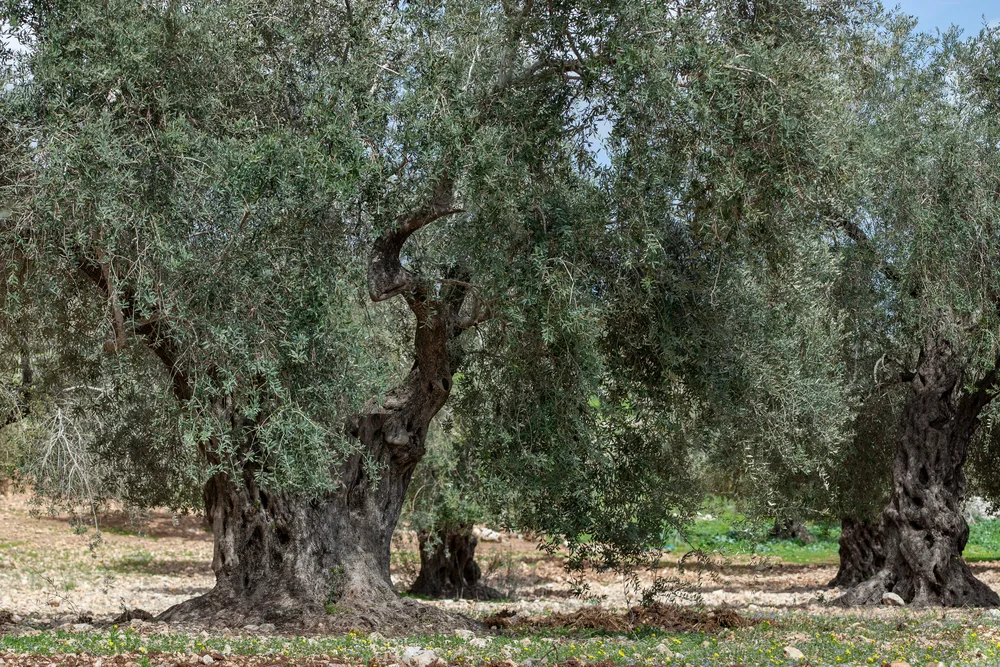
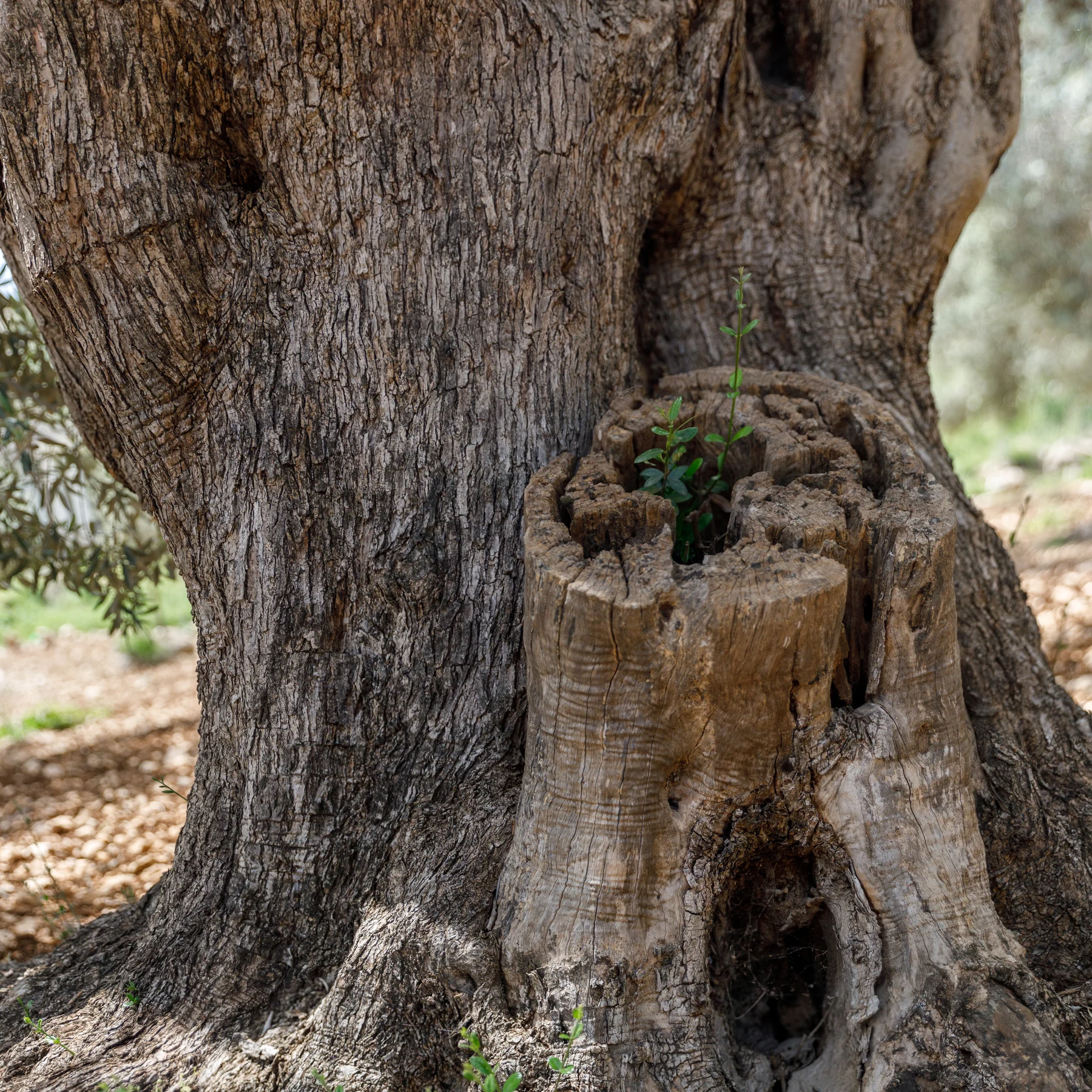
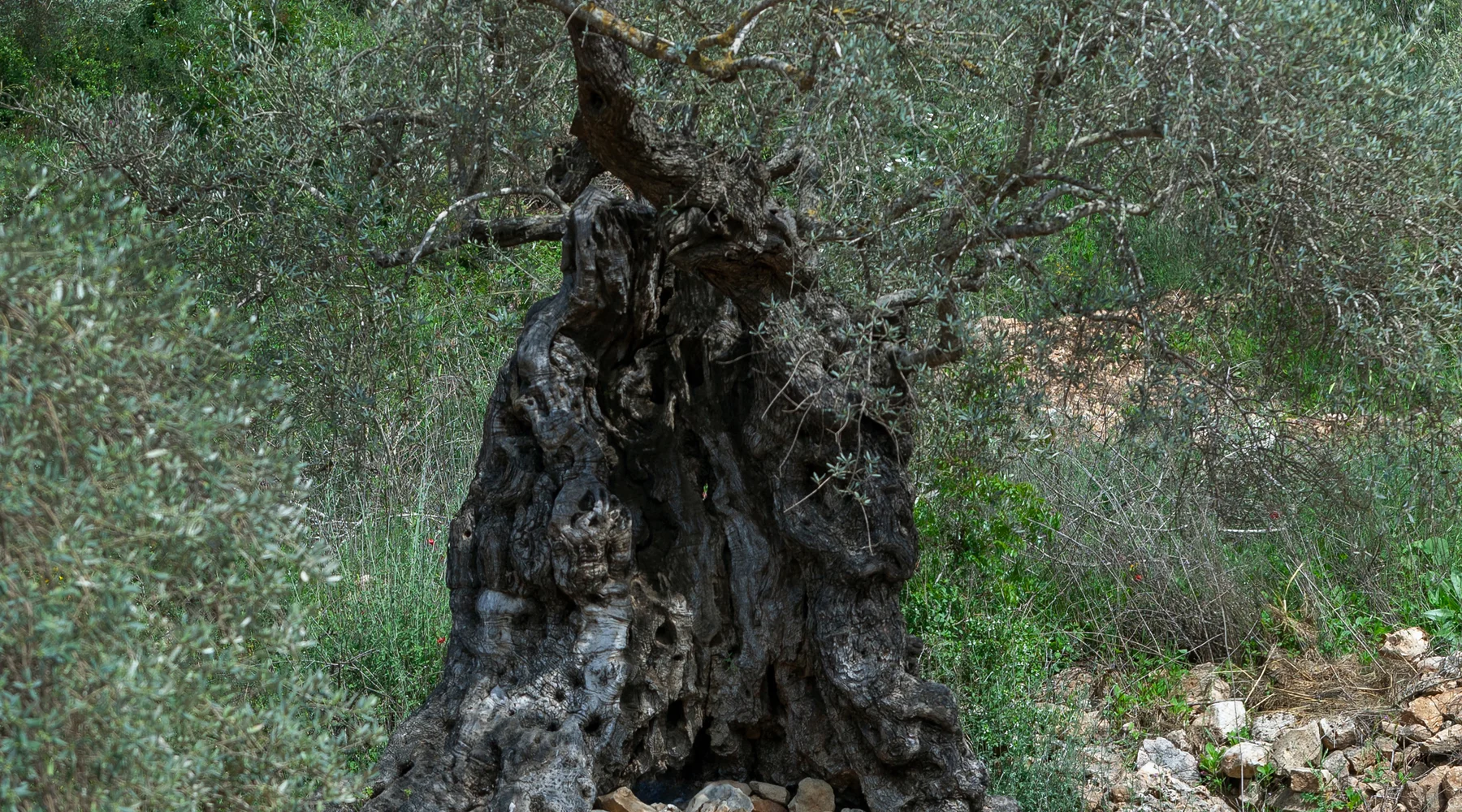
An olive is not an annual crop and it is not replaceable within a working life. A young Nabali tree — نبالي, the dominant Palestinian variety — takes years to come into bearing and decades to reach full yield. The trees photographed on this page are centuries old. There is no compensation payment and no replanting scheme that returns what a bulldozer removes in an afternoon, because the missing thing is time.
The government of Tunisia has pledged 180,000 olive saplings to Gaza, once conditions allow. Set against a million trees or against two million, that is a gesture rather than a replacement, and it would still be the better part of a human lifetime before any of them carried a real crop.
This is why the destruction of groves reads, to the people it happens to, as an attack on continuity rather than on property. A grove is the visible proof that a family has been on that hillside for longer than the state removing them from it. The terraces under those trees were built by hand by people whose descendants are kept off them by permit.
Under the Hague Regulations of 1907 an occupying power is "regarded only as administrator and usufructuary" of the occupied territory's property, including its agricultural land: permitted to use it, required to safeguard its capital, and not entitled to destroy it for the benefit of its own population (Article 55). In July 2024 the International Court of Justice found Israel's continued presence in the occupied Palestinian territory unlawful (ICJ advisory opinion, 19 July 2024).
You cannot replant a century. That is not a metaphor about heritage. It is the reason this particular method of removal is chosen.
The photograph at the top of this page is a cut stump inside the body of a living tree, with a shoot coming out of it. Olives do that. It is the least sentimental fact on this page and the only hopeful one, and it should not be mistaken for a solution: a shoot from a stump is not a grove, and it will not be one for a very long time.
Sources
- “Gaza Strip: ceasefire opens window for rehabilitation as over a third of cropland becomes accessible” — Food and Agriculture Organization of the United Nations with UNOSAT, the UN Satellite Centre, 31 October 2025 · 90% of olive orchards damaged, 89% of orchards and trees, 88% field crops, 87% cropland and agricultural wells, 80% vegetables and greenhouses; the April–July–September 2025 progression; North Gaza 94% and Gaza City 91%. Geospatial satellite assessment, run monthly since October 2023. Read directly at source. Measures area damaged, not trees counted.
- “Gaza's olive groves, oil and farmers” — Drop Site News, 20 October 2025 · Fayyad Fayyad, head of the Palestinian Olive Council: “We estimate that nearly one million of Gaza's 1.1 million olive trees have been destroyed”; “there is no olive season this year”; the sector “almost completely destroyed”; “the destruction is deliberate.” Also 35+ presses destroyed with five operational, ~50,000 tonnes produced in 2022, and Tunisia's pledge of 180,000 saplings.
- Elizabeth Fitt, “Gaza and West Bank farmers salvage olive harvest amid displacement, destruction and Israeli settler violence” — Mongabay, 4 March 2025 · the Palestinian Ministry of Agriculture figure of ~74% of cultivated olive area destroyed, “equivalent to the loss of approximately 2,290,000 olive trees”, over 15 months to January 2025; and the Land Research Center figure of 52,300+ West Bank olive trees destroyed since 7 October 2023, about 4% of the Ministry's register.
- OCHA, Humanitarian Situation Update #337 | West Bank — UN Office for the Coordination of Humanitarian Affairs, 6 November 2025 · 150 harvest-related settler attacks, 4,200+ trees and saplings vandalised, 77 villages and towns, ~140 Palestinians injured (73 by settlers), 1 Oct – 3 Nov 2025; Tom Fletcher on the six-year comparison. Read directly at source.
- “Israel's Environmental Apartheid in Palestine” — Institute for Middle East Understanding, 3 November 2022 · at least 2.5 million trees including nearly one million olive trees, 1967–2015, attributed by IMEU to MIFTAH and UNCTAD; ~19,000 trees in 2021 attributed to the Palestinian Central Bureau of Statistics; 9,000+ olive trees Aug 2020–Aug 2021 attributed to the ICRC. The underlying MIFTAH, UNCTAD, PCBS and ICRC documents were not read at source by this record.
- 800,000 Olive Trees Uprooted, 33 Central Parks — Visualizing Palestine, infographic, October 2013 · the 800,000 figure and the Central Park comparison, sourced by them to “The Besieged Palestinian Agricultural Sector,” p. 13. That report could not be retrieved at source; its publisher and date are unconfirmed here.
- Francesca Albanese, Anatomy of a Genocide — UN Special Rapporteur on the situation of human rights in the Palestinian territories occupied since 1967, Human Rights Council, 26 March 2024 · reasonable grounds to believe Israel is committing genocide in Gaza. A special-procedures report, not a court judgment; South Africa v. Israel remains before the ICJ.
- Legal Consequences arising from the Policies and Practices of Israel in the Occupied Palestinian Territory — International Court of Justice, advisory opinion, 19 July 2024 · the finding that Israel's continued presence in the occupied Palestinian territory is unlawful. Advisory, not a criminal judgment. Hague Regulations 1907 Art. 55 is quoted as it appears on Record 03.
- Record 03 — الزيتون, Olea europaea — the tree, the varieties, the terraces, the harvest, and the 2023 access figures. Photographs on this page are by the artist, taken in Palestine for this record.
- What the tree is, and why it stands for the country: the national tree of Palestine.