الزيتون
Not a wildflower. The tree the terraces were built for, that outlives the people who plant it, and that is cut down more often than anything else that grows in Palestine.
Updated · 6 registers · 10 sources cited
Register 01What it is called
الزيتون — zaytun — is the crop and the grove; a single tree is زيتونة, zaytuna. The oil is زيت, zeit, and the closeness of those two words is the closeness of the thing itself to the life around it.
The trees in Palestinian groves are not a single uniform crop. The dominant local variety is Nabali — نبالي — with Souri (صوري) and others alongside it: baladi varieties, meaning local, of this country, selected over centuries by the people farming them rather than bred in an institution.
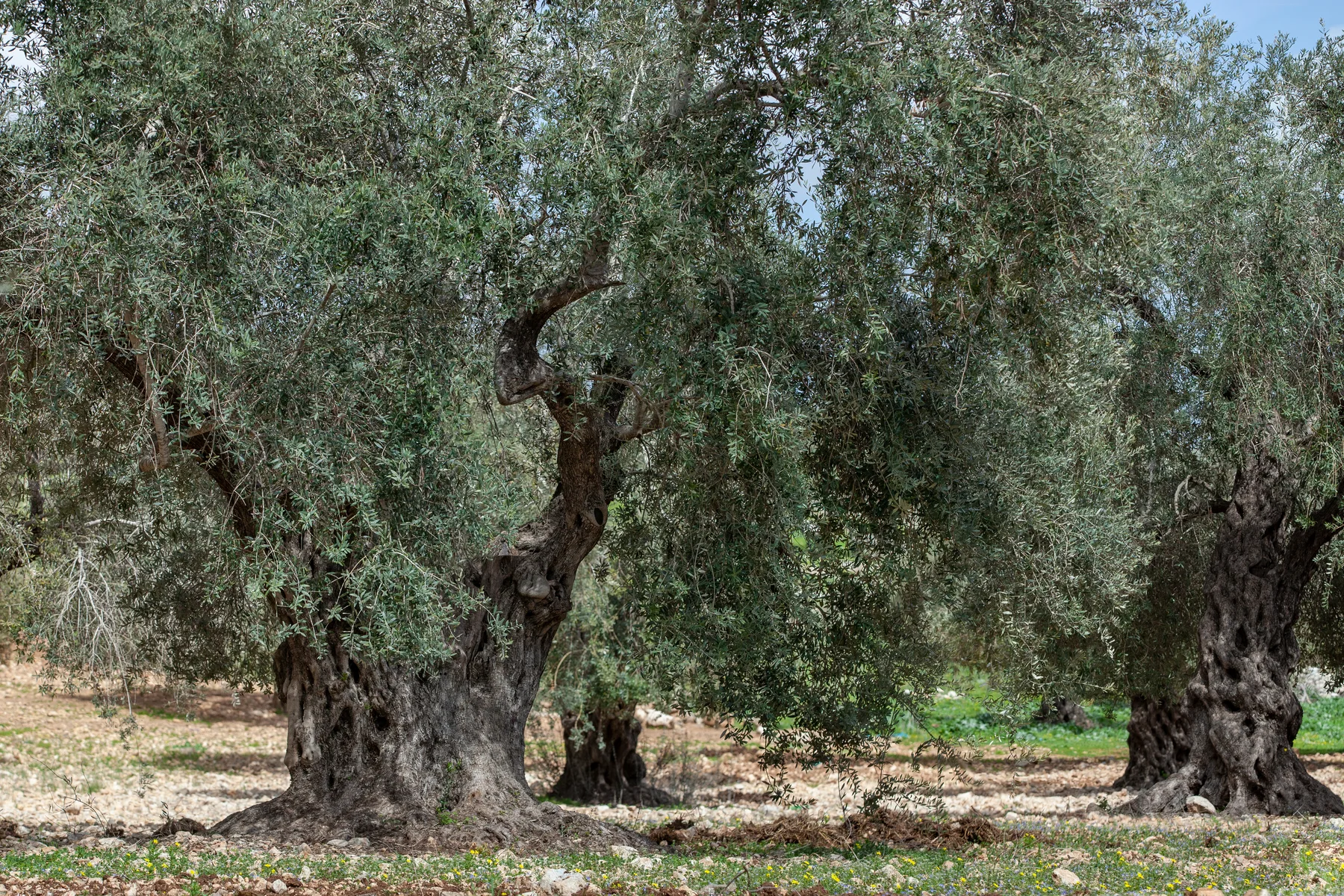
An olive is slow. It will not fruit properly for a decade and will not reach full yield for far longer, and it then keeps going for centuries — the hollowed, twisted trunks in the photograph above are what several hundred years look like. Nobody plants an olive for themselves. You plant it for people you will not meet. That is the fact underneath everything else on this page.
Register 02The terraces
The Palestinian hill country is not naturally farmable. It is limestone, steep, and it sheds its soil in the winter rains. What makes it cultivable is the terrace — سناسل, sanasil: dry-stone retaining walls built along the contour, without mortar, holding a strip of soil behind each one.
They are not decorative and they are not ancient ruins. They are working infrastructure, built and rebuilt by hand across generations, and the olive is what they were mostly built to hold. A terraced hillside is a piece of engineering with a lifespan measured in centuries, maintained by the continuous presence of the family that farms it.
Which is the vulnerability. A terrace system only survives if people can keep reaching it. Cut off access for a few seasons and the walls go, then the soil, then the hillside.
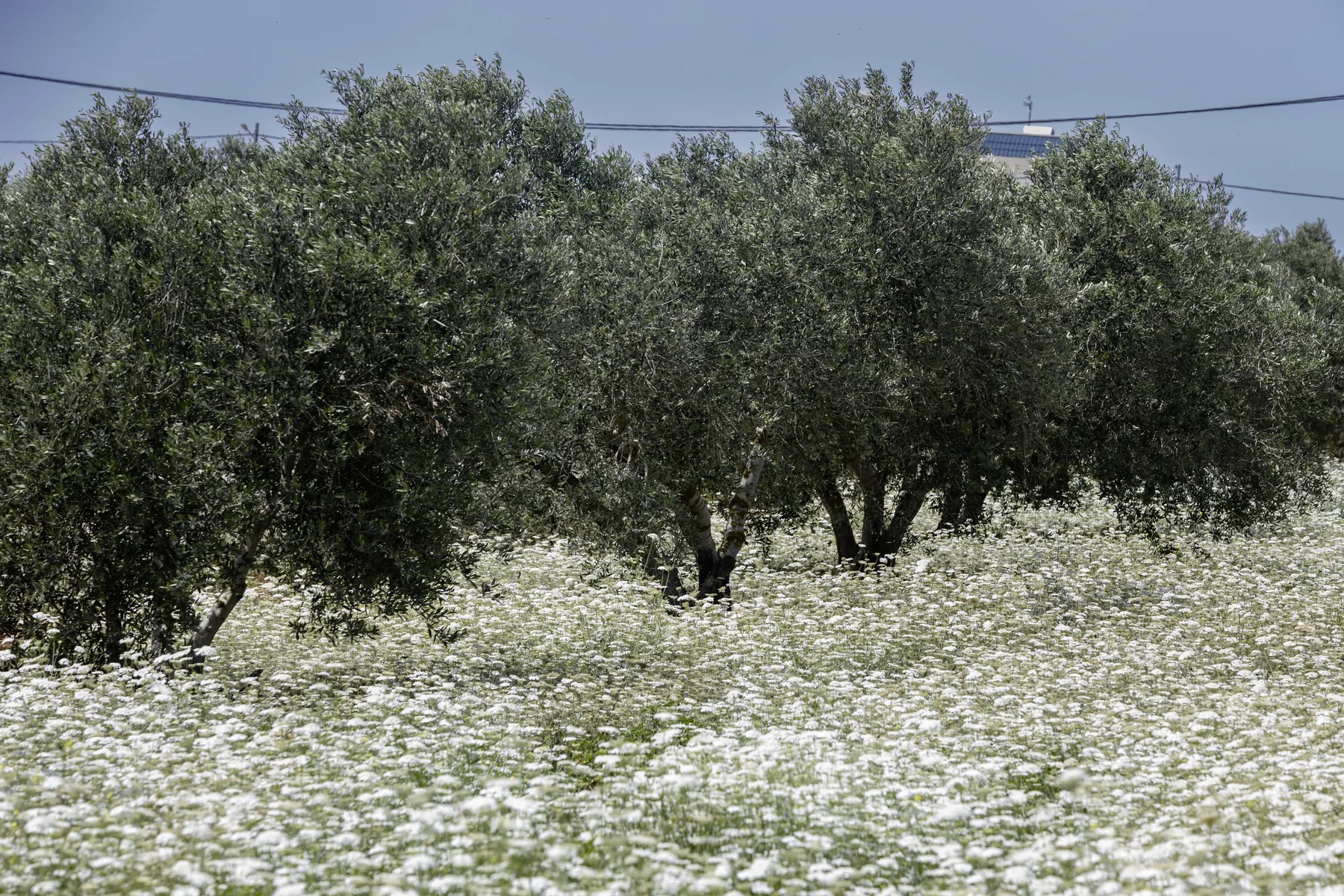
The groves are not monocultures either. The photograph above is a working olive grove in spring, the ground between the trees thick with chamomile — the same ground that produces akkoub, za'atar, khubeizeh and the rest of the wild-food harvest. An olive terrace is a habitat, and much of what appears elsewhere in this record grows in one.
Register 03The harvest
The olive harvest runs from October into November and it is not agricultural labour in the ordinary sense. Families return for it, including from the cities and from abroad; children are taken out of school; neighbours work each other's groves. Sheets go down under the trees and the fruit is combed off by hand and by stick.
The timing has its own proverbs, and they were written down a century ago. In his 1928 study of Palestinian plant lore, the physician and ethnographer Tawfiq Canaan records the rule for reading the crop months in advance: إن أبرز في آذار هيّئ له الجرار — if it blossoms already in March, prepare the big jars for the oil. But if the blossom holds off until April, prepare the scoops — a small year. And for the harvest itself: when the Feast of the Cross passes, do not take the beating stick from your olive trees (Canaan, JPOS 8, 1928; more on Canaan).
Canaan names the varieties as growers spoke of them: the malusi, small and black, whose oil is good “though its gathering makes one old”; and the huwari, of which they said “your oil turns over in the frying-pan” — meaning it is excellent. Two more baladi names to set beside the Nabali and the Souri, recorded from the people farming them in the 1920s.
He also records the rule about who else may pick. Once a family has taken its olives from a tree, anyone may gather what is left, and widows, orphans and the poor go first. The gleaners had their own word — sayyafat for those gathering olives, as against ba'arat for those gathering grain.
The oil then runs the household year: zeit w za'atar at breakfast, oil for cooking, for preserving, for soap, for lamps historically, and as a store of value — oil keeps, and a good year underwrites a bad one. Table olives are cured in brine at home. For a very large number of Palestinian families the olive is not a crop among crops. It is the crop, and the harvest is the year's central event.
Register 04In the culture
Because an olive outlives its planter, it works as proof. A tree standing in a grove is evidence that a family was there long enough to plant it and long enough to keep it, which is precisely why olives are counted, mapped, inherited, argued over, and named. Palestinians speak of trees the way other people speak of relatives, because the timescales are comparable.
It also carries honorific names, which Canaan recorded in 1928. Olives, pomegranates, figs and grapes are together أثمار الجنّة, athmar al-janneh, the fruits of Paradise. The olive alone is الشجرة المباركة, ash-shajarah al-mubarakah, the blessed tree, and شجرة النور, shajrat an-nur, the tree of light. Canaan adds one detail that says more than the names do: some people swear oaths by it (Canaan, JPOS 8, 1928, p. 160).
A proverb Canaan sets down elsewhere sorts the three orchard trees by how much they ask of you. The olive is the bedouin, who can live anywhere and needs very little; the fig is the fellah, who has more requirements; the vine is the one who needs constant attention. Of the three, the olive is the one you can leave and come back to (Canaan, JPOS 4, 1924, p. 31).
From the same page, a Christian belief attached to the date this record has already identified as the hinge of the year: on the night of the Feast of the Cross, the olive trees are said to kneel. That is the same night the harvest opens (The Year, Register 02).
The tree recurs constantly in Palestinian poetry and painting, and it recurs in a specific way: not as a symbol of peace in the international sense, but as an ancestor and a witness — something older than the current arrangement that is still standing.
To plant an olive is a statement about the future. To cut one down is a statement about the past.
Register 05Uprooted
Elsewhere in this record the mechanism is a protected-plants list that criminalises gathering (see Register 06 on the hannun). For the olive it is more direct. The trees are cut, burned, bulldozed and poisoned, and the people who own them are kept away from them. How many olive trees that adds up to, and why no one can tell you, is a question of its own.
The figures below are read directly from the UN Office for the Coordination of Humanitarian Affairs, which has documented settler attacks in the occupied West Bank since 2006. They are quoted from two specific OCHA documents rather than summarised, because the precise scope of each number is part of what it proves:
- After the 2023 harvest, more than 96,000 dunums of olive-cultivated land went unharvested across the West Bank because Israeli restrictions kept the farmers off it — land behind the Barrier in the “Seam Zone,” land within 150 metres of it, and land next to Israeli colonies.
- The mechanism was administrative. Access to those areas had required “prior coordination”, a scheduled Israeli military permission, and in 2023 the Israeli authorities cancelled almost all of those approvals. The agricultural gates along the Barrier remained overwhelmingly closed.
- The Food Security Sector, a partnership of dozens of humanitarian organisations, put the resulting loss at more than 1,200 metric tons of olive oil and US$10 million, worst in Tulkarm, Qalqiliya and Nablus.
- Over the same September–November window OCHA documented 113 harvest-related incidents in which Israeli settlers attacked Palestinians, damaged their trees, or stole crops and harvesting tools. Over 2,000 trees were vandalised in those incidents alone.
- And it is not a 2023 anomaly. By 10 December 2025 OCHA had documented over 1,700 settler attacks causing casualties or property damage that year, across more than 270 communities — an average of five a day — injuring 1,110 Palestinians, 772 of them at the hands of settlers and 327 at the hands of Israeli forces.
Alongside the violence runs the access regime. Groves that fall behind the separation wall, or beside a colony, or in a closed military zone, can be reached only with a permit, on designated days, for a set number of hours — a system OCHA has repeatedly documented as leaving farmers unable to prune, plough or harvest properly (OCHA, Olive harvest 2023: hindered access afflicts Palestinian farmers in the West Bank). A tree that cannot be tended does not need to be cut down. It declines on its own, and the terrace with it.
The legal position is not ambiguous. Under the Hague Regulations of 1907 an occupying power is "regarded only as administrator and usufructuary" of the occupied territory's property, including its agricultural land — permitted to use it, required to safeguard its capital, and not entitled to appropriate or destroy it for the benefit of its own population (Article 55). The destruction of Palestinian olive groves and the transfer of that land to Israeli colonies is not a by-product of a conflict between neighbours. It is the removal of a population's means of remaining.
Register 06Photographed before
The American Colony Photo Department in Jerusalem photographed the olive harvest repeatedly between the 1900s and the 1930s. The plates are now in the Library of Congress, and they show what the harvest looked like a century ago: the same trees, the same sheets, the same hand-work.
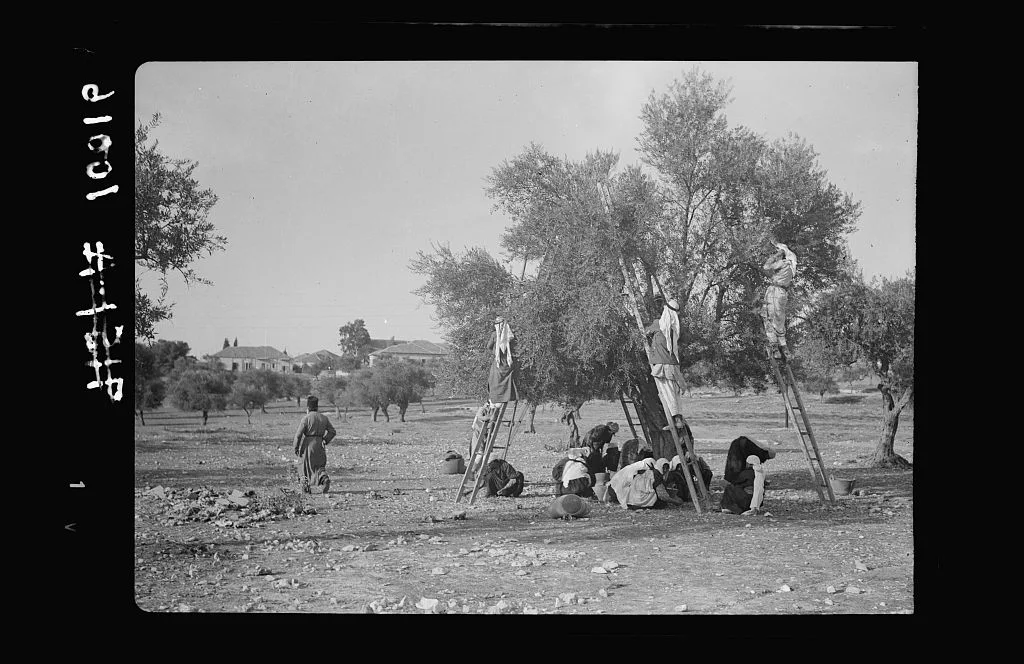
Library of Congress, Matson Collection, matpc.18895 · no known restrictions on publication
And then there is this one.
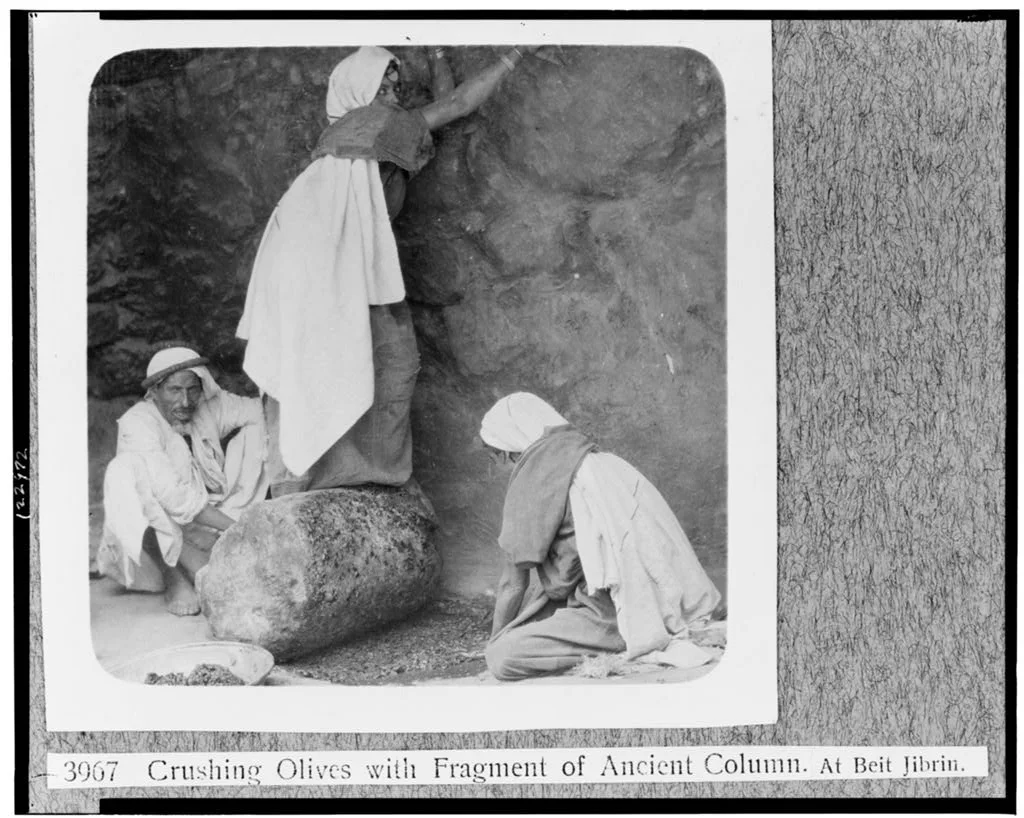
Library of Congress, cph.3c22972 · no known restrictions on publication
Three people crushing olives with a piece of a Roman column, using what the ground provided, in the village of Bayt Jibrin — بيت جبرين — in the Hebron subdistrict.
Bayt Jibrin no longer exists. It had 2,430 inhabitants in 1945. It was attacked and depopulated on 29 October 1948, and Kibbutz Beit Guvrin was founded on its land the following year. Its people were driven east. Their descendants are still refugees a few kilometres away, in Fawwar camp and in a camp that carries the village's name — Bayt Jibrin camp, also called ʽAzza, in Bethlehem (Zochrot; Palestine Remembered; Walid Khalidi, All That Remains).
The photograph is not of a lost world. It is of a specific afternoon, in a specific village, fifteen to thirty-eight years before that village was emptied, and the grandchildren of the people in it are alive, and are still refugees, and can see the hill.
This is what the archive is for on this site. Not nostalgia, and not decoration. The American Colony photographers were documenting a picturesque Holy Land for a Western market. What they actually made was evidence.
Sources
- Olive harvest 2023: hindered access afflicts Palestinian farmers in the West Bank — UN OCHA, occupied Palestinian territory
- Humanitarian Situation Update #348 — West Bank — UN OCHA oPt, 10 December 2025 (2025 settler-attack and injury figures)
- Bayt Jibrin — village profile — Zochrot
- Bayt Jibrin, Hebron district — بيت جبرين — Palestine Remembered
- “Harvesting olives,” 23 November 1938 — American Colony Photo Department · Library of Congress, Matson Collection
- “Crushing Olives with Fragment of Ancient Column. At Beit Jibrin” — American Colony Photo Department, c.1910–1933 · Library of Congress
- T. Canaan, “Plant-lore in Palestinian Superstition,” The Journal of the Palestine Oriental Society 8 (1928): 129–168 — the blossom and harvest proverbs, the malusi and huwari varieties, the honorific names at p. 160, and the gleaning custom; read at source
- T. Canaan, “Mohammedan Saints and Sanctuaries in Palestine,” JPOS 4 (1924): 1–84 — the olive/fig/vine proverb and the olives kneeling on the night of the Feast of the Cross, p. 31; read at source
- Hague Regulations 1907, Art. 55 (usufruct) — ICRC
- Why this tree is Palestine’s national one without any government having said so: the national tree.