السحلب
A wild orchid on a Palestinian hillside, and the one plant in this record where the honest answer to “what do people call it” is: not this, exactly.
Updated · 6 registers · 5 sources cited
Register 01What it is called
Most entries in this record open with an Arabic name older and more precise than the Latin one. This one has to open differently, and the difference is the interesting part.
السحلب — sahlab — does not name this species. It names the group, and more exactly it names the use: the pair of pale underground tubers that terrestrial orchids carry, and the thick milk drink made from them in winter, which is what most people in the region mean when they say the word. Alongside it sit the older and franker names خصى الثعلب — khusa al-tha'lab, the fox's testicles, and خصى الكلب, the dog's, both describing exactly what the paired tubers look like when you pull one up.
European botany did the same thing and then hid it in Greek. Orchis — the genus name from which the whole family is called orchid — is simply the ancient Greek word for testicle. Two naming traditions, the same observation, one of them wearing a lab coat.
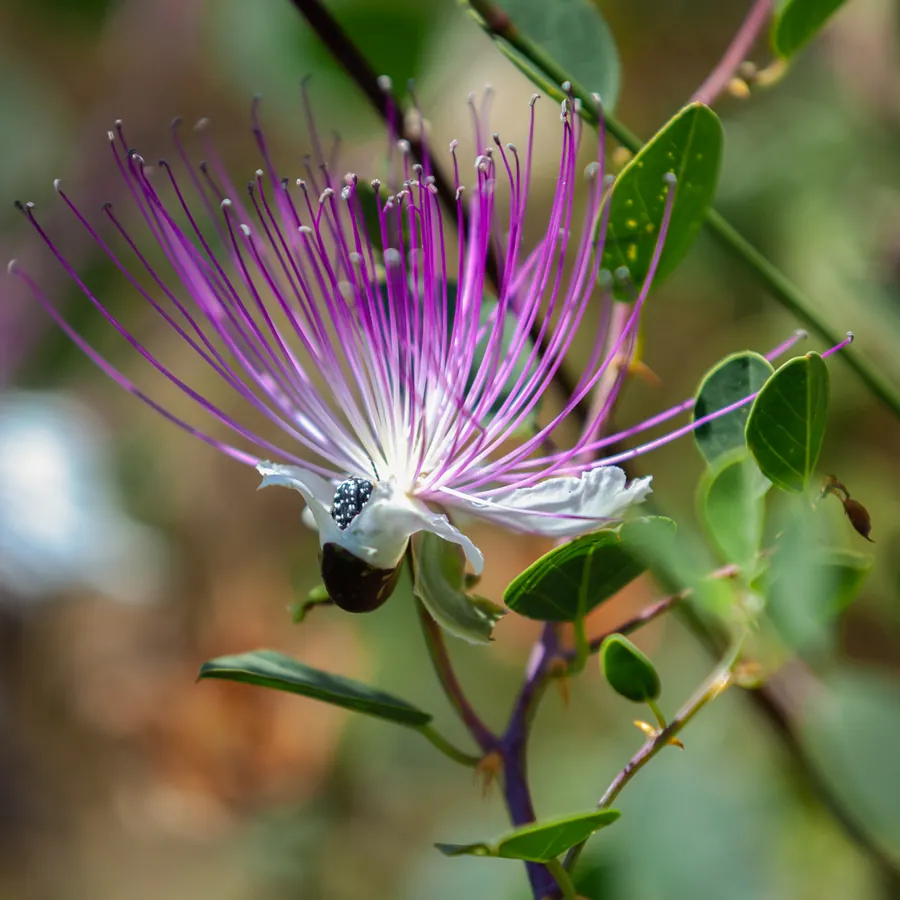
What Palestinian Arabic has no widespread separate folk name for is this particular species. That is not a gap in the language. It is what a lexicon built by use looks like: it names finely where people handle things, a dozen names for the caper, five kinds of za'atar, and coarsely where they do not. The pyramidal orchid is beautiful, and it is not a crop.
A name tells you what somebody needed to be able to say. It is not a measure of how much the plant matters.
Register 02Where it grows
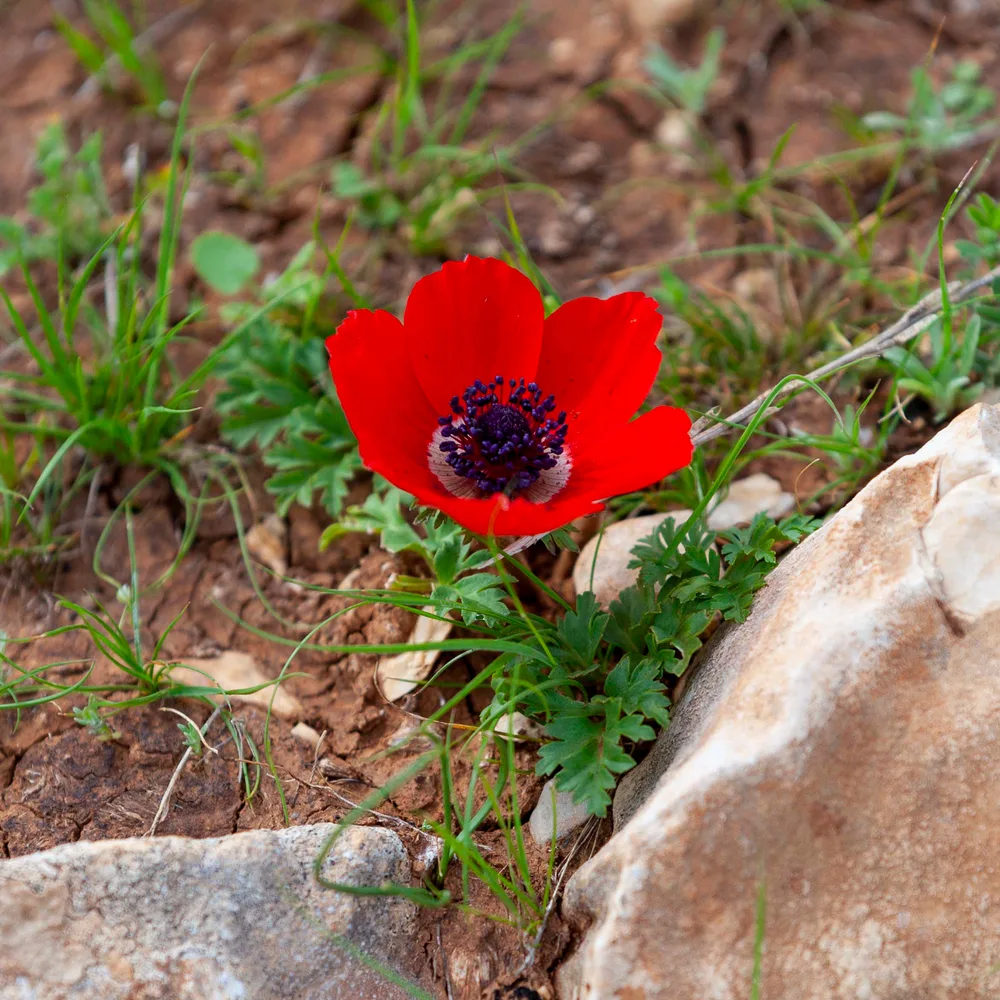
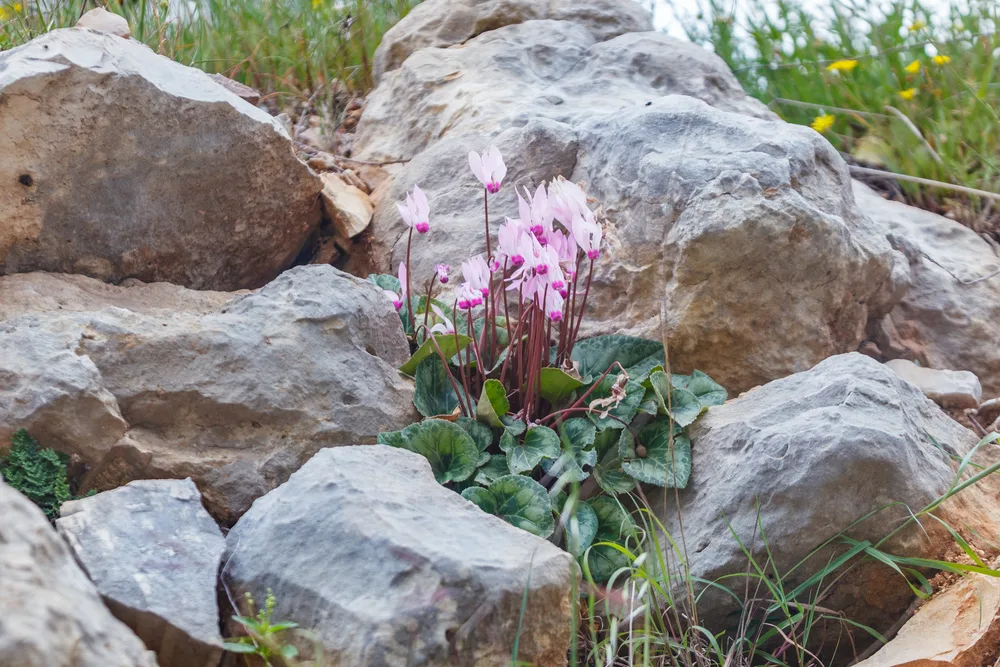
The pyramidal orchid comes up on thin limestone soils — open hillside, garrigue, rough grazing, the grassy shelves of old terraces and the strips between them, and flowers in the Palestinian spring, roughly March into May, after the anemones and alongside the tail of the cyclamen.
It grows as a single stem out of bare-looking ground, which is misleading: like all orchids it depends on fungi in the soil to establish, and it is slow. A flowering spike is the visible end of several years of underground work. That dependency is why orchids are so difficult to transplant, so slow to recover from disturbance, and so unforgiving of having the ground they are in ploughed, built on, or dug over.
Register 03How the flower works
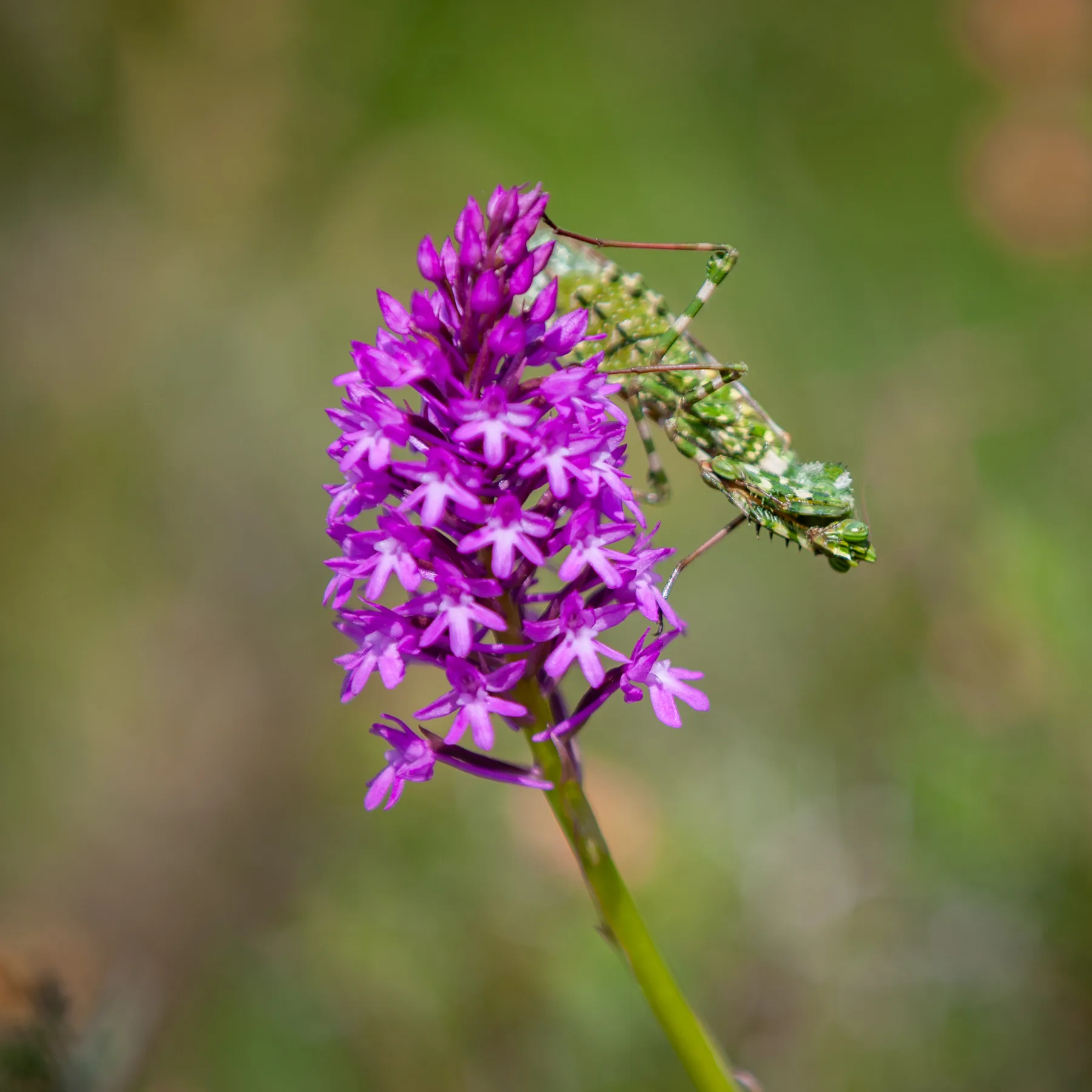
The spike is a dense cone of small magenta flowers, tightly packed, opening from the bottom up — a true pyramid early on that squares off into a column as the lower flowers age. Each individual flower carries a broad three-lobed lower lip with a pair of raised ridges running down it, which act as a guide rail, and a long slender spur trailing backwards from the flower.
That combination is a specification, not decoration. The narrow spur means the reward can only be reached by an insect with a long tongue, butterflies and day-flying moths, and the ridged lip steers the insect's tongue into precisely the right slot, where the pollen packets are waiting to be stuck onto it. The plant is manufacturing a runway.
The green bush-cricket on the spike in the photograph is not part of that arrangement. It is just there, on the best-lit object on the hillside.
Register 04Salep
The tubers are the reason the group has a name at all. Dried and ground, they yield a starchy flour that thickens milk into sahlab, drunk hot in winter across the eastern Mediterranean, and which is also the traditional stretch in Turkish-style ice cream. It is one of the very few uses of a wild orchid anywhere that operates at commercial scale.
The bill for that has now been quantified. A 2026 study in Current Biology by Susanne Masters, Margret Veltman and Abdolbaset Ghorbani sequenced DNA from salep in museum collections and in current markets spanning nearly two centuries, and identified which species the tubers actually came from. What it found:
- Salep was historically made predominantly from a single species, the early purple orchid (Orchis mascula), and is now made from a broadening mixture — including the green-winged orchid, Anacamptis morio, in the same genus as the orchid on this page.
- Tuber size has declined steadily across two centuries, regardless of species, which the authors describe as a classic symptom of overexploitation, because orchids are perennials whose tubers grow larger with age. Smaller tubers mean younger plants are being dug.
- Harvesting has spread into regions where salep is not traditionally drunk at all, and the diversity of salep on sale today exceeds what is locally available — meaning long-distance trade.
The authors' summary of the direction of travel is that traditional salep orchid populations are declining, pushing the trade onto new species and new territory (Masters and Veltman, The Conversation, April 2026).
This record has not found evidence of a commercial salep harvest in Palestine specifically, and does not assert one. What is documented is regional, and it is the reason the next register has to be written carefully.
Register 05What protection is for
Orchids are the textbook case for plant protection, and it would be dishonest to pretend otherwise. They are slow, fungus-dependent, dug up for a commodity, and measurably declining under that pressure. International trade in them is strictly regulated, and they form the largest plant family listed under the CITES convention. If any wild plant on a Palestinian hillside has a defensible case for legal protection, it is this one.
Which is exactly why it belongs in this record.
The pyramidal orchid falls under the same protected-plants regime that appears throughout this record: a scheme Israeli authorities enforce inside present-day Israel and extend into the occupied West Bank through the Civil Administration under military command — an instrument written by a legislature Palestinians cannot vote for and delivered through a military administration (see the hannun, Register 06).
And the enforcement record is the finding. The list runs to dozens of species. There is no recorded indictment for picking any of the protected ornamental species — not the anemone, not the narcissus, not the orchid. Every documented prosecution is for one of the three wild plants Palestinians eat: za'atar, akkoub and maryamiyya. Between 2004 and 2016, Israeli courts decided 61 za'atar and akkoub cases plus dozens more for sage, and every defendant was Palestinian, as the lawyer and researcher Rabea Eghbariah has documented (القدس العربي).
The orchid is the plant with the real conservation case, and it is the plant nobody has ever been charged over. That is not an argument against protecting orchids. It is the evidence that protection is not what the instrument is doing.
Read the two facts together and the shape is clear. A genuine conservation problem exists and is going unaddressed, while enforcement concentrates entirely on the plants one population gathers to eat. Set out plant by plant, with sources, in Under the Law.
Register 06Photographed before
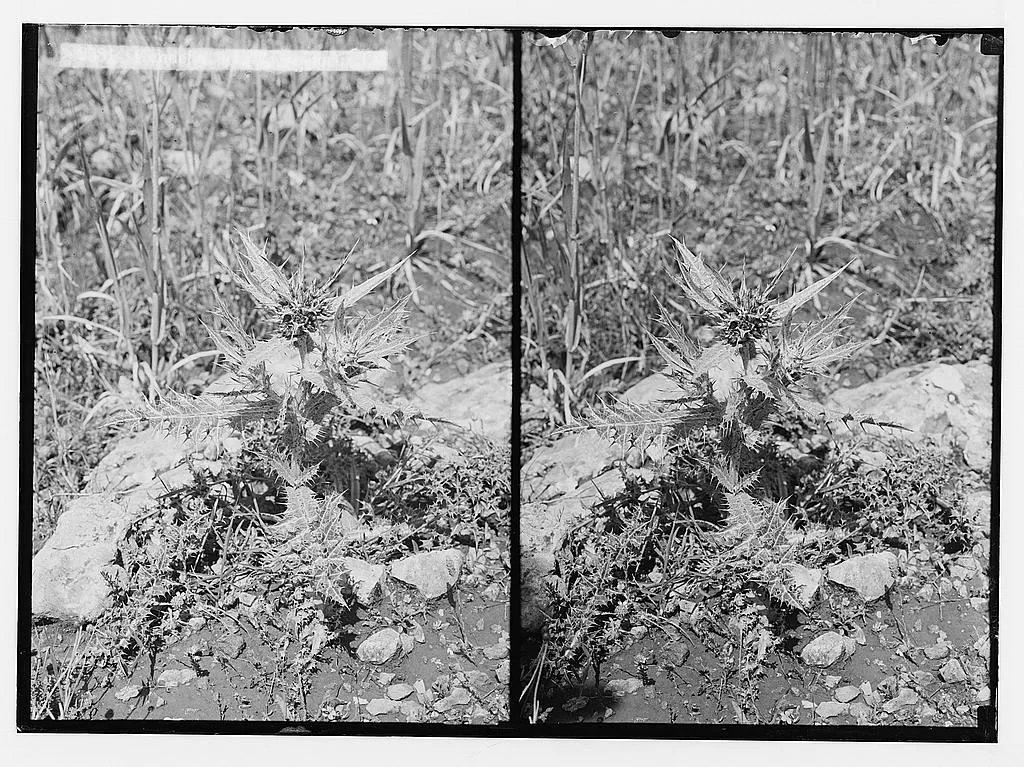
The American Colony Photo Department photographed this exact species, on this kind of ground, around 1900, and filed it in the series Wild Flowers of Palestine with the correct binomial and the parenthetical note “(Another view of orchid)” — the catalogue language of a working set, shot more than once, from more than one angle.
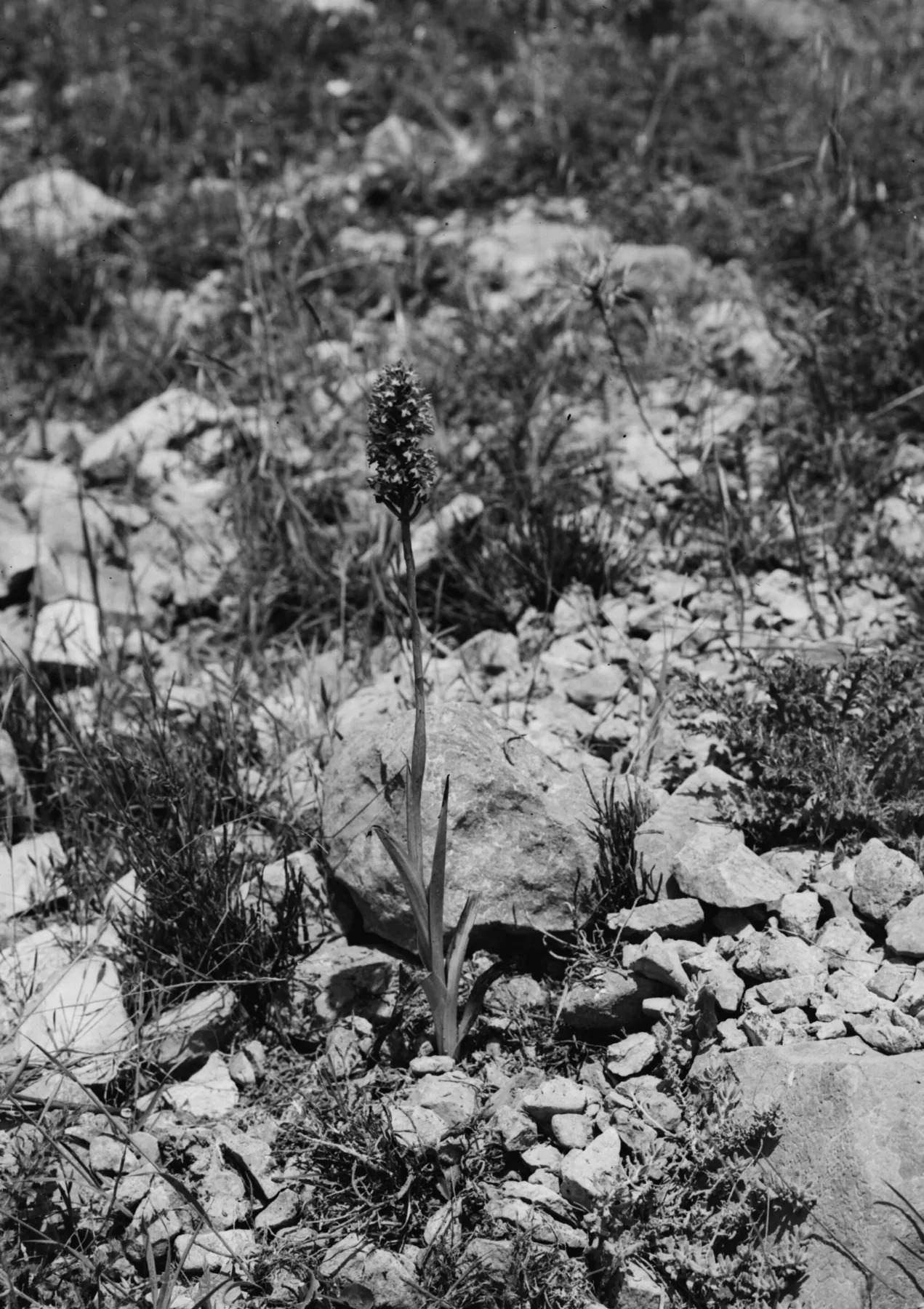
Library of Congress, Matson Collection, matpc.02402 · public domain · one half of a stereograph pair
A single spike, in flower, standing out of limestone rubble with the stones sharp in the foreground and the hillside falling away behind. Not a specimen on a cloth. The plant left where it was found.
Set it beside the photograph at the top of this page. Same species, same rock, the same decision to photograph the plant standing in its own ground rather than cut and carried indoors — a century and a quarter apart. The American Colony made these for sale to pilgrims and to a Western market that wanted the Holy Land. What the plate is, now, is evidence: dated, located, public-domain proof of what grew here and how densely.
The archive was assembled to illustrate somebody else's story about this place. It works just as well as a record of the place itself.
Sources
- Edible orchids are being overharvested in the Mediterranean — how to protect these astonishing blooms — Susanne Masters (Leiden University) and Margret Veltman (University of Oslo), The Conversation, 22 April 2026, reporting their study with Abdolbaset Ghorbani in Current Biology, 2026
- Molecular evidence reveals unsustainable harvest of wild orchids — Current Biology, 2026
- أرض الزعتر والعكوب الحزين: لماذا تجرّم إسرائيل قطف النباتات البرية؟ — القدس العربي، على بحث المحامي والباحث ربيع إغبارية
- Adalah: cancel the designation of za'atar and akkoub as protected plants — Adalah, the Legal Center for Arab Minority Rights
- “Wild flowers of Palestine. Anacamptis (Orchid) (A. pyramidalis (L.) Rich.)” — American Colony Photo Department, c. 1900 · Library of Congress, Matson Collection, matpc.02402