What is maramia?
Maramia is wild sage — Salvia fruticosa — the herb Palestinians put in the teapot. It is named after the Virgin Mary, it is the second most cited wild edible plant in the country, and gathering it is a criminal offence.
Updated · 6 registers · 12 sources cited
01The short answer
Maramia is مريمية — wild Mediterranean sage, Salvia fruticosa Mill., a grey-green woody sub-shrub of the mint family. Its dried leaves are dropped into a pot of black tea, or steeped alone, and drunk after food. It is the everyday hot drink of Palestinian houses, and it is not a speciality item: it grows wild on the hillsides, it is gathered in spring, and it is dried and kept for the rest of the year.
The English spelling moves around because the Arabic is being transliterated by ear — maramia, maramiya, maryamiyya, miramiyeh, marmariyya. They are one word. Canaan wrote it méramiyeh in 1928, and footnoted that around Tulkarm it also went by a second name he printed as sdjerah — from شجرة, “the shrub.” As in, the one you mean when you say a shrub.
| Maramia | Garden sage | |
|---|---|---|
| Species | Salvia fruticosa | Salvia officinalis |
| Arabic | مريمية | — |
| Older name | Salvia triloba | — |
| Where | Wild, eastern Mediterranean hillsides | Cultivated, northern Mediterranean |
| Leaf | Often three-lobed — a small leaf either side of the main one | Single, undivided |
| Used for | Tea, after food | Cooking, mainly with meat |
If a recipe or a shop says “sage” and means the tea, it means this plant, not the one in a European spice rack. The two are different species. Canaan's generation wrote it Salvia triloba — “three-lobed sage,” after the leaf. That is the same plant under a name botany has since retired: Salvia triloba L.f. is now carried as a synonym of Salvia fruticosa Mill. (GBIF; Plants of the World Online).
02Why it carries Mary's name
مريمية is built on مريم, Maryam — Mary. The plant is named after the Virgin. Why, exactly, was written down in Jerusalem in 1928 by the Palestinian physician Tawfiq Canaan, in the plant-lore paper this record keeps returning to:
“The méramiyeh is called after the Blessed Virgin. It is related how she once took a long walk in the heat of the summer. Sweating profusely she sat on a stone to rest. At her feet there was a salvia plant. She took a few of the leaves to wipe her forehead, and thereby this plant acquired its sweet perfume and is still honoured with the name of the Virgin.”
Canaan adds, in the same paragraph, that some peasants held the scent to be Eve's rather than Mary's, and gives the phrase he heard in the village of Artas: budi simmi rihit immik — “Take and smell the aroma of your mother” (Canaan, JPOS 8, 1928, p. 161).
And then a footnote, which is the part worth stopping on: “In many places the dead are deposited in the grave upon meramiyeh, which is also often placed over the grave.”
So the plant in the teapot is also the plant laid in the grave. That is not a symbolic flourish; it is a line of ethnographic record, written by a Palestinian doctor about the villages he practised in, and it puts maramia in the two most ordinary places a plant can be in a life — the afternoon and the burial.
A herb that scents a house every day and is laid under the dead at the end of it is not a garnish. It is infrastructure.
Canaan was not working alone here either. On this same page he credits his informants by name in the footnotes: Miss Baldensperger — Louise Baldensperger, who would co-write From Cedar to Hyssop four years later — and Mr. St. H. Stephan, Stephan Hanna Stephan, the Beit Jala scholar of the Jerusalem Circle. The knowledge on this page moved between named people in one small city, and they wrote it down.
03The Mary plants
Maramia is not the only plant in Palestine carrying Mary's name. There are at least three, and they are not related to each other botanically — they are related by whose name got attached to them.
| Arabic | Literally | Species | What it is |
|---|---|---|---|
| مريمية | Mary's own / Mary-like | Salvia fruticosa | The sage in the tea |
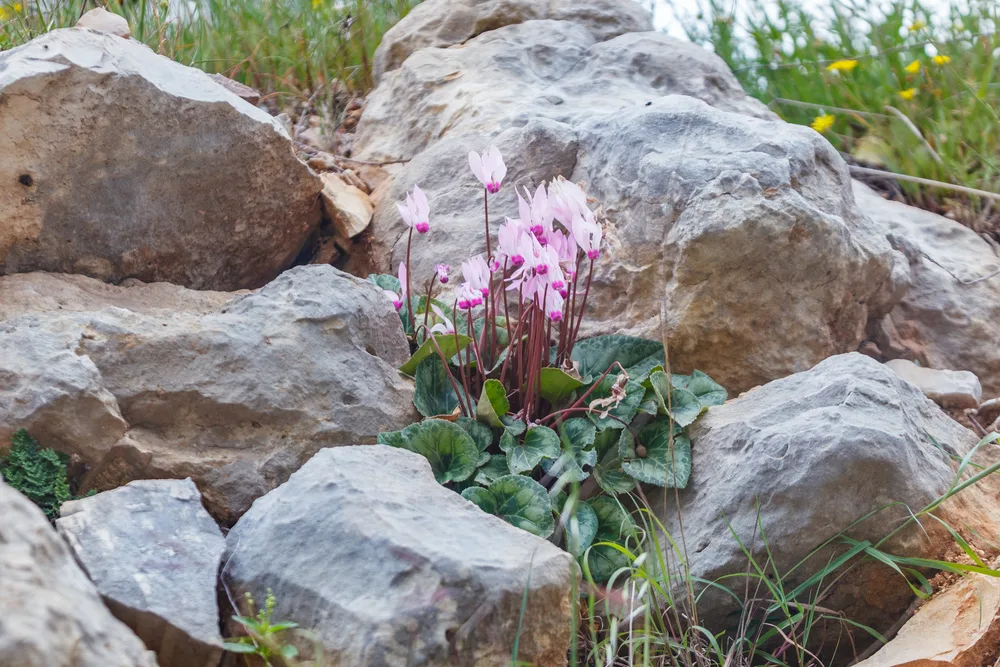
| بخور مريم | Mary's incense | Cyclamen persicum | The cyclamen in the rock crevices |
| كفّ مريم | Mary's palm — the hand | Anastatica hierochuntica | Sold to pilgrims as a “Rose of Jericho” |
Canaan corrected the record on the third one in 1928 and the correction never took. His footnote reads: “The rose of Jericho (Anastatica hierochuntica) is called kaff el-‘adrā, the palm of the Virgin. I do not know why Dalman (Arbeit, 54) translates it ‘sole of the Virgin.’” A Palestinian scholar telling a German one, in print, that he has the local name wrong — and the plant is still sold to pilgrims under a third name that is neither a rose nor from Jericho.
This record keeps meeting the same pattern: the name used internationally is not the name used on the ground, and the gap is never accidental.
It runs through the national flower, called the Gilboa iris in English and سوسن فقوعة — after the village on whose land it grows — in Arabic. It runs through the wild carrot filed under an English queen's needlework. And on this page it runs the other way for once, because maramia is the name that won: it is what the plant is called in the shops, on the packets and in the search box, and the Linnaean binomial is the one nobody uses.
04How much of the country actually uses it
This is usually asserted rather than counted. It has been counted.
In 2006 a team led by the Palestinian botanist Mohammed S. Ali-Shtayeh, of An-Najah University in Nablus and the Biodiversity and Environmental Research Center at Til, interviewed 190 people across fifteen communities in five districts of the northern West Bank — Nablus, Jenin, Salfit, Qalqilia and Tulkarm. The informants were 138 women and 52 men, aged between 30 and 95, average age 52. They recorded 100 wild edible plant species across 70 genera and 26 families (Ali-Shtayeh et al., Journal of Ethnobiology and Ethnomedicine, 2008).
Maramia came second of the hundred. Za'atar was cited by 150 of the 190 informants; Salvia fruticosa by 131.
| Rank | Plant | Species | Informants citing it |
|---|---|---|---|
| 1 | زعتر za'atar | Majorana syriaca | 150 |
| 2 | مريمية maramia | Salvia fruticosa | 131 |
| 3 | خبيزة khubeza | Malva sylvestris | 129 |
| 4 | زعمطوط cyclamen | Cyclamen persicum | 99 |
| 5 | عكّوب akkoub | Gundelia tournefortii | 99 |
The same paper sets those figures beside seven other Mediterranean countries surveyed by Hadjichambis and colleagues. Palestine's second-place plant is cited more than twice as often as any other country's first-place plant. Greece's most-quoted wild edible was named 53 times, Italy's 50, Albania's 40, Morocco's 37, Egypt's 29, Cyprus's 17, Spain's 15. Maramia: 131.
Ali-Shtayeh's team also recorded what is happening to the practice: 49% of the plants are gathered and preserved for the year, maramia among them, and the habit is “still alive in the PA, but is disappearing” as younger people lose the knowledge needed to identify and process the species. That last sentence was published in 2008. The enforcement regime described below began in earnest afterwards.
05The plant the photographers missed
Between roughly 1900 and 1920 the American Colony photographers in Jerusalem made a series of 166 glass plates called Wild Flowers of Palestine. It is the most complete photographic record of this flora from that period, and this record has used it on nearly every page.
It contains two plates of sage. Neither is maramia.
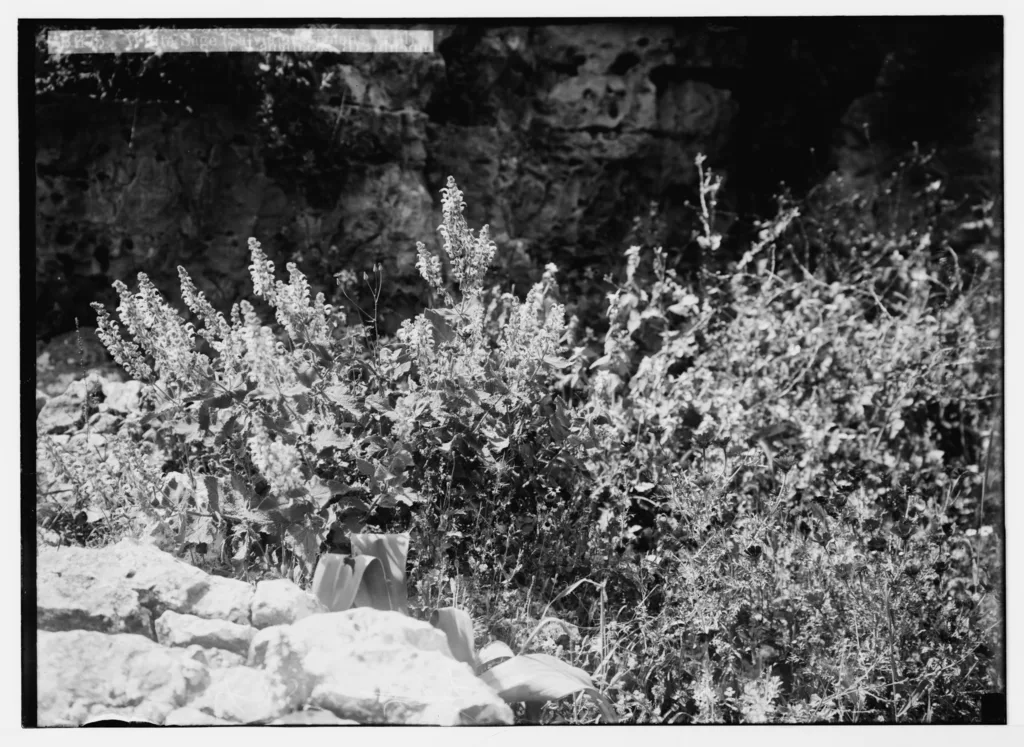
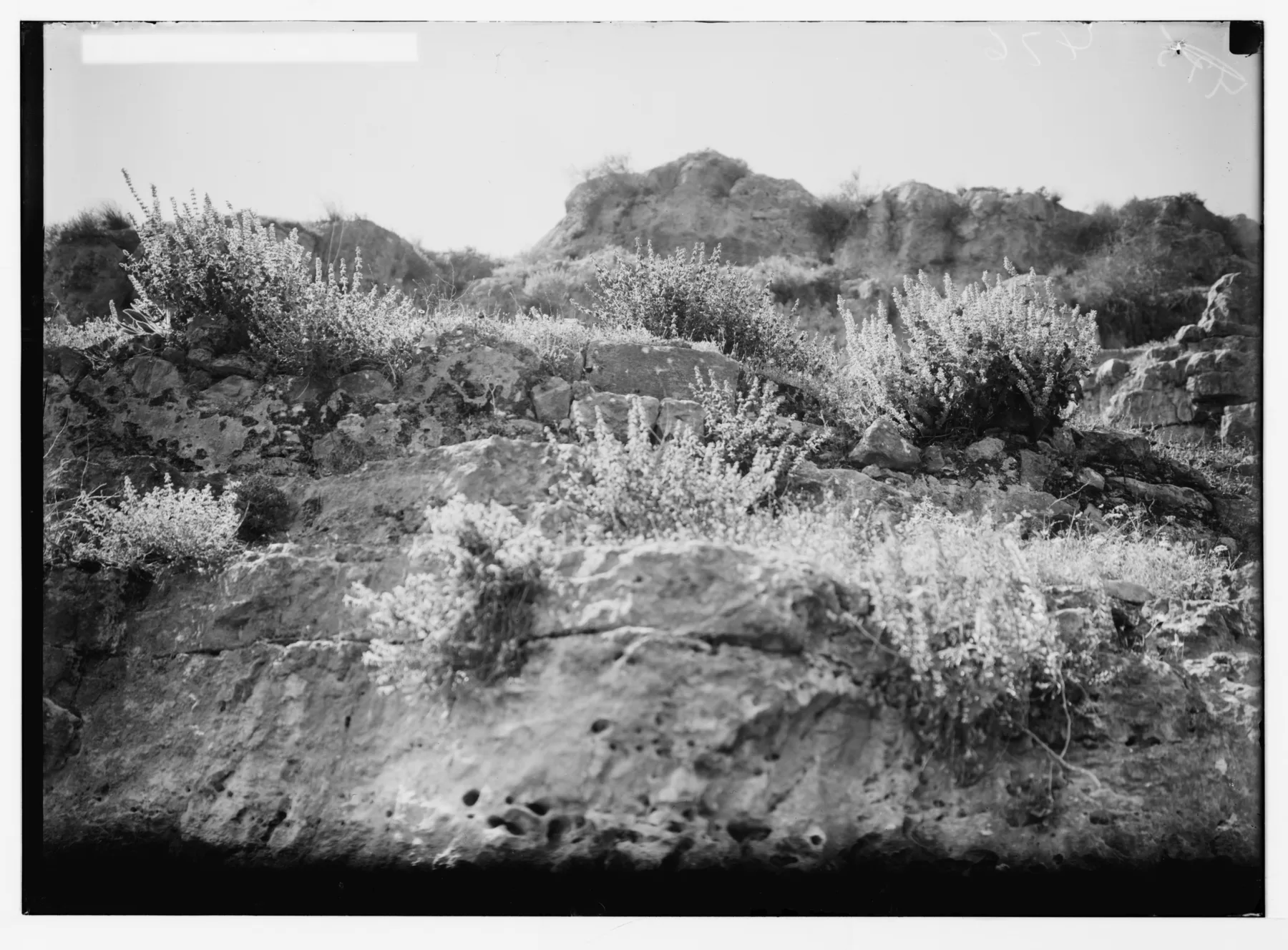
Both plates — the specimen above and the hillside at the top of this page — were catalogued as white sage, Salvia graveolens Vahl. That name is now a heterotypic synonym of Salvia dominica (POWO), a tall, showy, strong-smelling sage that nobody makes tea from. No plate of Salvia fruticosa appears in the series as mirrored on Wikimedia Commons — and if one exists uncatalogued, this record has not found it and says so rather than rounding the claim up.
So the survey photographed a sage. It photographed the one that looked like a wildflower — white spires, dramatic against rock — and left out the grey, low, unphotogenic sub-shrub that 131 of 190 Palestinians would later name as one of the two most important wild plants in their food.
The colonial-era record of this flora is not short on skill. It is short on the question what is this for. A camera that selects for what looks like a flower will miss the plant that everybody actually uses, every single time.
This is the same finding the archival register on Record 09 arrives at from the other direction: the difference between the two bodies of work is the filing, not the method.
06And it is an offence to pick it
Maramia is on the Israeli protected-plants list, and Palestinians have been fined and indicted for gathering it. It is one of three plants at the centre of that enforcement, with za'atar and akkoub. Adalah, the Legal Center for Arab Minority Rights, documented 26 indictments and 151 fines in the three years 2016–2018 (Adalah). The full instrument, the legal challenge and the enforcement record are set out on Under the Law.
Set the two datasets on this page against each other and the result is not subtle.
Of the hundred wild edible plants recorded across the northern West Bank, the three that are criminalised to gather rank first, second and joint-fifth. Za'atar 150, maramia 131, akkoub 99. The protected list did not catch three obscure plants. It caught the top of the list.
| Plant | Rank of 100 | Cited by | Status |
|---|---|---|---|
| زعتر za'atar | 1st | 150 / 190 | Prosecuted |
| مريمية maramia | 2nd | 131 / 190 | Prosecuted |
| عكّوب akkoub | =5th | 99 / 190 | Prosecuted |
| الحنون anemone | Not edible | — | No indictment recorded |
| سوسن فقوعة the national flower | Not edible | — | No indictment recorded |
This record calls that pattern the ornamental exemption: the flowers a state puts on its emblems are protected in name, and the plants a people puts in its food are protected in enforcement. Only one of those produces a court file. Maramia is the clearest case of it on the whole site, because it is the plant with the widest, best-measured, most domestic use of any on the protected list — and it is a tea.
There is a film of the enforcement. The Palestinian artist Jumana Manna spent years following the akkoub and za'atar prosecutions into the courtroom for Foragers (2022). Her summary of the legal position — “an ecological veil for legislation that further dispossesses them from their land” — is quoted in full on Under the Law.
Ali-Shtayeh's informants said in 2008 that the knowledge was disappearing on its own. It is now also illegal to practise. Those are two different losses arriving at the same plant from opposite directions.
Sources
- M. S. Ali-Shtayeh, R. M. Jamous, J. H. Al-Shafie‘ et al., “Traditional knowledge of wild edible plants used in Palestine (Northern West Bank): A comparative study,” Journal of Ethnobiology and Ethnomedicine 4:13 (2008) — the 190 informants, fifteen communities, five districts, 100 species, the citation counts in Table 3 and the eight-country comparison; read in full at source via the Europe PMC full-text API. An-Najah University, Nablus, and the Biodiversity and Environmental Research Center (BERC), Til. Open access. Palestinian-authored.
- T. Canaan, “Plant-lore in Palestinian Superstition,” JPOS 8 (1928): 129–168 — p. 161 and its footnotes: the Virgin and the salvia leaves, the aroma of Eve and the phrase heard at Artas, the burial use, the Tulkarm name shajarah, the kaff el-‘adrā correction to Dalman, and the credits to Miss Baldensperger and Mr. St. H. Stephan. Read at source. Palestinian-authored — see the Jerusalem Circle.
- Adalah — The Legal Center for Arab Minority Rights in Israel — 26 indictments and 151 fines, 2016–2018, and the 2019 demand that the designations be cancelled. Palestinian legal centre.
- Foragers (2022), dir. Jumana Manna — 64 minutes, in Arabic; the prosecutions filmed from inside the courtroom. Palestinian artist.
- Plants of the World Online — Salvia fruticosa Mill. — Royal Botanic Gardens, Kew: accepted name, and Salvia triloba as the retired one
- Plants of the World Online — Salvia graveolens Vahl — recorded as a heterotypic synonym of Salvia dominica L.; this is what establishes that the Matson “white sage” plates are not maramia. Checked directly against the POWO API.
- Salvia fruticosa Mill. — GBIF 6412283 — accepted, Lamiaceae; verified via api.gbif.org, which also returns Salvia triloba L.f. as a synonym of this species and Salvia graveolens Vahl as a synonym of Salvia dominica
- “Wild flowers of Palestine. White sage (Salvia graveolens Vahl),” LOC matpc.05852 — American Colony Photo Department, c. 1900–1920. Library of Congress, Matson Collection; public domain. Retrieved through the Wikimedia Commons mirror, because loc.gov blocks scripted access.
- “Wild flowers of Palestine. Field of white sage,” LOC matpc.05853 — the same series and the image at the top of this page; public domain
- Salvia fruticosa — Wikidata Q864698 — entity identifiers, cross-checked against GBIF, POWO and iNaturalist
- The protected-plants instrument, the Palestinian legal challenge and the wider enforcement record are set out on Under the Law; the hundred gathered species and how they are eaten on Edible.
- مريمية and every other plant name in this record, Arabic to English and back: the plant-names index.
._LOC_matpc.05852.jpg)
