Is the poppy the national flower of Palestine?
No. Palestine's national flower is the Faqqua iris, adopted in 2016. And the red flower people call the Palestinian poppy is not a poppy: it is the anemone, الحنون.
Updated · 5 registers · 9 sources cited
01The short answer
Palestine has a designated national flower and it is not a poppy. The Palestinian Council of Ministers adopted the Faqqua iris, سوسن فقوعة, Iris haynei, in 2016 on the recommendation of the Environment Quality Authority. That decision, its history and the second flower Palestinians actually invoke are set out on the national flower page.
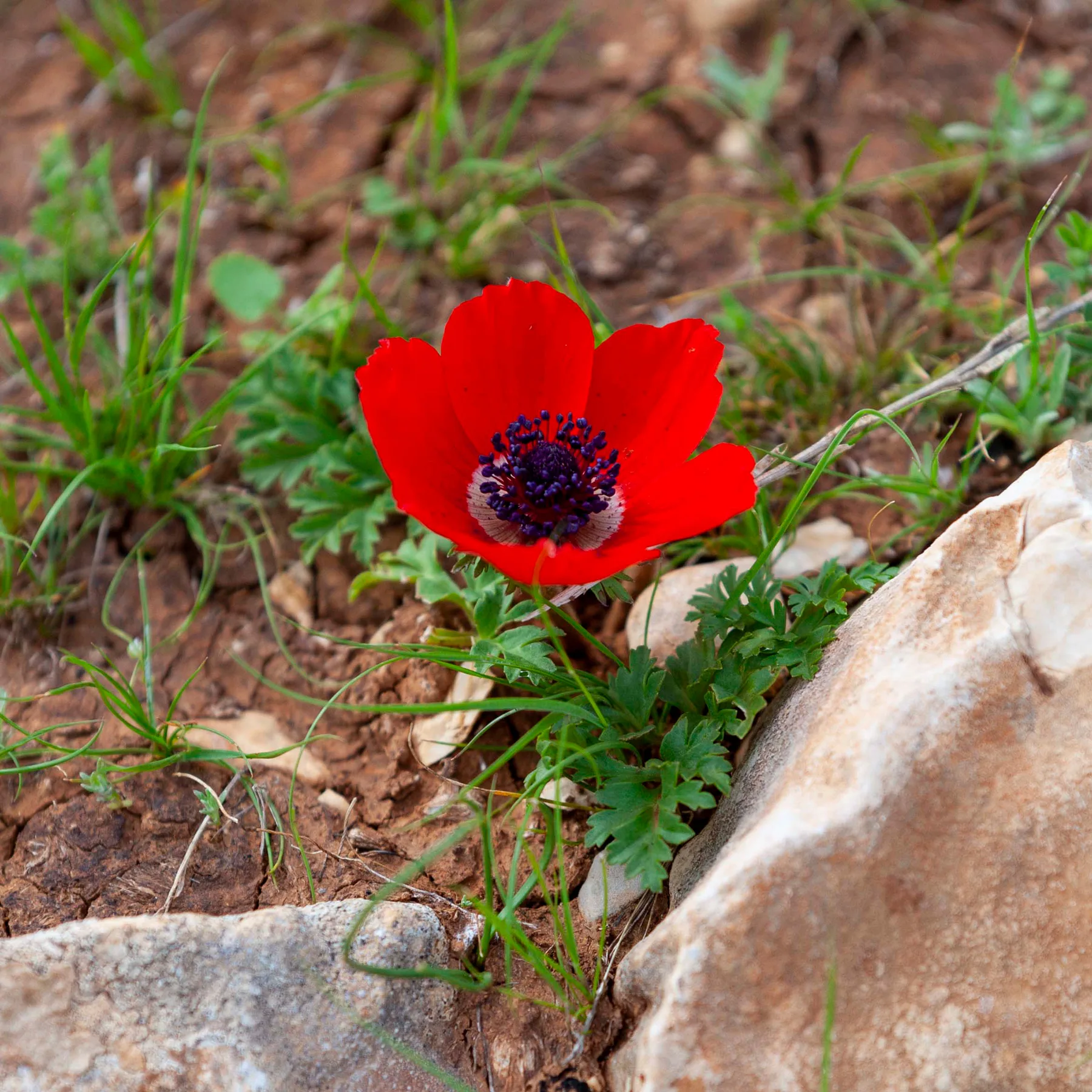
The second half of the answer is the part that surprises people. The red flower that appears in Palestinian poetry, on embroidery, on posters and on the tote bag sold as a “Palestinian poppy” is almost never a poppy. It is Anemone coronaria, الحنون, the hannun, and it belongs to the buttercup family, Ranunculaceae. True poppies are Papaveraceae. The two families are not close relatives.
Both halves of this can be true at once, and both are: the poppy is not the national flower, and the flower being called a poppy is not one.
02How to tell them apart
Both are scarlet, both are about the same size, and both come up in spring across the same hillsides. One feature separates them at a glance.
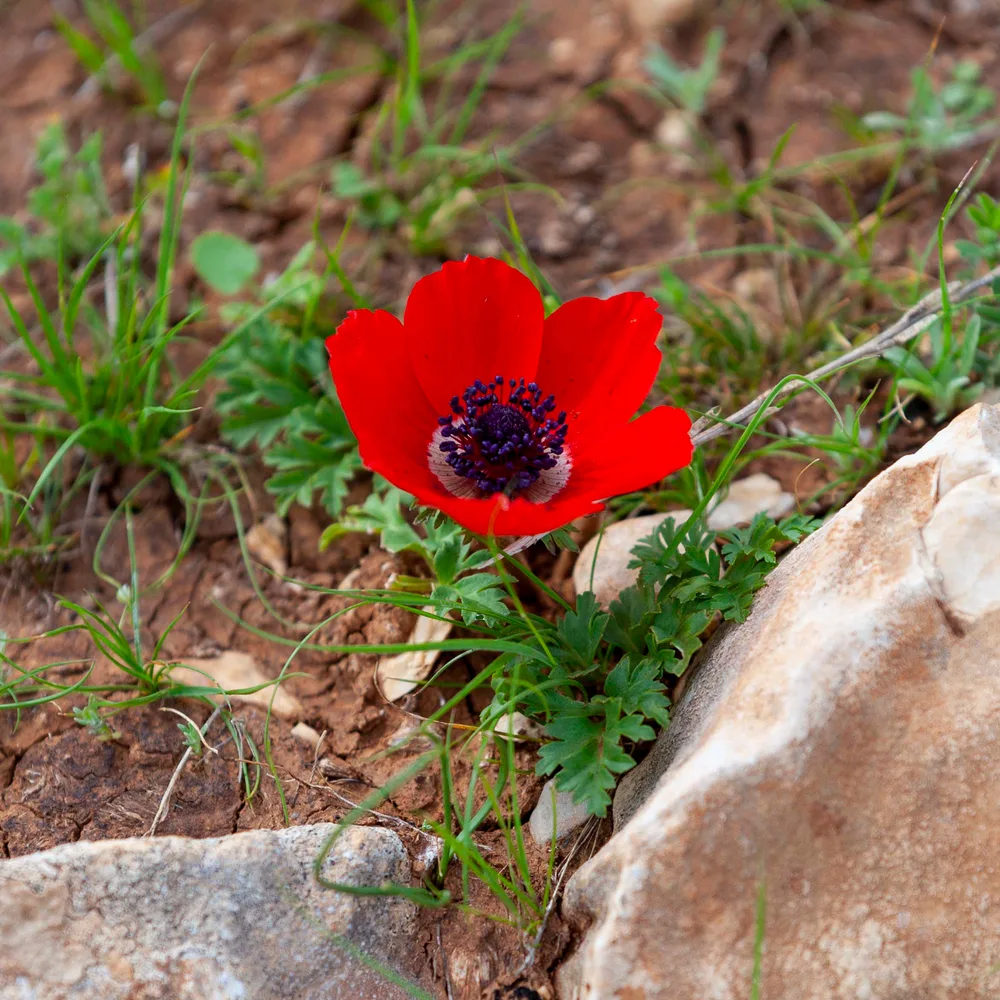
Look at the centre. The anemone has a solid black boss of stamens, a dark disc you can see from several metres away. A true poppy has a pale centre with dark blotches at the base of each petal.
| Anemone | True poppy | |
|---|---|---|
| Arabic | الحنون | الخشخاش |
| Species | Anemone coronaria | Papaver rhoeas |
| Family | Ranunculaceae | Papaveraceae |
| Centre | Solid black disc of stamens | Pale, with dark basal blotches |
| Petals | Usually 5–8, firm | 4, thin and crumpled like tissue |
| Stem and bud | Smooth, upright bud | Bristly, nodding bud that lifts as it opens |
| Season | From December, peaking February–April | Later in spring |
The crumpled petal is the second reliable check. A poppy petal looks like tissue paper that has been folded in a bud and never quite recovered, because that is exactly what happened to it. Anemone petals open flat and firm.
If a photograph shows a red flower with a black centre and firm petals, it is an anemone, whatever the caption says.
03The poppies that really do grow here
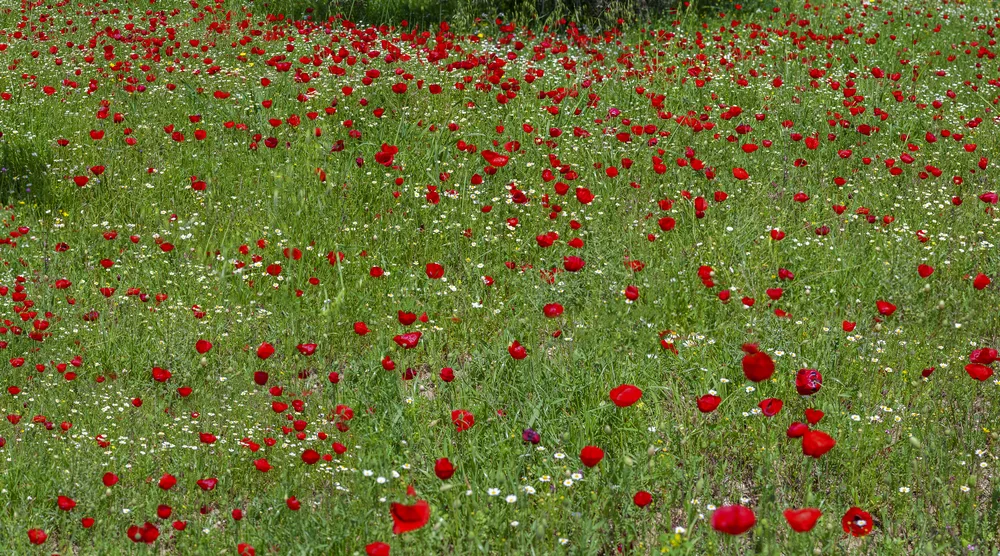
Real poppies grow in Palestine, and they are genuinely red. The commonest is Papaver rhoeas, the corn poppy, خشخاش منثور, the same species that grows through cereal fields across the Mediterranean and western Europe. It appears later in the season than the anemone, often at field edges and on disturbed ground.
Because the two overlap in colour and in place, a spring hillside can carry both, and a photograph taken in April can contain both. Nothing about the correction on this page says poppies are absent. It says the flower that carries the national symbolism is a different plant.
04Why the mistake keeps spreading
Three things feed it, and none of them is carelessness by Palestinians.
English has a habit of calling any red field flower a poppy. The First World War fixed Papaver rhoeas in English as the red flower of remembrance and loss. A writer reaching for a red flower that stands for the dead reaches for the word poppy, and the word arrives before the botany does.
The Arabic name does not travel. الحنون has no English equivalent in common use. “Anemone” is a shop word for a cut flower, and it carries none of what hannun carries, so translators substitute a word that carries something.
And the error copies cleanly. Pages answering “what is the national flower of Palestine” frequently give the poppy, and each new page repeats the last. The claim spreads because it is short, plausible and already written down, which is the same reason a correction has to be equally short and carry a source.
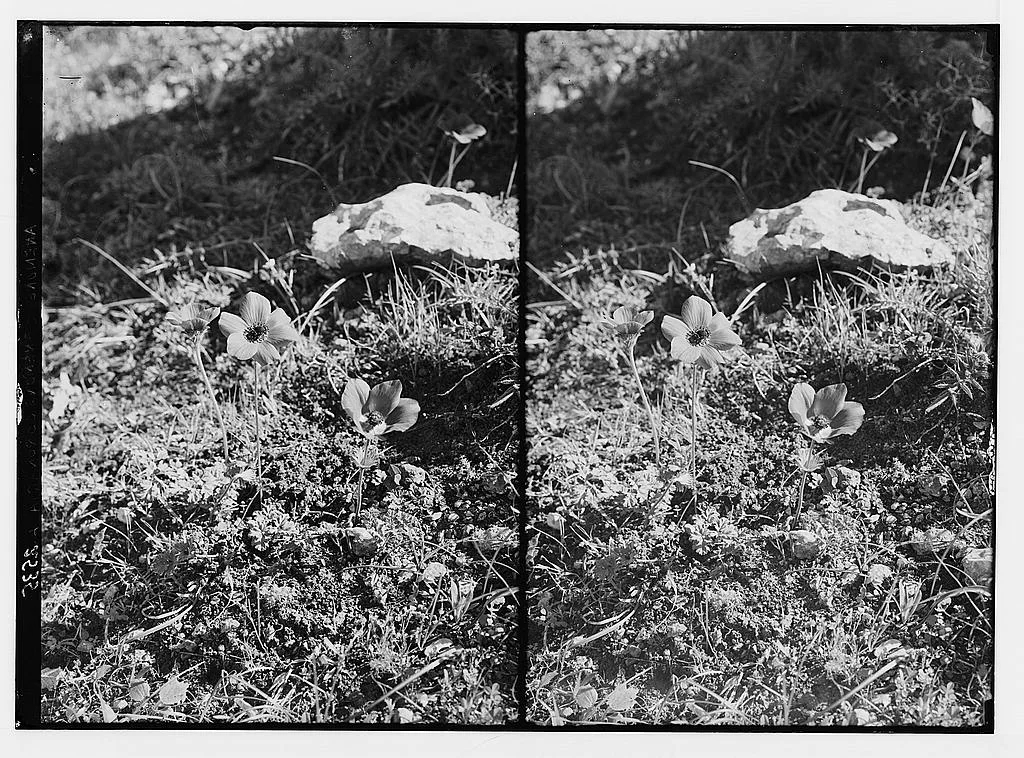
Set against that, the Palestinian record is specific. The Palestinian physician Tawfiq Canaan entered the plant in 1928 as Anemone coronaria, gave its classical Arabic name شقائق النعمان, and treated it as the marker of April. He was writing about the flower people meant, and he named it correctly.
05Why the correction is worth making
Getting this right is not pedantry about families and stamens.
The anemone's meaning is built into its Arabic name, and the poppy's is borrowed. شقائق النعمان, shaqa'iq an-Nu'man, carries النعمان, an old Arabic word for blood. The flower was carrying blood and return in this specific ground long before there was a national movement to attach it to. Calling it a poppy imports a European war memorial and drops a Palestinian one.
The full weight of that name, its Canaanite and Phoenician layer and its use in mourning, is set out on Record 01, which is where this record keeps it.
There is also a practical consequence. Someone searching for the plant under the wrong name will not find the Arabic material about it, will not find what it is called where it grows, and will not find out that it is toxic and not eaten. A wrong name is a dead end in a catalogue.
Sources
- Imad Atrash and Maha Abu Gharbieh, “The National Flower of Palestine: Faqqua Iris,” This Week in Palestine — the 2016 Council of Ministers designation on the Environment Quality Authority's recommendation. Atrash is executive director of the Palestine Wildlife Society. Palestinian-authored.
- T. Canaan, “Plant-lore in Palestinian Superstition,” JPOS 8 (1928): 129–168 — the anemone as the April marker and the classical name شقائق النعمان; read at source. Palestinian-authored.
- Anemone coronaria L. — GBIF 3033261 — accepted name, family Ranunculaceae; verified via api.gbif.org
- Papaver rhoeas L. — GBIF 2888443 — accepted name, family Papaveraceae; verified via api.gbif.org
- Papaver rhoeas — Wikidata Q130201 — for the Arabic name خشخاش منثور
- Anemone coronaria — Wikidata Q511179 — entity identifiers, cross-checked against GBIF
- Papaver rhoeas — for the remembrance-poppy association in English usage and the crumpled-petal morphology
- The anemone's Arabic naming, its Canaanite substrate and its use in mourning are set out in full on Record 01; the national flower and its adoption on this page.
- The other thing this flower gets called, and whether the Bible meant it: what the “lily of the field” is.