What is the “Wild Flowers of Palestine” series?
It is a photographic survey of this flora made in Jerusalem by the American Colony Photo Department, roughly 1900 to 1920. This record counted 119 plates in it. Not one of them carries a word of Arabic.
Updated · 6 registers · counted at source
01What the series is
The American Colony Photo Department was a commercial photographic studio in Jerusalem, run by members of a Christian utopian community that settled in the city in 1881. Its photographers worked across Palestine for roughly half a century, and the negatives now sit in the Library of Congress as the Matson Photograph Collection, some 22,000 items covering 1898 to 1946.
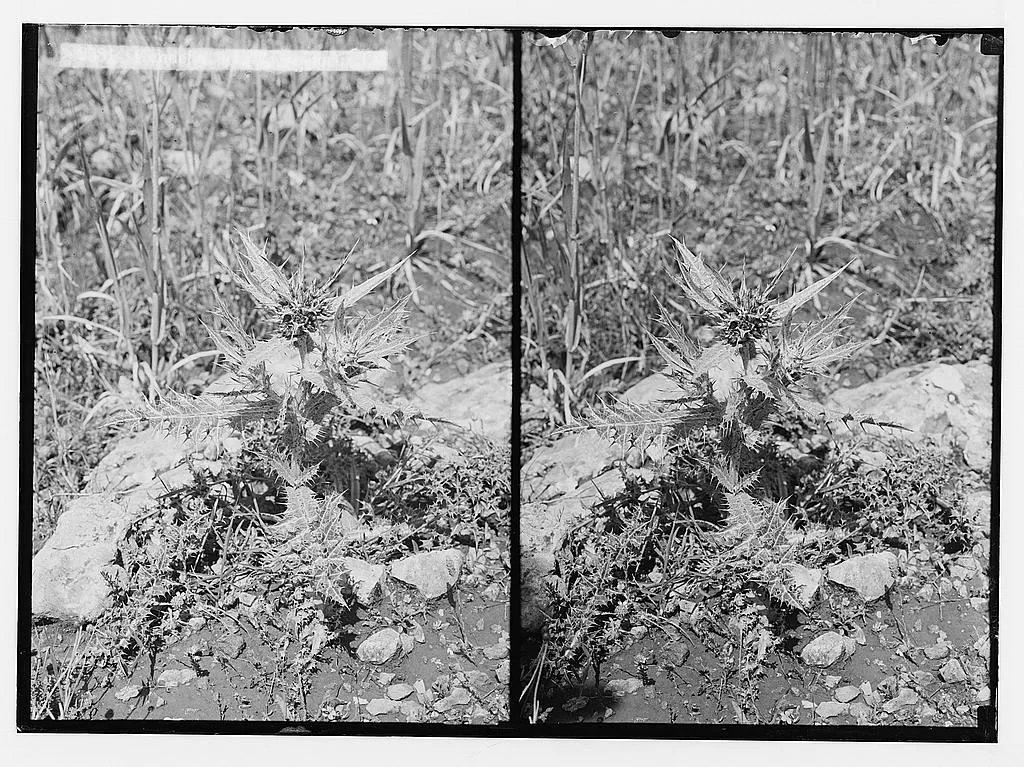
Inside that collection is a run of plates captioned Wild Flowers of Palestine. They are careful photographs. Some are specimens cut and pinned to a board in the studio; others are captioned “taken in their natural settings” and show the plant where it grew. Several were shot as stereographs, two near-identical frames side by side for a viewer that produced an illusion of depth.
The series is the most complete photographic record of this flora from the period, and this record has used it on nearly every page. It is also the reason this page exists: a survey that thorough is worth counting, because what a survey leaves out is a fact about the survey.
02The count
On 24 August 2026 this record queried the Wikimedia Commons mirror of the Matson
Collection for every file whose title begins Wild Flowers of Palestine, and counted
119 distinct plates by their matpc catalogue numbers. Every caption was then read
for script and for names.
Not one of the 119 plates carries a word of Arabic.
Not one Arabic character appears in any caption in the series. Neither does a transliterated Palestinian plant name: no za'atar, no akkoub, no khubeza, no maramia. Seventy-one of the captions carry a Linnaean binomial in brackets. The rest carry an English common name and nothing else.
| Counted in the series | Number |
|---|---|
| Distinct plates | 119 |
| Captions containing Arabic script | 0 |
| Captions containing a transliterated Arabic plant name | 0 |
| Captions carrying a Linnaean binomial | 71 |
| Captions built on a scriptural phrase | 7 |
03The plants it never photographed
In 2006 a team led by the Palestinian botanist Mohammed S. Ali-Shtayeh interviewed 190 people across fifteen communities of the northern West Bank and ranked 100 wild edible plants by how many people named them. Set that ranking beside the plate list.
| Rank | Plant | Species | In the series? |
|---|---|---|---|
| 1 | زعتر za'atar | Majorana syriaca | Absent |
| 2 | مريمية maramia | Salvia fruticosa | Absent |
| 3 | خبيزة khubeza | Malva sylvestris | Yes, as “Wood-mallow” |
| 4 | بخور مريم | Cyclamen persicum | Yes, twice |
| =5 | عكّوب akkoub | Gundelia tournefortii | Yes, as “Gundelia” |
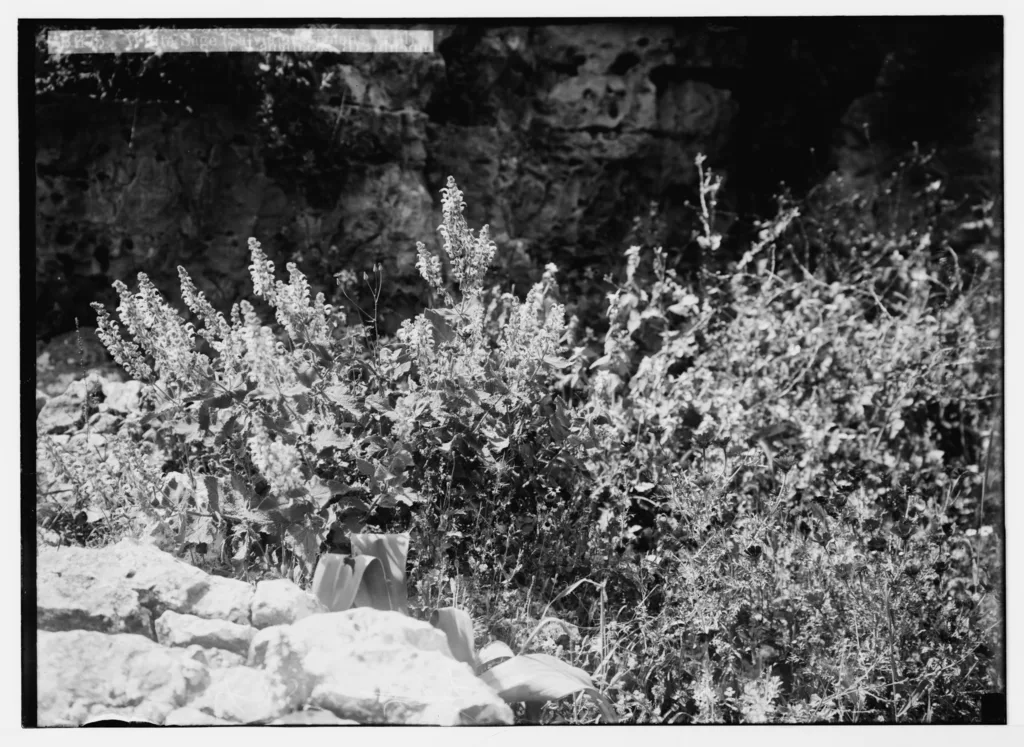
The two plants Palestinians name most often are the two the survey never photographed. Za'atar was named by 150 of 190 people and does not appear. Maramia was named by 131 and does not appear, though the series does contain two plates of a different sage. Wild fennel, شومر, is absent as well.
The three that do appear are filed under an English name or a bare genus. A reader of this catalogue in London in 1910 could not have learned from it that any of these plants was eaten, or by whom, or what it was called by the people who ate it.
04Scripture as a filing system
Seven captions in the series name the plant out of the Bible rather than out of the country.
Whether the Bible actually meant this plant is a separate question, and the Greek does not settle it: what the “lily of the field” is.
- “Lily of the field” for Anemone coronaria, twice. In Arabic the flower is الحنون.
- “Rose of Sharon” for Narcissus tazetta, twice.
- “Bethlehem-star” for Ornithogalum fimbriatum.
- “Jerusalem sage” for Phlomis viscosa.
- “Pheasant's eye” for Adonis autumnalis, carrying the Greek myth instead.
The King James phrase is doing the work of a plant name. A buyer in New York knew what a lily of the field was, having read about it, and would not have known what a حنون was. The captions were written for that buyer.
The photographers were standing in a country where every one of these plants already had a name. They wrote down the one their customers would recognise.
This record has met the same pattern on nearly every page it has built, and it reaches the national flower itself, filed in English under a mountain range and in Arabic under the village on the same ridge.
05The studio is in the frame
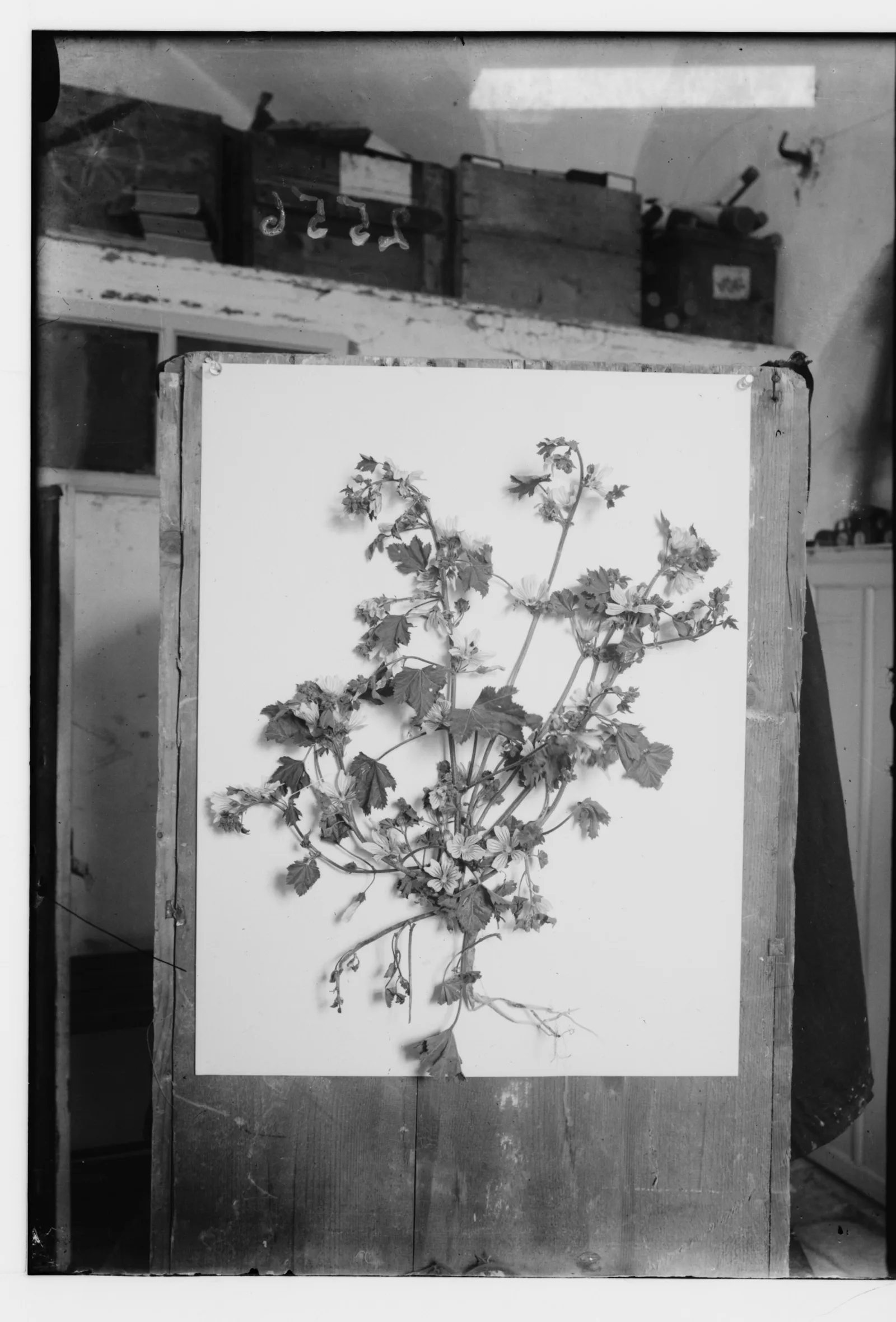
The mallow plate at the top of this page was made indoors. The specimen is pinned flat to a white board, the board is propped against a wooden bench, and behind it are storage crates on a shelf, a window and a hanging cloth. Nothing is hidden. The photograph is a record of an object on a table.
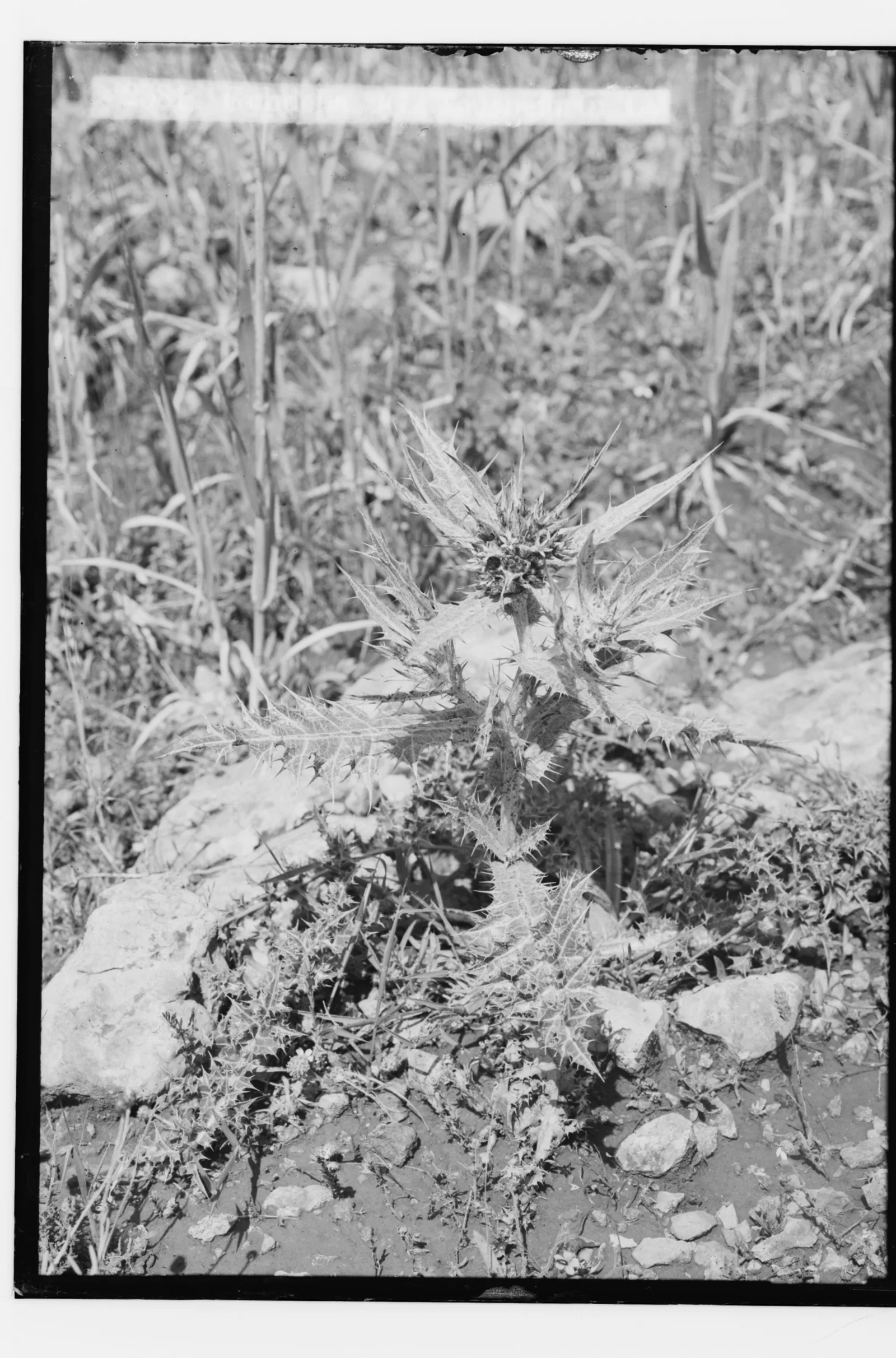
Both methods appear across the 119 plates, and both are careful. This matters because the difference between that body of work and the photographs on this site is not skill and not equipment.
The difference is the filing. A plate captioned “Gundelia (G. Tournefortii L.)” and a page headed عكّوب can hold the same plant, photographed with the same care, and answer different questions. One tells you what the specimen is. The other tells you it is food, when it is gathered, and that gathering it has put people in court.
06How to see it yourself
The plates are public domain and free to view. They are held by the Library of Congress in the Matson Photograph Collection, and mirrored in full resolution on Wikimedia Commons with their catalogue metadata intact.
A practical note, because it cost this record time. loc.gov refuses
automated requests and refuses browsers without a full profile, so a script pointed at the
Library of Congress returns nothing useful. The Wikimedia Commons mirror answers a plain API
call and carries the same images at the same resolution. Search Commons in the File namespace
for intitle:"Wild flowers of Palestine" and the series comes back.
Read the catalogue numbers. Each file name ends in a matpc
number, and that number is the stable identifier at the Library of Congress. The mallow above
is matpc.02428; the akkoub is matpc.02449. Cite the number rather than the file name, which
changes.
Several plates in the series are stereographs. If a plate looks like the same picture twice, it is: crop to one frame.
loc.gov blocks the tools used here, so it does not assert a figure for the complete series. See
how this record is made.
Sources
- Wikimedia Commons — Wild Flowers of Palestine, Matson Collection mirror — the 119 plates counted here, queried via the Commons API on 2026-08-24. Full resolution, public domain, catalogue metadata intact.
- Library of Congress — Matson (G. Eric and Edith) Photograph Collection — the holding institution; ~22,000 items, 1898–1946. Cited, not machine-read: loc.gov refuses scripted access.
- “Wood-mallow (Malva sylvestris L.),” matpc.02428 — the studio plate at the top of this page; public domain
- “Gundelia (G. Tournefortii L.),” matpc.02449 — the field plate in Register 05; public domain
- M. S. Ali-Shtayeh, R. M. Jamous, J. H. Al-Shafie‘ et al., “Traditional knowledge of wild edible plants used in Palestine (Northern West Bank),” J. Ethnobiol. Ethnomed. 4:13 (2008) — the ranking in Register 03: 190 informants, 100 species, per-plant citation counts. An-Najah University and BERC, Til, Nablus. Palestinian-authored.
- The American Colony, Jerusalem — for the community's founding date and the Photo Department's history
- The naming asymmetry this page counts is set out plant by plant across the record, and reaches the national flower on this page.
_LOC_matpc.02428.jpg)
._LOC_matpc.02449.jpg)