What is the lily of the field?
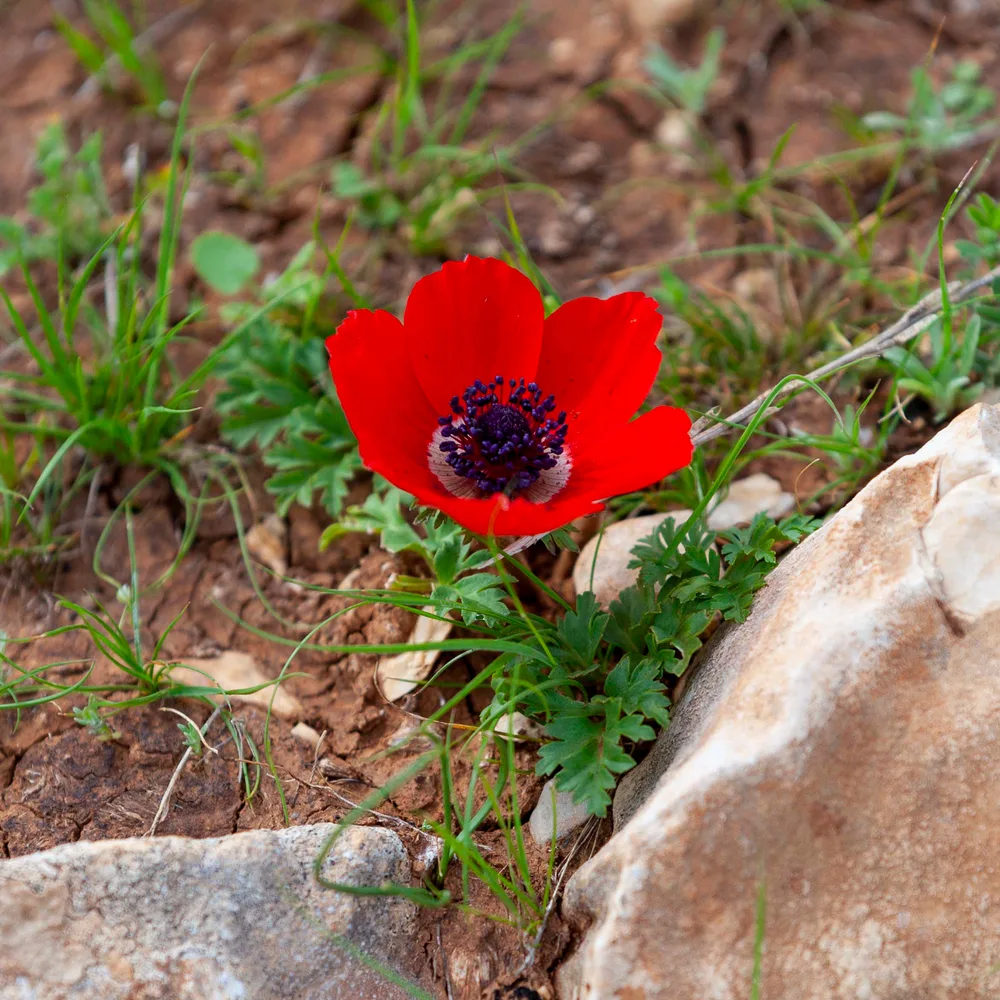
It is not a lily, and the verse never says it is. The Greek of Matthew 6:28 reads krina tou agrou — showy flowers of open country — and names no species at all. The plant most often meant is the scarlet anemone that covers Palestinian hillsides every spring, and which Palestinians call الحنون.
Published · 5 registers · 10 sources cited
01The short answer
There is no botanical answer in the text, because the text does not give one. Matthew 6:28 reads katamathete ta krina tou agrou — consider the krina of the field. Krinon is a Greek word for a showy flower. It is not the name of a genus, and Greek in the first century was not doing the job that Linnaean binomials do now.
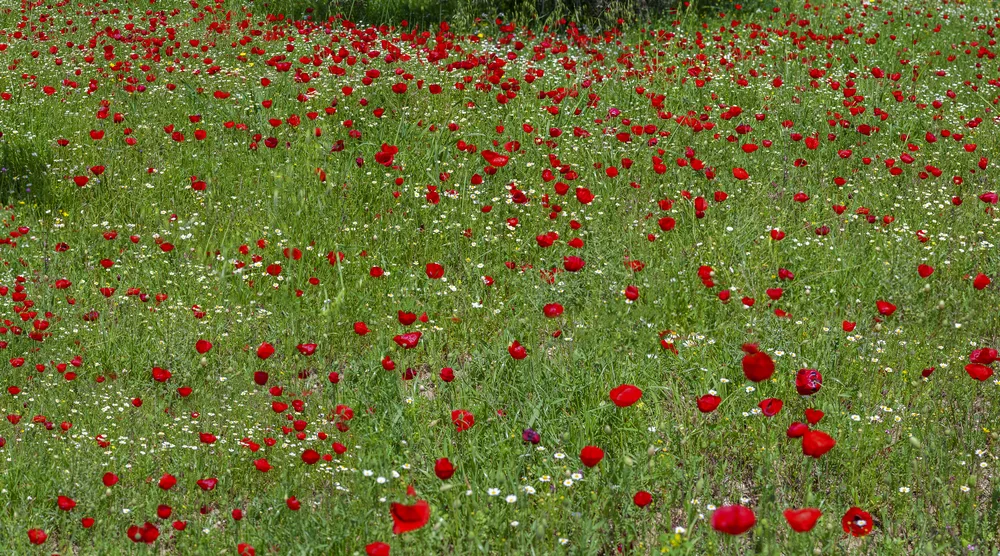
The plant most commentators point to is the crown anemone, Anemone coronaria. It is the obvious thing to gesture at while speaking outdoors in Galilee or the Judean hills in spring: it floods open ground in dense scarlet stands, it lasts a week or two, and it is unmistakably more spectacular than anything anybody was wearing.
Almost certainly it is not Lilium. The Madonna lily, Lilium candidum, does grow in the region, but it is scarce, it flowers in early summer rather than with the spring rains, and it does not carpet a field. A speaker choosing an example of ordinary, free, overwhelming abundance would not have reached for it.
02What the Greek says, and what the commentators do with it
The clause in full: katamathete ta krina tou agrou pos auxanousin, ou kopiosin oude nethousin — consider the flowers of the field, how they grow; they do not labour, nor do they spin.
| Commentator | Work | What they propose |
|---|---|---|
| Harold Fowler | The Gospel of Matthew (1968) | Autumn crocus, scarlet poppy, Turk's cap lily, Anemone coronaria, narcissus, gladiolus, iris — a list, not a verdict |
| R. T. France | The Gospel of Matthew (2007) | Flowers were less specifically defined then; “lily” could stand for any showy variety |
| Daniel J. Harrington | The Gospel of Matthew (1991) | Treats the identification as unsettled |
Notice what the scholarship actually says. The serious commentators do not converge on a species; they converge on the observation that the question is anachronistic. Fowler's list runs to seven plants across four families. The confident single-species answers circulating online are confident about something the discipline is not.
Which is the honest verdict: the anemone is the best candidate and it is a candidate, not a determination. This record states it that way rather than picking a winner the text does not supply.
03What the verse says in Arabic
The Arabic Bible reads زنابق الحقول, zanabiq al-huqul. زنبق, zanbaq, is the lily proper — Lilium. The Arabic translation makes the same botanical commitment the English one does, and inherits the same problem (Matthew 6:28, Arabic).
The word it does not use is سوسن, sawsan. That is the other Arabic word in this territory, and in Palestine it names irises and iris-like flowers: the national flower is سوسن فقوعة, and the wild gladiolus carries سوسن الحقل, the field iris, as one of its four names.
So Arabic has a perfectly good phrase that means “the iris of the field,” and the translators did not use it. They followed the Greek into the lily. Two translation traditions, working centuries and a language apart, both landed on a plant that probably is not the one, because both were translating a word rather than looking at a hillside.
What the flower is actually called, in five Arabic names none of which is a lily, is set out on Record 01 and indexed with the rest on the plant-names page.
04The photographers knew, and used the verse anyway
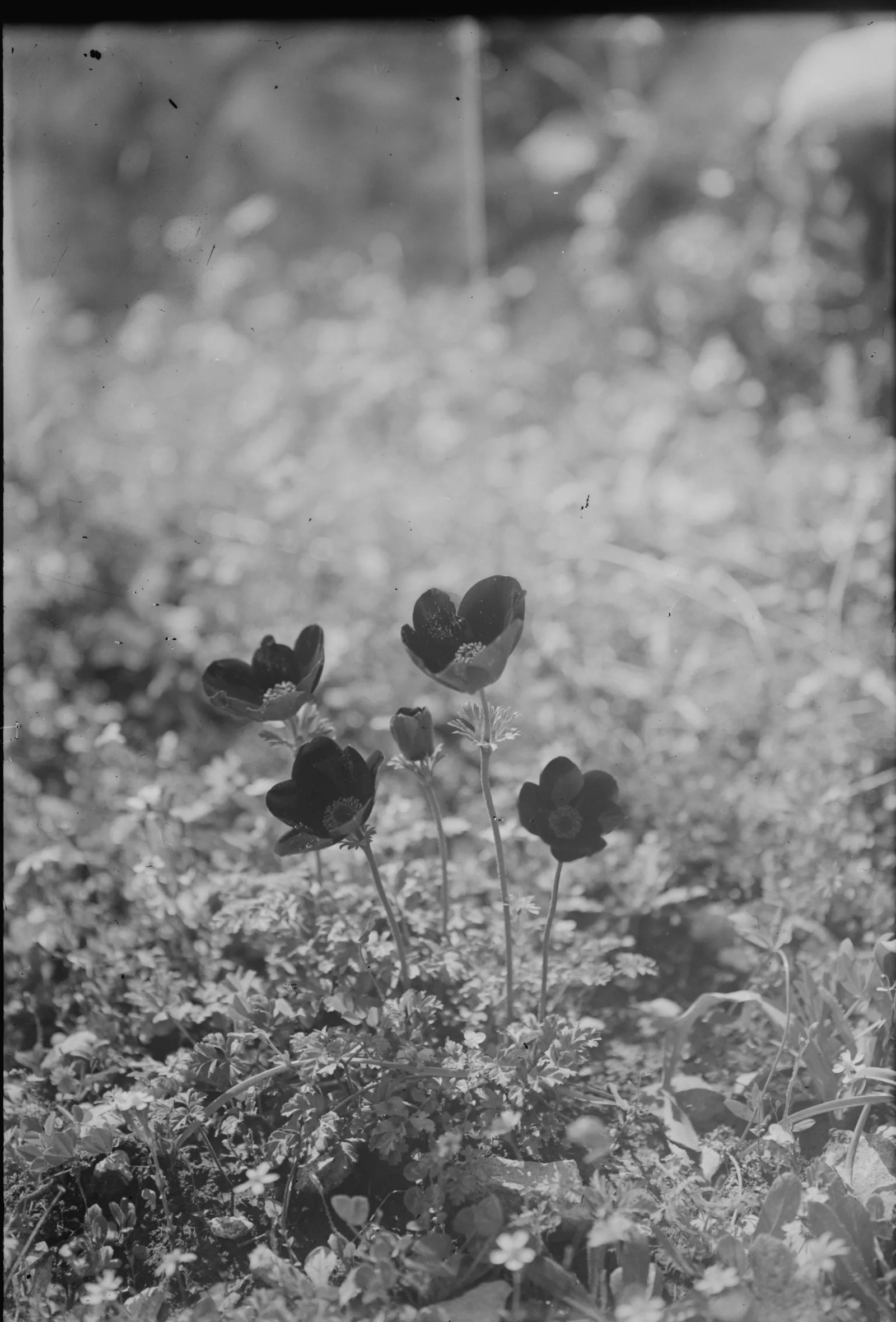
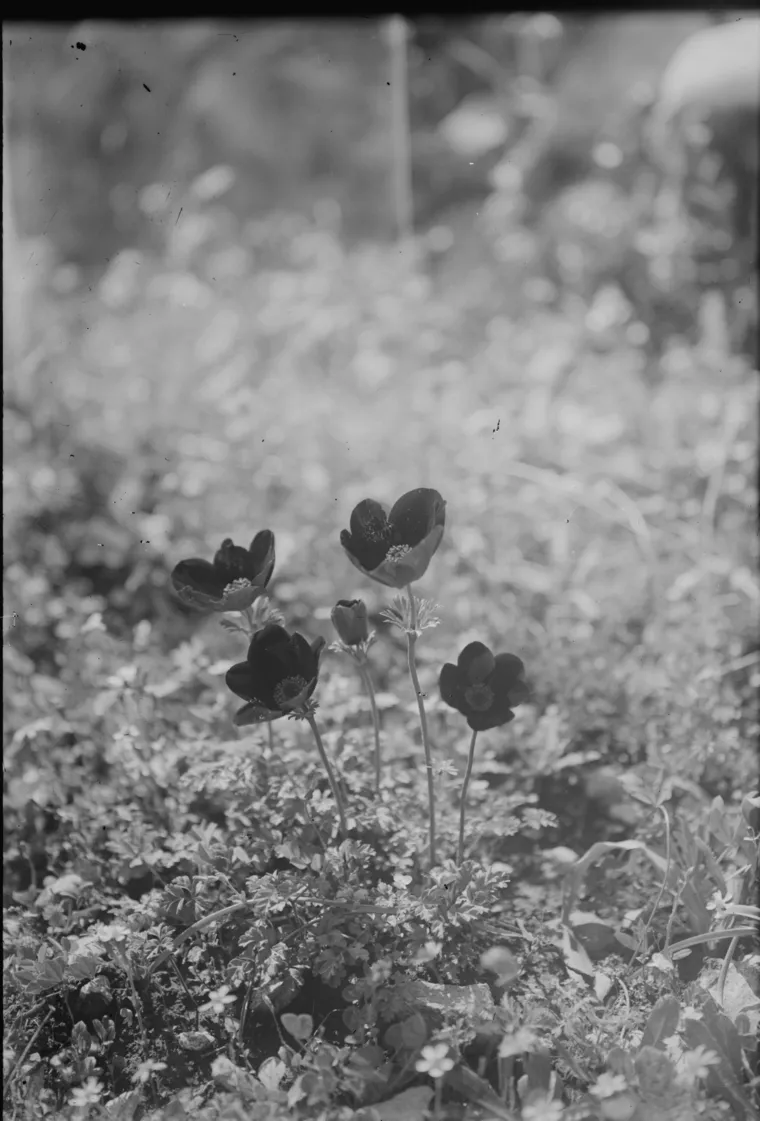
Between about 1900 and 1920 the American Colony Photo Department in Jerusalem made a 166-plate series called Wild Flowers of Palestine. Two of its plates show Anemone coronaria, and both are captioned “Lily of the field.”
- matpc.02407 — “Wild flowers of Palestine. ‘Lily of the field’ (Anemone coronaria L.)” — the studio specimen.
- matpc.05949 — “Wild flowers of Palestine. (Taken in their natural settings) ‘Lily of the field.’ (Anemone. Anemone Coronaria L.)” — the field plate reproduced at the top of this page.
The binomial is right there in the brackets. These photographers were not confused about what the plant was. They knew it was an anemone, wrote the Latin down, and led with the gospel phrase because the gospel phrase was what their customers in New York and London would recognise and pay for.
A flower Palestinians had called hannun for centuries, catalogued under a name taken from somebody else's scripture, with the correct name in brackets beside it.
Seven captions in that series are built on a scriptural phrase, and not one of the 119 plates carries a word of Arabic. The whole survey has been counted, caption by caption.
05The verdict, stated plainly
- The verse names no species. Krinon is a category, not a taxon.
- It is not Lilium, on the balance of evidence. Wrong season, wrong abundance, wrong rhetorical job.
- The anemone is the strongest single candidate and the one this record would name if forced to name one.
- “Lily” is a translation decision, made in Greek, kept in Latin, kept in English, and kept in Arabic.
- The plant has its own name where it grows. الحنون, hannun — and four more besides.
The question “what is the lily of the field” has an answer, and the answer is that the question was framed in a language that had already lost the plant. Somebody standing on that hillside in spring would not have needed a species name. Everybody looking at the same ground knew which flower was meant, because it was the only one you could see.
Sources
- Matthew 6:28 — Greek text and analysis — καταμάθετε τὰ κρίνα τοῦ ἀγροῦ; the lexical range of κρίνον. Read at source
- Matthew 6:28–29, Arabic — زنابق الحقول; the Arabic translation uses zanbaq, the lily proper, and not sawsan. Read at source
- Matthew 6:28 — the commentary apparatus — where the Fowler, France and Harrington positions summarised in Register 02 are collected, with their bibliographic details. Flagged in the note above as a secondary read
- “Wild flowers of Palestine. ‘Lily of the field’ (Anemone coronaria L.),” LOC matpc.02407 — American Colony Photo Department; public domain, via the Wikimedia Commons mirror. The studio plate
- “Wild flowers of Palestine. (Taken in their natural settings) ‘Lily of the field.’ (Anemone. Anemone Coronaria L.),” LOC matpc.05949 — the field plate at the head of this page; LOC catalogue record. Between 1898 and 1946, public domain. One half of a stereograph pair, cropped for publication
- Plants of the World Online — Anemone coronaria L. — accepted name, family Ranunculaceae. Royal Botanic Gardens, Kew
- Anemone coronaria — Wikidata Q511179 — entity identifiers; cross-checked against GBIF and POWO
- The flower itself, its five Arabic names, and the blood in the oldest of them: Record 01, الحنون.
- The 1900 survey counted caption by caption — 119 plates, 0 words of Arabic, 7 scriptural captions: Wild Flowers of Palestine.
- Why the anemone is also not a poppy, which is the other thing it gets called: the poppy question. Every name in both languages: the plant-names index.
._LOC_matpc.02407.jpg)
_%27Lily_of_the_field.%27_(Anemone._Anemone_Coronaria_L.)._LOC_matpc.05949.jpg)