What is the national flower of Palestine?
There are two answers and both are correct. The designated national flower is the Faqqua iris. The flower Palestinians actually reach for is the red anemone. The distance between those two answers is worth more than either of them.
Updated · 6 registers · 10 sources cited
01The short answer
Palestine's official national flower is the Faqqua iris, سوسن فقوعة, Iris haynei — adopted by the Palestinian Council of Ministers in 2016 on the recommendation of the Environment Quality Authority. It is endemic to Palestine and grows in its greatest density on the hills around Faqqua, east of Jenin.
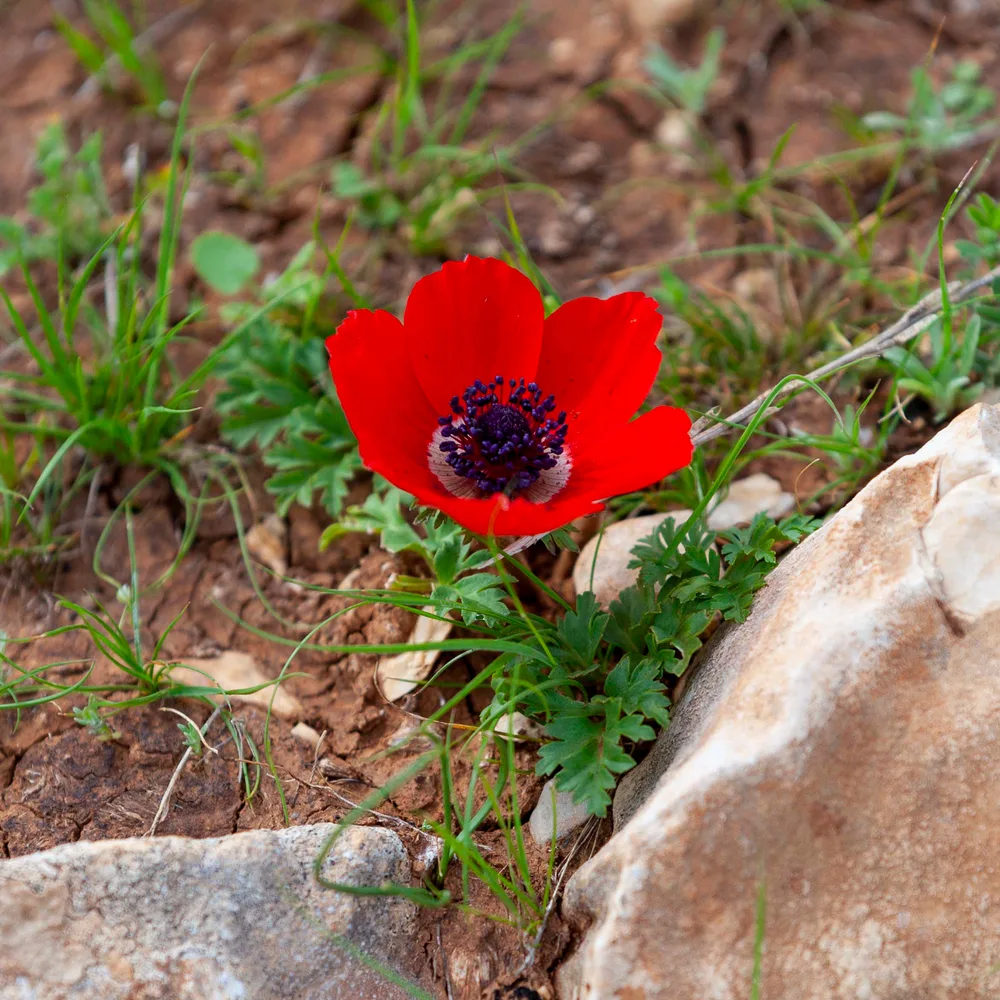
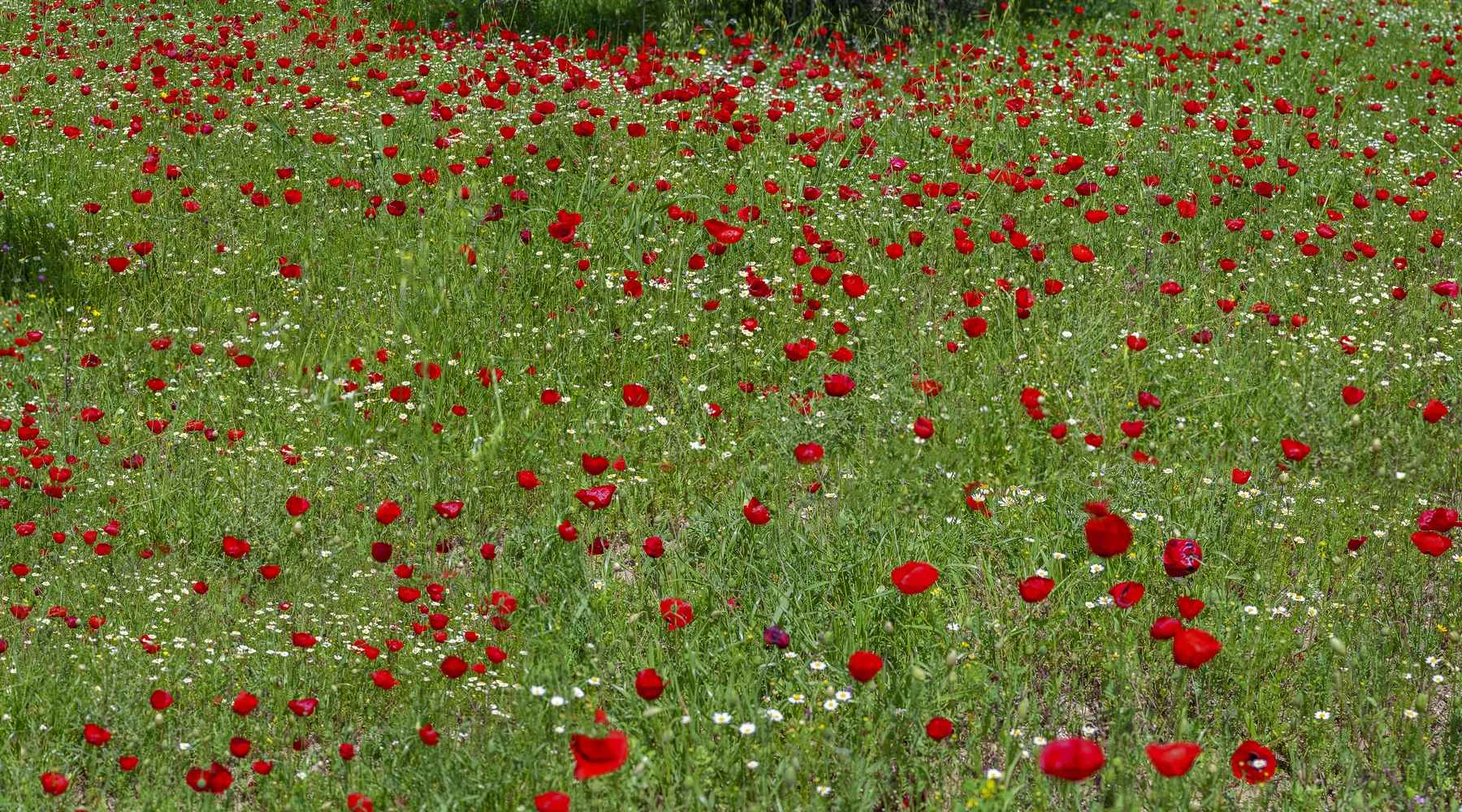
The flower that appears in Palestinian poetry, song, embroidery and mourning is a different one: the red anemone, الحنون, the Anemone coronaria. It has no official status at all.
| The designated flower | The invoked flower | |
|---|---|---|
| Name | سوسن فقوعة | الحنون |
| Species | Iris haynei | Anemone coronaria |
| Status | National flower since 2016 | None |
| Where | Faqqua, east of Jenin | Everywhere, February–April |
| Edible | No — toxic | No — toxic |
Most sources answering this question give the first name and stop. That is accurate and incomplete, because it describes a decision taken in a cabinet room in 2016 and not what a Palestinian means when they talk about a flower.
02The designated flower
The Faqqua iris is one of the most geographically concentrated national flowers in the world. Its densest population covers roughly 20 to 25 square kilometres around the village of Faqqua in the Jenin governorate — a range small enough that you could walk across it in a morning. Imad Atrash and Maha Abu Gharbieh, writing for This Week in Palestine, call Palestine “the only country in the world that possesses such a dense field” of it. Beyond that core it is recorded from Marj Ibn Amer to the Bisan mountains, the eastern foothills of the Jordan Rift Valley, and the slopes east of Jerusalem (Atrash and Abu Gharbieh, This Week in Palestine).
| Character | Recorded |
|---|---|
| Height | Stem to 60 cm, flowers held well above the leaves |
| Colour | Crimson petals under a dense net of veins, with a patch of dark purple, almost black |
| Flowering | March to April |
| Ground | Chalk and dolomite, and the edges of terra rossa, at 150–550 m |
| Pollinated by | Male night-flying bees |
That last line is not decoration. It is one of the Oncocyclus irises, a group whose flowers are pollinated by male solitary bees that shelter in them overnight — which is part of why a plant like this cannot simply be moved somewhere more convenient. It needs its insects, its chalk and its dry summer, in that place (mahmiyat.ps, Palestine's protected-areas record).
Palestinian sources describe it as endangered, and rare, with numbers that have fallen sharply. This record has not verified its category directly against the IUCN Red List and does not assert a specific one — but the Palestinian institutions closest to the plant agree it is in trouble, and a species whose core population fits inside 25 square kilometres has very little margin.
A national flower you could lose by damaging one hillside east of Jenin.
03Gilboa or Faqqua
In English-language botany this plant is almost always the Gilboa iris. In Arabic it is سوسن فقوعة, the Faqqua iris.
They are the same ridge. The range that English calls Mount Gilboa is the range on whose eastern slope the village of Faqqua sits, in the Jenin governorate. One name reaches for the Hebrew Bible. The other is the name of the village whose land the flower grows on, used by the people who live there.
This record has met that pattern on almost every page it has built. The anemone catalogued by foreign photographers as a “Lily of the field”. The cyclamen filed under a discarded botanical name rather than any of its six local ones. The wild carrot filed under an English queen's needlework. The كفّ مريم sold to pilgrims as a Rose of Jericho, which is neither a rose nor from Jericho.
The naming asymmetry this record keeps documenting reaches all the way to the national flower. Even here, the internationally used name is not the local one.
Both names are in honest use and this page uses the Palestinian one. The binomial itself, Iris haynei Baker, commemorates a nineteenth-century German botanist — a third naming layer, and the one that ended up in the databases.
04The flower people actually name
Ask what flower stands for Palestine and most Palestinians will say the red anemone. الحنون — hannun — the flower that comes up scarlet across the hills from February, and the flower of the martyrs.
That association is not a recent political overlay. Its classical Arabic name is شقائق النعمان, shaqa'iq an-Nu'man, and النعمان is itself an old Arabic word for blood. The flower was carrying blood and return in this specific ground long before there was a national movement to attach it to — down through the Canaanite and Phoenician layer, to the blood of Adonis (Record 01, Register 03).
Tawfiq Canaan recorded it in 1928 as a working calendar entry rather than a symbol: “April is marked specially by the blossoming of the Anemone coronaria” — with a footnote giving the classical name (Canaan, JPOS 8, 1928).
One flower was chosen by a cabinet in 2016. The other has been doing this job since before anyone here wrote anything down.
Neither fact cancels the other. A state designates an emblem; a people keeps a symbol. Palestine has both, they are different plants, and an answer that gives only the first one is describing the paperwork.
05So what about the poppy?
The “Palestinian poppy” is, almost always, the anemone. That question has its own page, with the field marks, the poppies that really do grow here, and why the mistake keeps spreading. This is one of the most common confusions in English writing about Palestine, and it is worth clearing up because it changes what you are looking at.
| Anemone | True poppy | |
|---|---|---|
| Species | Anemone coronaria | Papaver spp. |
| Family | Ranunculaceae | Papaveraceae |
| Centre | A dense black boss of stamens | Dark blotches at the petal base |
| Season | From December, peaking February–April | Later in spring |
| Arabic | الحنون | الخشخاش |
Real poppies do grow in Palestine and are genuinely red. But the flower on the keffiyeh-print tote, in the dabke verse and on the wall in Ramallah is nearly always الحنون. If a source says “Palestinian poppy” and shows a flower with a solid black centre, it is showing you an anemone.
06What both answers have in common
Set the two candidate flowers side by side and something falls out that neither of them was chosen for.
Both are toxic. Neither is eaten. And nobody has been prosecuted for picking either.
Most parts of the Faqqua iris — roots and leaves included — are poisonous; swallowing them causes stomach pain and vomiting, and handling them irritates the skin. The same Palestinian record notes, without comment, that the iris is gathered: local people pick it, for ornament (mahmiyat.ps, Arabic entry). The anemone is likewise toxic and likewise not food (Record 01).
Now set that against what is actually enforced. Every documented prosecution under the protected-plants regime is for one of three edible plants — za'atar, akkoub and maramia, the sage in the tea. No indictment has been recorded for picking any protected ornamental species (Under the Law). Those three rank first, second and joint-fifth of a hundred wild edible plants surveyed across the northern West Bank.
The ornamental exemption: the flowers a state puts on its emblems are protected in name, and the plants a people puts in its food are protected in enforcement. Only one of those produces a court file.
So the honest full answer to the question at the top of this page is three sentences rather than one. Palestine's national flower is the Faqqua iris, endemic, endangered, and holding on across about twenty-five square kilometres east of Jenin. The flower Palestinians actually invoke is the anemone, which has carried blood and return in this soil for millennia. And a Palestinian is far more likely to end up in court over a handful of wild thyme than over either of them.
Sources
- Imad Atrash and Maha Abu Gharbieh, “The National Flower of Palestine: Faqqua Iris,” This Week in Palestine — the 2016 Council of Ministers designation on the Environment Quality Authority's recommendation, the 20–25 km² core range, and the wider distribution. Atrash is executive director of the Palestine Wildlife Society. Palestinian-authored.
- سوسن فقوعة — Iris haynei — محميات فلسطين / mahmiyat.ps, the Palestinian protected-areas record, Arabic entry: endemism, habitat and altitude, night-bee pollination, the toxicity note, gathering for ornament, and conservation status. Palestinian institution.
- “Iris haynei: the national flower of Palestine” — mahmiyat.ps, English entry: morphology, the 60 cm stem, crimson petals and near-black patch, March–April flowering
- “The National Flower of Palestine: Faqoua Iris” — Palestine Wildlife Society, on the Environment Quality Authority's founding in 1996 and the Palestinian conservation record. Palestinian institution.
- T. Canaan, “Plant-lore in Palestinian Superstition,” JPOS 8 (1928): 129–168 — the anemone as the April marker and the classical name شقائق النعمان; read at source. See the Jerusalem Circle.
- Iris haynei — for the English common name “Gilboa iris” and the Oncocyclus placement
- Iris haynei Baker — GBIF 5299154 — accepted name, verified via api.gbif.org
- Plants of the World Online — Iris haynei — Royal Botanic Gardens, Kew
- The anemone material, its sources and the Canaanite substrate are set out in full on Record 01; the enforcement figures on Under the Law.
- The tree that was never designated and never needed to be: the national tree of Palestine. And the flora both belong to, counted: 1,710 native taxa.