سيف الغراب
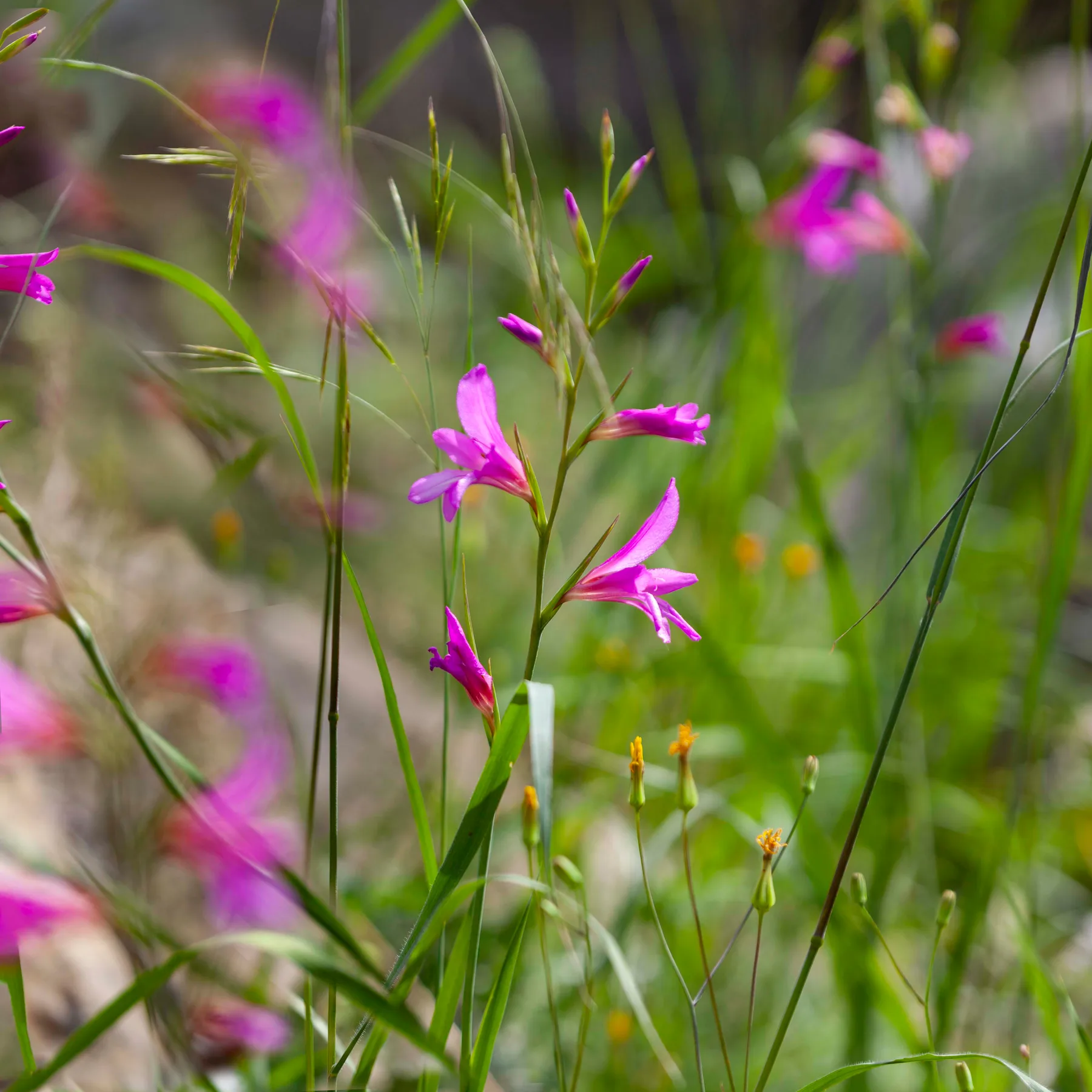
A magenta spike that comes up inside the standing wheat. It is a weed of the grain field, which is the whole reason four different languages ended up naming it after the crop it grows in.
Updated · 4 registers · 5 sources cited
Register 01Four names for one plant
The Palestinian open-science flora platform Barari lists four Arabic names in local use for this species, and they are worth taking one at a time, because each one is a different person looking at a different part of the plant (Barari, Gladiolus italicus).
- سيف الغراب saif al-ghurab — the crow's sword. For the leaves, which are flat, stiff, sharply pointed and stand straight up out of the ground. The Latin does the same thing: gladiolus is a small gladius, a short sword.
- منقار العصفور minqar al-usfur — the bird's beak. For the bud, which is narrow, pointed, and hooked slightly open at the tip.
- سوسن الحقل susan al-haql — the field iris. Placing it by family and by habitat at once: an iris relative, and one that lives in cultivated ground.
- دلبوث dilbuth — a name that is simply the plant's own, with no image inside it.
Two of those are shape names taken from close up, at the distance of a hand. You get names like the bird's beak from people who were pulling the plant out of a crop, not from people who saw it from a road.
Register 02A weed of the wheat
It grows from a corm — a swollen underground stem that sits out the dry summer and sends up a new spike when the rains have done their work. Barari records it as a perennial geophyte, flowering March to April, setting seed in April and May.
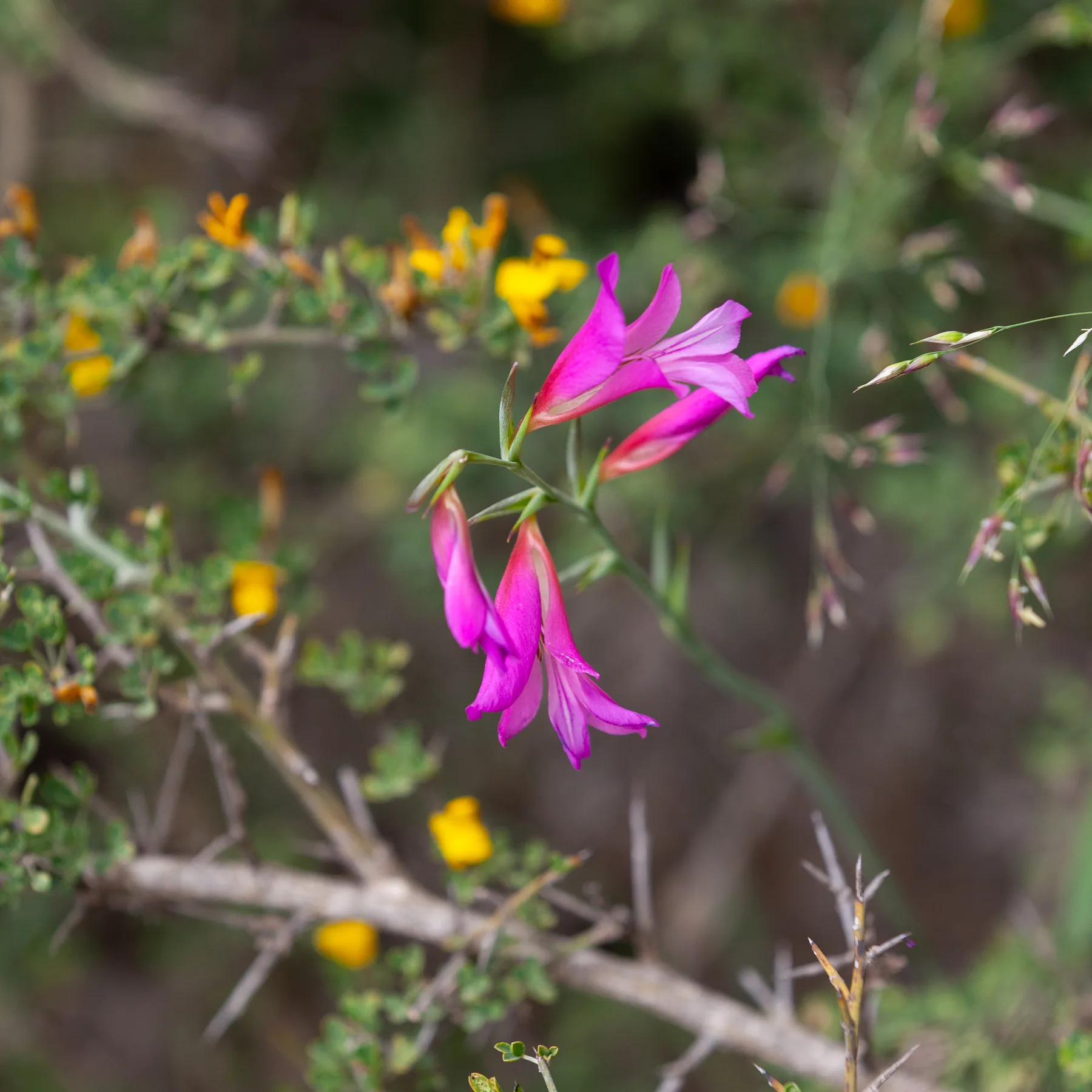
Its habitat is the cereal field, and that is not incidental to it. This is an archaeophyte of cultivation — a plant whose distribution across the Mediterranean tracks the distribution of grain farming, because ploughing is what it needs. Which places it in the same category as several plants already in this record: not wilderness species, but plants of the worked edge, living off human disturbance and unbothered by it.
March and April are the crowded weeks of the Palestinian year — the same weeks that carry the anemone, خميس النبات the Thursday of the Plants, and the season for the three plants people are prosecuted for gathering (The Year).
Register 03Whether it is eaten
Barari's entry for this species records edibility as unknown. It gives blooming and seed-collection periods but no edible part, no preparation and no foraging window — the fields it fills for the caper and the shomar.
It is also absent from the twenty-five species in the 2018 Palestinian wild-food survey (Palestinian Wild Food Plants).
So this record does not say that it is eaten in Palestine, and does not say that it is not. Corms of related gladioli are recorded as food elsewhere in the Mediterranean, and that is precisely the kind of near-miss that would be easy to import and wrong to. What can be said is what the sources say: two Palestinian botanical references describe this plant carefully and neither of them describes eating it.
Register 04Photographed before — and the studio is in the frame
The American Colony Photo Department photographed the wild gladiolus more than once for its Wild Flowers of Palestine series. It filed this species as “Gladiolus, Cornflag (G. segetum Gawl)” — G. segetum being an older name for the same plant, and segetum meaning of the cornfield.
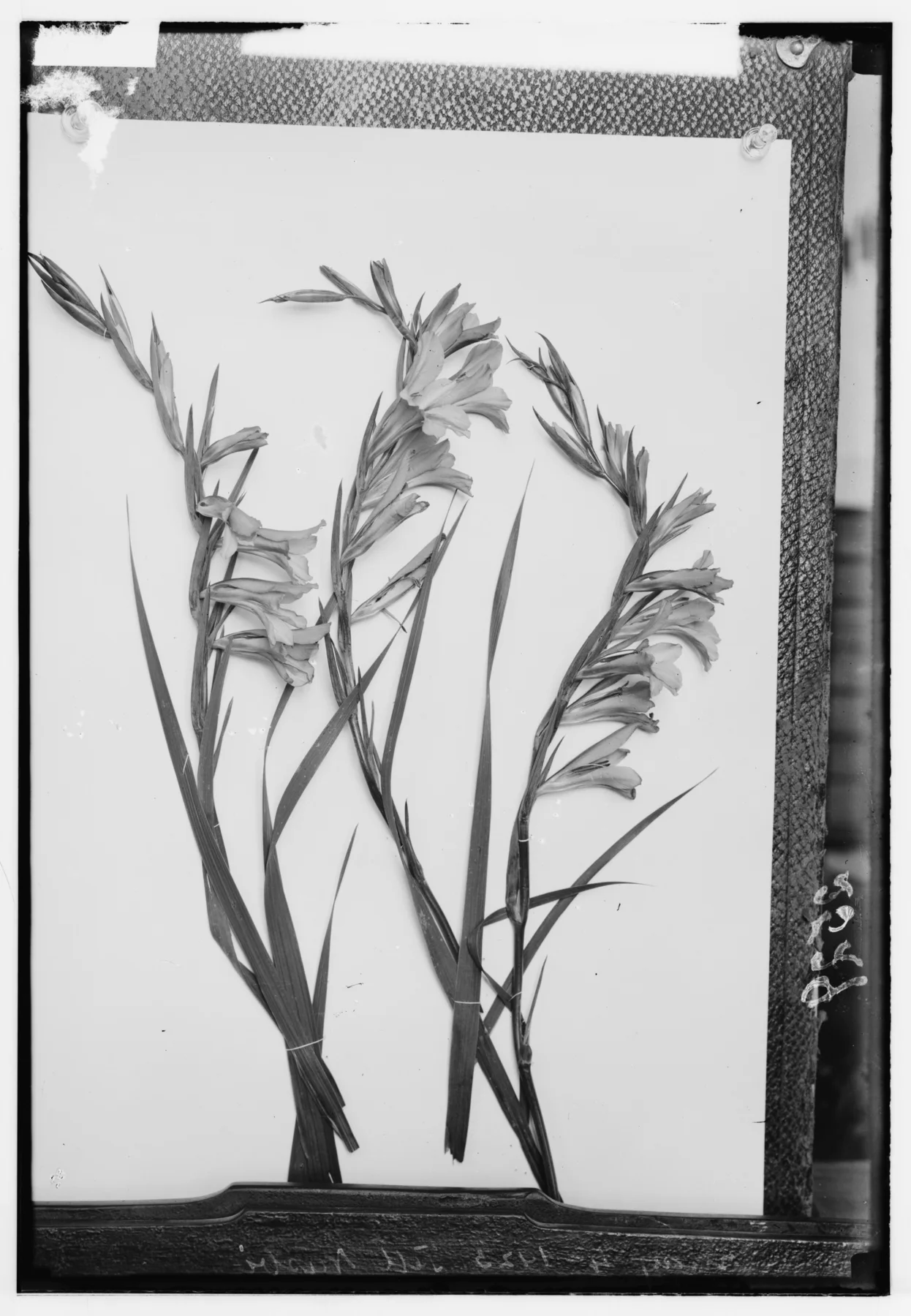
Library of Congress, Matson Collection, matpc.00187 · public domain
The English name and one of the Arabic names are the same idea. Cornflag is the flag of the grain field; سوسن الحقل is the iris of the field. Two naming traditions with nothing else in common looked at this plant and both filed it under the crop. On this species, unusually for this record, the names agree.
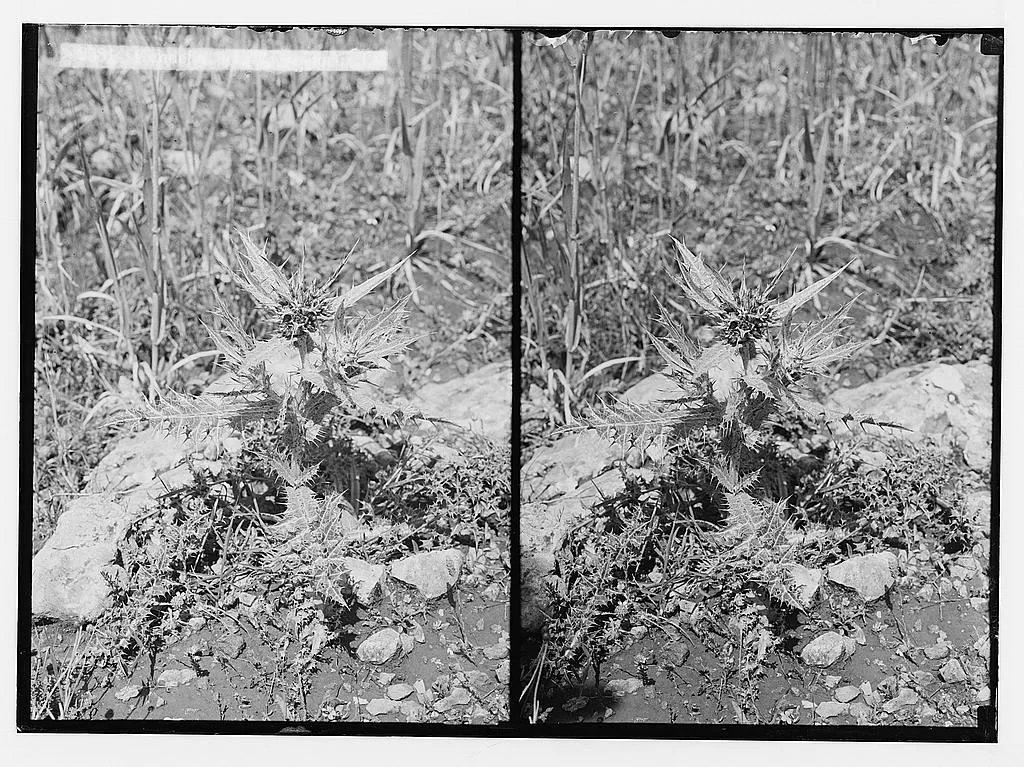
What does not agree is the photograph. Look at what is actually in that plate: three stems cut off at the base, laid flat on a pale card, tied together with string, and stood against a board. Then look at a second gladiolus plate from the same series, made around 1900, where the camera has pulled back far enough to show the whole arrangement.
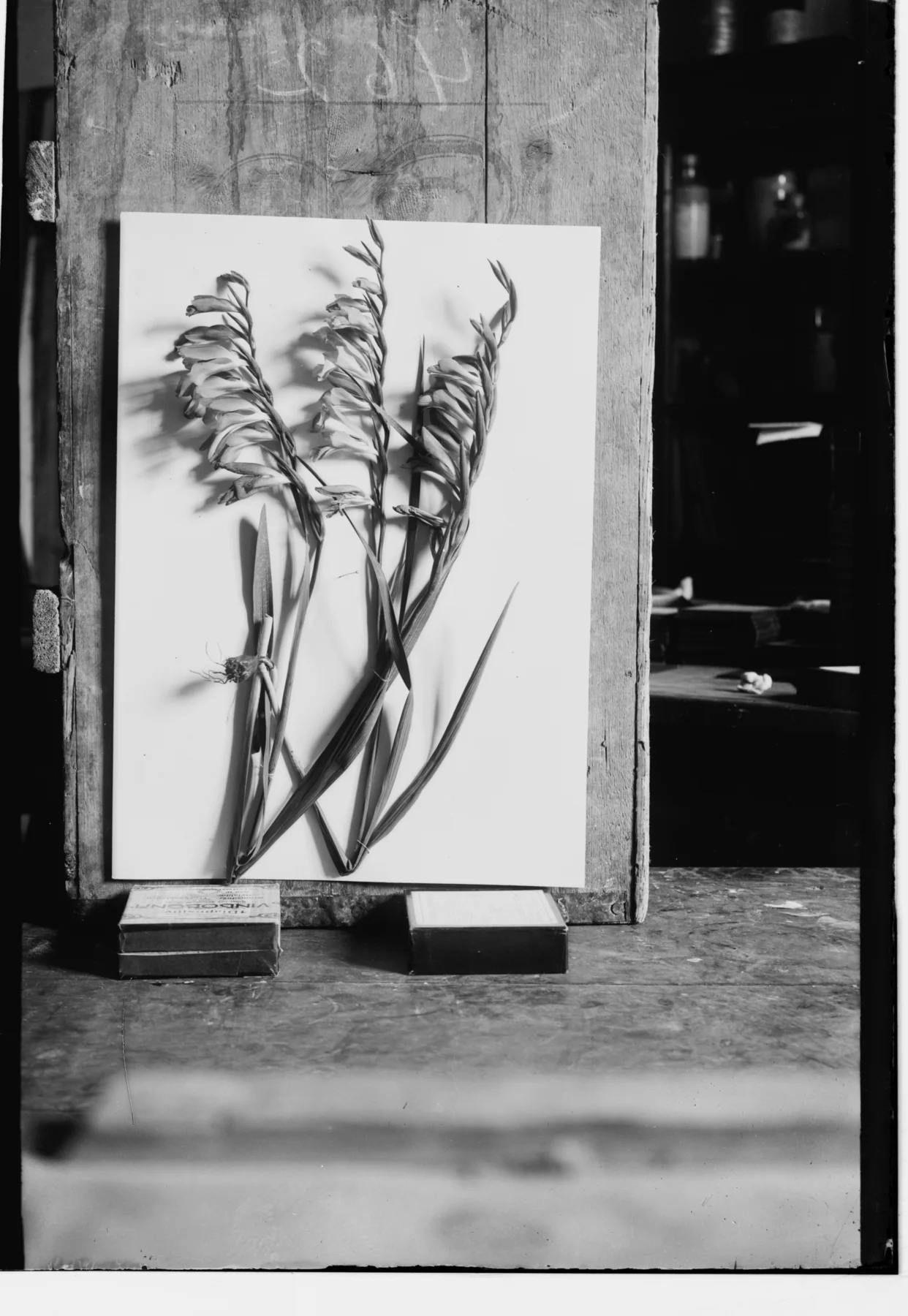
Library of Congress, Matson Collection, matpc.05841 · public domain · one half of a stereograph pair. Captioned as a different gladiolus species; shown here for the working method it makes visible.
The card is propped in a wooden frame. The frame is standing on two small boxes, used as blocks to get the height right. All of it is on a workbench, and behind it is the dark of a working room with bottles on the shelves. This is not a photograph of plants in Palestine. It is a photograph of a table in Jerusalem with some cut plants on it, and the apparatus has been left in shot.
Nobody was hiding anything. It simply was not a record of where these flowers grow. It was a catalogue, and a catalogue is made indoors.
Record 08 settled that the difference between these two bodies of work is the filing, not the method — both photographers shot specimens and both went to the field. This plate refines that. The American Colony did go out sometimes, and when it did the results are the best evidence in this record of what Palestine's hillsides looked like a century ago. But for a great many of the 166 plates in the flower series, the answer to where was this taken is: on that bench, in front of that board.
The photograph at the top of this page was taken with the plant still in the ground, in March, in the field it belongs to, by someone who lives where it grows. That is the entire difference, and it is visible without either photograph having to say anything about it.
Sources
- Gladiolus italicus Mill. — براري / Barari, an open-science platform for community knowledge of wild plants · the four Arabic names, the flowering and seed periods, and the edibility status. Barari cites Mashjar Juthour, Palestinian Wildflower Pocket Guide (2017) and B. Al Sheikh, Checklist and Ecological Data Base of Wild Plants of the West Bank — Palestine (2019).
- “Wild flowers of Palestine. Gladiolus, Cornflag (G. segetum Gawl)” — American Colony Photo Department, 1923 · Library of Congress, Matson Collection, matpc.00187 · no known restrictions on publication
- “Wild flowers of Palestine. Gladiolus (G. atroviolaceus Boiss.)” — American Colony Photo Department, c. 1900 · Library of Congress, matpc.05841 · the plate showing the studio setup
- Palestinian Wild Food Plants — ed. Omar Imseeh Tesdell · Khalil Sakakini Cultural Centre and AFAC, 2018 — consulted; Gladiolus does not appear among its listed species
- These four names beside every other one in the record: Palestinian plant names in Arabic and English.
_LOC_matpc.00187.jpg)
._LOC_matpc.05841.jpg)