What is akkoub?
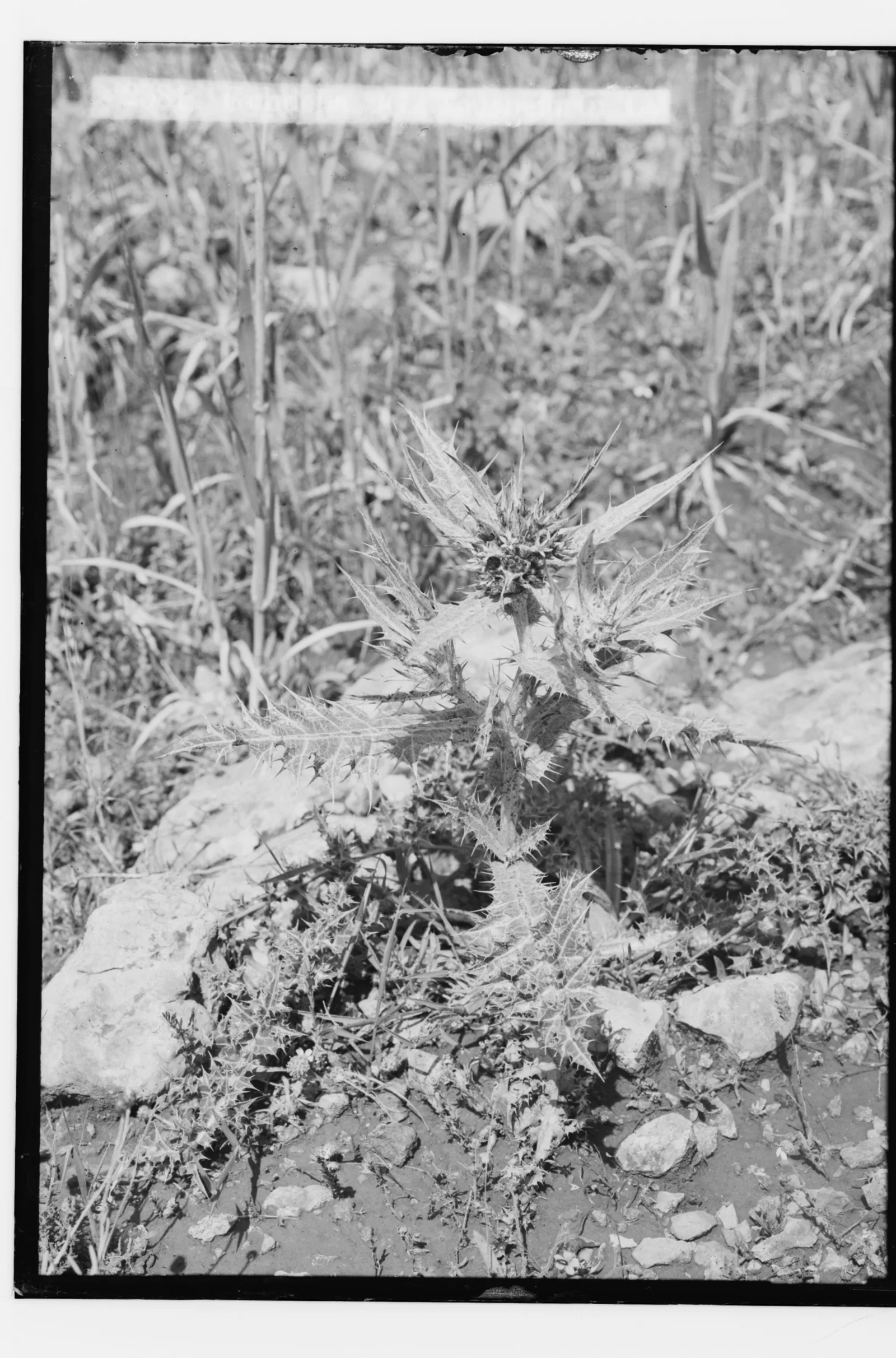
Akkoub is a spiny thistle that Palestinians eat. عكّوب, Gundelia tournefortii. The flower heads and young stems are cut in spring, stripped of thorns by hand, and cooked. Gathering it has put people in court.
Updated · 5 registers · 9 sources cited
01The short answer
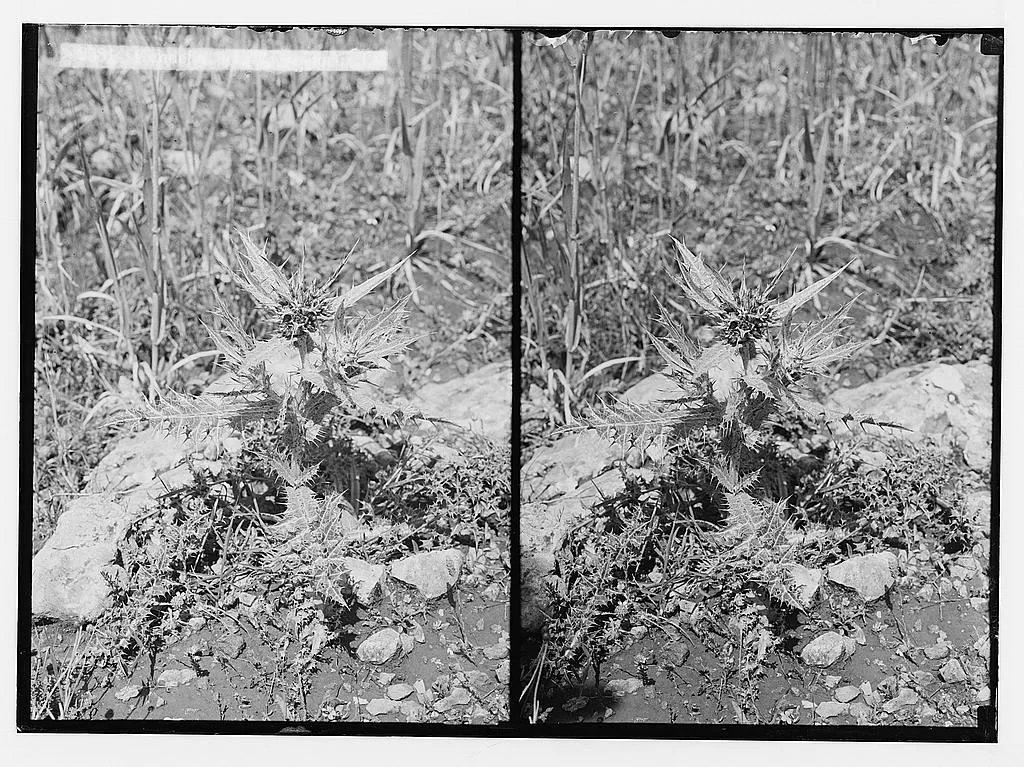
Akkoub is عكّوب, Gundelia tournefortii L., a low spiny perennial of the daisy family that grows on stony ground and field edges across Palestine and the wider Levant. It is armed all over. The leaves end in stiff spines and the flower heads sit inside a collar of them.
The part that is eaten is the flower head, with the young stem and the softest inner leaves. They are cut while still tight and green, before the plant hardens off. The season is short. Gathering runs roughly March to May, and a stand is worked over repeatedly, a few heads at a time, as new ones come.
Its English name is usually given as tumble thistle or gundelia, and neither is in general use. In this country the plant is عكّوب, and the word covers the vegetable, the dish and the act of going out to get it.
02The thorns are the whole point
Akkoub takes more work than any other wild plant in the Palestinian kitchen, and the work is the reason it means what it means.
Every head has to be cleaned by hand. The spines are stripped off with a knife, one head at a time, and the job is slow enough that it is done sitting down, usually by several people together, usually while talking. A bag of akkoub represents hours. Households that gather it in quantity do the cleaning as a group, and the cleaning is as much a part of the season as the picking.
The season runs about two months, and the same stand is gone over again and again, one head at a time.
What it tastes like. Cooked akkoub is closest to artichoke heart, which is a near relative in the same family, with a green bitterness behind it. The texture holds up to long cooking rather than collapsing.
03How it is cooked
The standard preparation was written down in a survey of 190 people across the northern West Bank, and the paper gives it plainly enough to quote.
“The inflorescence, young stems and leaves are cut, fried in olive oil, then boiled with meat chops until well done, and then a boiled yogurt suspension is added and the mixture is left to boil for a few minutes before the meal is ready for serving.”
That is akkoub bi-laban, the dish most households mean when they say they are making akkoub (Ali-Shtayeh et al., 2008). The yoghurt is stabilised before it goes in, which is why the paper specifies a boiled suspension: unstabilised yoghurt splits when it hits heat.
It is also preserved. The same study found that 49% of the wild edible plants it recorded are gathered and stored for later in the year, and lists akkoub among the examples alongside za'atar and maramia. Cleaned heads are frozen, or cooked down and kept, so a two-month season feeds a longer stretch.
04How widely it is used
The same 2006 fieldwork gives a number rather than an impression. Of 100 wild edible species recorded across fifteen communities in Nablus, Jenin, Salfit, Qalqilia and Tulkarm, akkoub was named by 99 of the 190 people interviewed, placing it among the five most-cited wild foods in the survey.
Where akkoub sits in that ranking relative to za'atar and maramia, and what the ranking implies about which plants the law reaches, is set out on the maramia page, which holds that finding.
It travels beyond the kitchen. Akkoub appears in the Palestinian market as a seasonal good with a price that tracks the weather, and the arrival of the first akkoub is a marker of the year in the same way the first anemones are on the calendar.
05Why picking it is an offence
Akkoub is on the Israeli protected-plants list, and Palestinians have been fined and indicted for gathering it. It is one of three plants at the centre of that enforcement, with za'atar and maramia. The Palestinian legal centre Adalah documented 26 indictments and 151 fines in the three years 2016 to 2018.
The instrument itself, how it is extended into the occupied West Bank by military order, the legal challenge Adalah brought in 2019 and what the authorities said in response are set out in full on Under the Law, which is where this record keeps them.
The enforcement is timed to the season. Each March, as the akkoub and za'atar harvest begins, the Israeli Nature and Parks Authority runs a public warning campaign. The campaign lands in the weeks when the plants are worth gathering.
The Palestinian artist Jumana Manna spent years filming these prosecutions and made Foragers (2022, 64 minutes, in Arabic), shot in the Golan Heights, the Galilee and Jerusalem. It follows people gathering akkoub and follows them into the courtroom. Her account of the legal position is quoted in full on Under the Law.
Sources
- M. S. Ali-Shtayeh, R. M. Jamous, J. H. Al-Shafie‘ et al., “Traditional knowledge of wild edible plants used in Palestine (Northern West Bank): A comparative study,” J. Ethnobiol. Ethnomed. 4:13 (2008) — the preparation quoted verbatim in Register 03, the 99-of-190 citation count, the 49% preservation figure, and the five districts. An-Najah University and BERC, Til, Nablus. Read in full at source. Palestinian-authored.
- Adalah — The Legal Center for Arab Minority Rights in Israel — 26 indictments and 151 fines, 2016–2018, and the 2019 demand that the designations be cancelled. Palestinian legal centre.
- Foragers (2022), dir. Jumana Manna — 64 minutes, in Arabic; the akkoub and za'atar prosecutions filmed from inside the courtroom. Palestinian artist.
- Gundelia tournefortii L. — GBIF 3087520 — accepted name, family Asteraceae; verified via api.gbif.org
- Plants of the World Online — Gundelia tournefortii — Royal Botanic Gardens, Kew
- Gundelia tournefortii — Wikidata Q11151237 — entity identifiers, cross-checked against GBIF, POWO and iNaturalist
- “Gundelia (G. Tournefortii L.),” LOC matpc.02449 — American Colony Photo Department, c. 1900–1920. Library of Congress, Matson Collection; public domain, via the Wikimedia Commons mirror.
- The protected-plants instrument, the legal challenge and the full enforcement record are on Under the Law; the hundred gathered species and how they are eaten on Edible.
- عكّوب and every other plant name in this record, Arabic to English and back: the plant-names index.
._LOC_matpc.02449.jpg)