سوسن فقوعة
The national flower of Palestine, and one of the smallest wild populations in this record. It grows on the hills east of Jenin, it is poisonous in every part, and it is picked anyway.
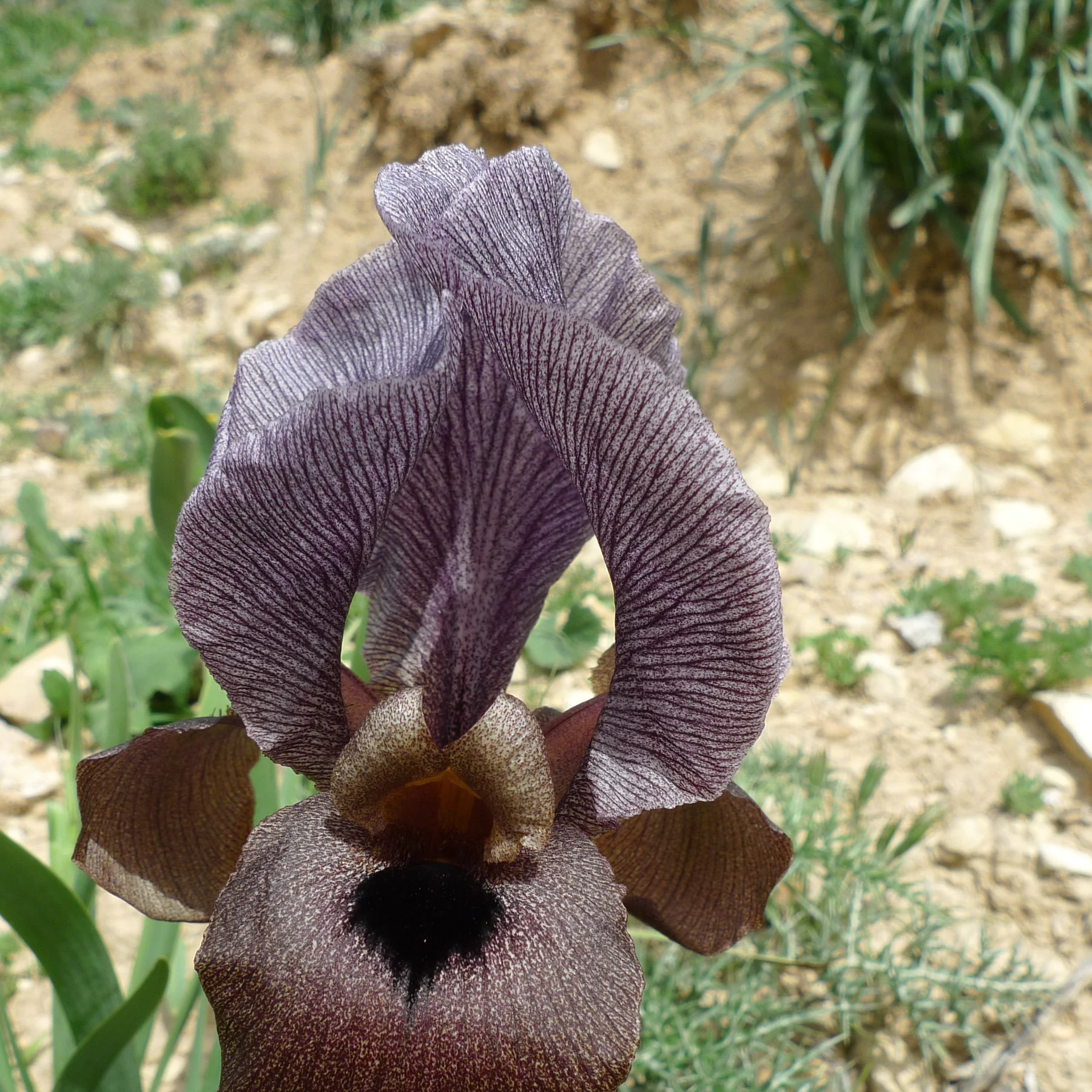
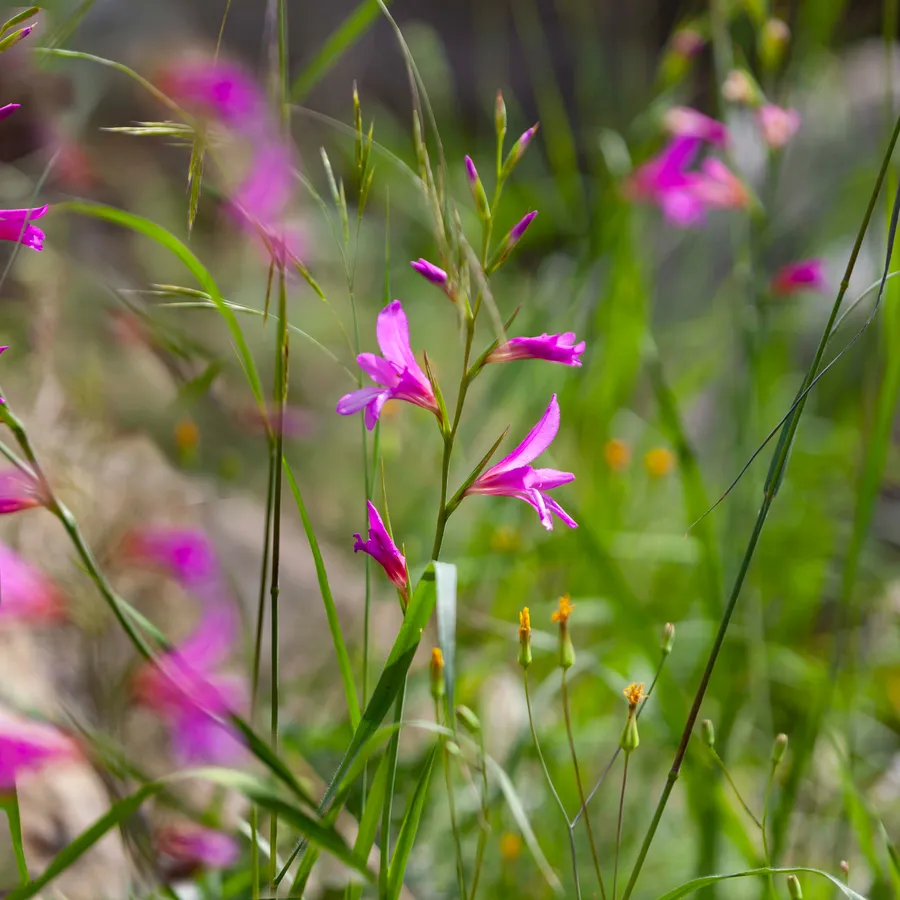
Photograph by Alastair Rae · CC BY-SA 2.0 · not our photograph, and the only record on this site illustrated by someone else. See Register 05.
Updated · 5 registers · 9 sources cited
Register 01Three names, and none of them agree
The Arabic name is سوسن فقوعة, susan Faqqu'a: the iris of Faqqua. Faqqua is a village east of Jenin, and the name points at a place where people live. The plant is named after its neighbours.
The English botanical name is the Gilboa iris, after the ridge the village stands on. That ridge is not nameless in Arabic either. The Palestinian protected-areas record calls it الجلبوع, al-Jalbūʿ, and places the plant "in the Jalbūʿ area, including Faqqua, east of Jenin" (mahmiyat.ps, Arabic entry). Jalbūʿ and Gilboa are the same old word in two languages. The English common name took the ridge; the Arabic name of the flower took the village.
The Latin took neither. Iris haynei Baker commemorates Friedrich Gottlob Hayne, a Berlin pharmacologist who died in 1832, and whose connection to these hills is that a botanist in London later decided to attach his name to them.
A village, a ridge, and a German pharmacist. Three naming traditions looked at one flower and filed it three different ways, and only one of them was standing near it.
This is the fourth plant in this record whose names disagree along the same line, and it is the only one where the disagreement reaches a flag. The full version of that argument, including why the flower Palestinians actually invoke is a different plant altogether, is on What is the flower of Palestine?
Register 02An iris that is pollinated at night
It is a geophyte: it spends the dry summer underground and comes up with the rains. The leaves are smooth, linear to lanceolate and grey-green, in a rosette at the base. From that rosette a single slender stem rises to about 60 cm, carrying the flower well clear of the foliage (mahmiyat.ps, English entry).
The flower is built the way irises are built, in two sets of three. Three large outer petals, the falls, hang downward. Three smaller inner ones, the standards, stand up between them. Both are covered in a dense net of veins scattered with fine dots, the ground colour is crimson, and low on each fall there is a patch of dark purple so deep it reads as black.
That patch is the diagnostic mark of the Oncocyclus irises, and the dark colouring is not decoration. Palestinian sources record that this flower is pollinated by male night bees, which shelter inside it (mahmiyat.ps). A large dark chamber holds the day's heat after dark, and the bees that sleep in it carry pollen from one flower to the next in the morning. The plant is not advertising to anything that flies in daylight. It is offering a warm room for the night.
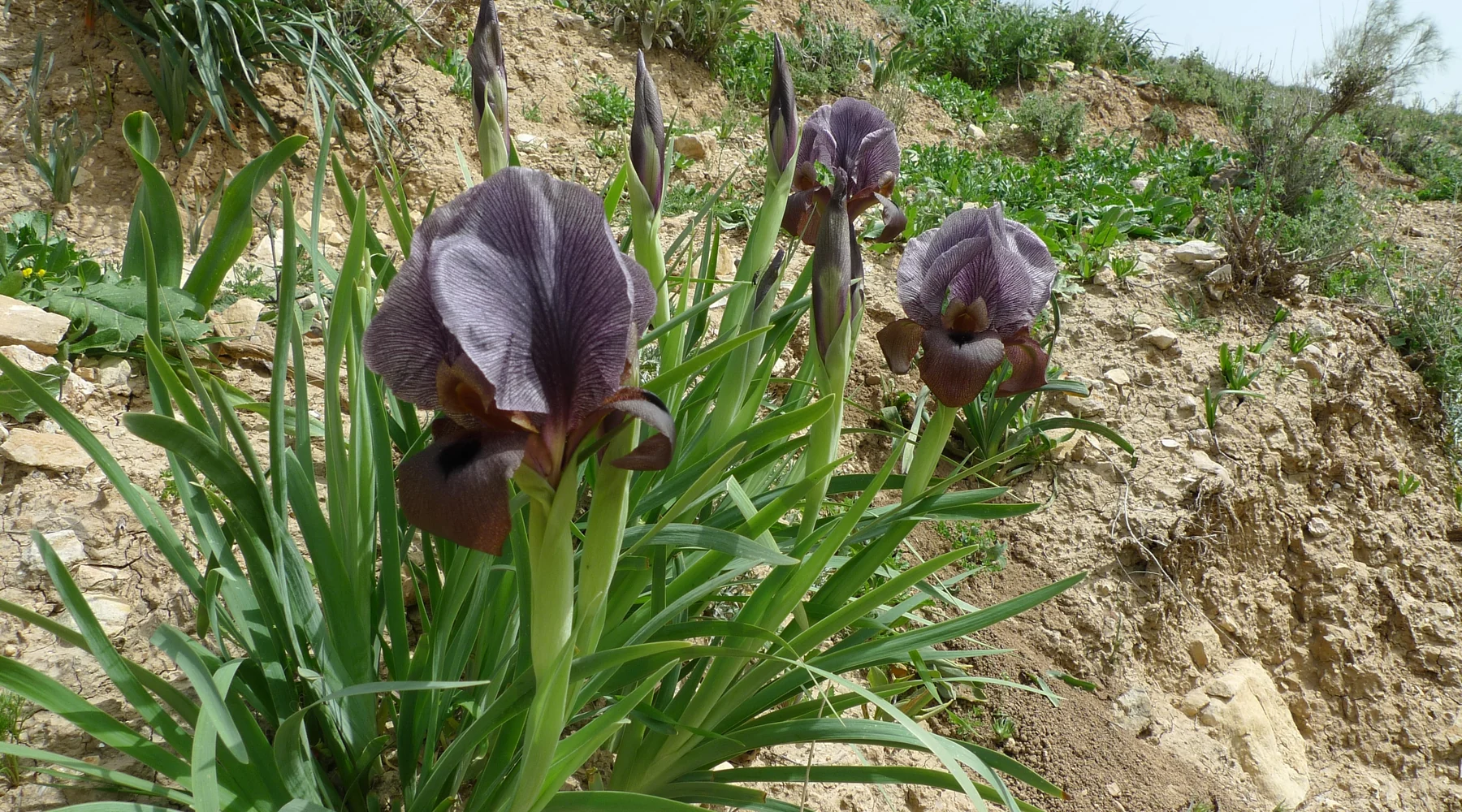
Photograph by Alastair Rae · CC BY-SA 2.0
The fruit is a capsule of several chambers holding uniform seed. The plant is neither spiny nor succulent, and it tolerates high salinity.
Register 03How little of it there is
The Palestinian protected-areas record describes it as endemic to Palestine, growing in the Jalbūʿ area and above all around Faqqua, east of Jenin, in the north of the West Bank. It wants calcareous or dolomite ground, or the margins where that meets the red terra rossa soil, at 150 to 550 metres, in country that is reliably dry in summer (mahmiyat.ps).
Those conditions describe a narrow band of hillside. The national flower of a country occupies a strip of stony slope a few kilometres across, and almost nowhere else on earth.
Its status in the same record is stated twice and identically. Endangered by the IUCN criteria, and endangered locally. The Arabic entry opens by giving its condition as نادر, rare, before it describes the plant at all.
Register 04Whether it is eaten, and what happens to it instead
It is not eaten, and this is one of the few plants in this record where the sources are emphatic rather than silent. Most parts of the plant are toxic, including the roots and the leaves. Swallowed, it causes stomach pain and vomiting. Handled, it irritates the skin (mahmiyat.ps).
What the same entry records under uses is short and worth reading slowly: the plant is grown in cultivated forms, and it is picked by local people for ornament and decoration.
So the national flower of Palestine is gathered from the wild, by hand, out of a population listed as endangered, and no prosecution has ever followed. Meanwhile akkoub, maramia and za'atar, all of them edible and none of them endangered, carry criminal penalties for the same act.
That asymmetry has a name on this site. It is set out, with the enforcement figures behind it, on Under the Law and on the flower question: the flowers a state puts on its emblems are protected in name, and the plants a people puts in its food are protected in enforcement.
Register 05This is the one record we could not photograph
Every other plant in this record is photographed by the artist whose work this site is built on, in the ground, in Palestine. This one is not. The photographs above were made by Alastair Rae on 24 March 2012 and released under a Creative Commons licence, and they are used here with credit because the alternative was to publish the national flower of Palestine with no picture of it at all.
Until today this site did the second thing. The page that names the flower has carried a line since 4 August saying we had no photograph of it and would not borrow one. That line has been changed rather than quietly dropped, and the change is logged (Corrections).
Two things are worth saying about the photographs themselves. The photographer filed them as Gilboa Iris, which is the ridge name in its Hebrew form, because that is the name under which nearly every image of this plant on the open web is catalogued. And the 1900s Wild Flowers of Palestine series, which photographed the wild gladiolus twice and the anemone repeatedly, never photographed this one. Its plates include the Sofar iris of Lebanon and Iris helenae. The flower that would become the national flower of Palestine is not in the catalogue.
The most photographed country in the world, and the least photographed flower in it is the one on the flag's shortlist.
This register stays until it can be deleted. If a photograph of سوسن فقوعة taken in Faqqua by a Palestinian photographer reaches this record, it will replace the images above and this section will be rewritten to say so.
Sources
- سوسن فقوعة — Iris haynei — محميات فلسطين / mahmiyat.ps, Arabic entry · the Jalbūʿ placement, soil and the 150–550 m altitude band, the male night bees, the capsule, the toxicity of roots and leaves, gathering for ornament, and the rare / endangered status. A joint project of the Palestinian Environment Quality Authority, the Palestinian Society for Environment and Sustainable Development and Germany's Hanns Seidel Foundation.
- “Iris haynei: the national flower of Palestine” — mahmiyat.ps, English entry · morphology, the 60 cm stem, the falls and standards, the veining and the near-black patch, crimson ground colour, March–April flowering, and the endemism to the Faqqua area of Jenin
- “The National Flower of Palestine: Faqoua Iris” — Palestine Wildlife Society, Beit Sahour · the 2016 designation and the Environment Quality Authority
- Imad Atrash and Maha Abu Gharbieh, “The National Flower of Palestine: Faqqua Iris” — This Week in Palestine · the Council of Ministers designation of 2016
- Iris haynei Baker — GBIF 5299154 · accepted name and authority
- Plants of the World Online — Iris haynei — Royal Botanic Gardens, Kew
- Iris haynei, two photographs — Alastair Rae, 24 March 2012 · CC BY-SA 2.0 via Wikimedia Commons · the images on this page, used with credit under the licence
- What is the flower of Palestine? — the designation, the anemone, and why there are two answers, with its own sources
- One of eight endemic Iridaceae taxa in a flora of 1,710: how many wild plants grow in Palestine.
.jpg)
.jpg)